Charon's Obol Myth Meaning & Symbolism
A soul cannot cross the river Styx without the coin placed on their lips, a final payment to the ferryman for the journey into the underworld.
The Tale of Charon’s Obol
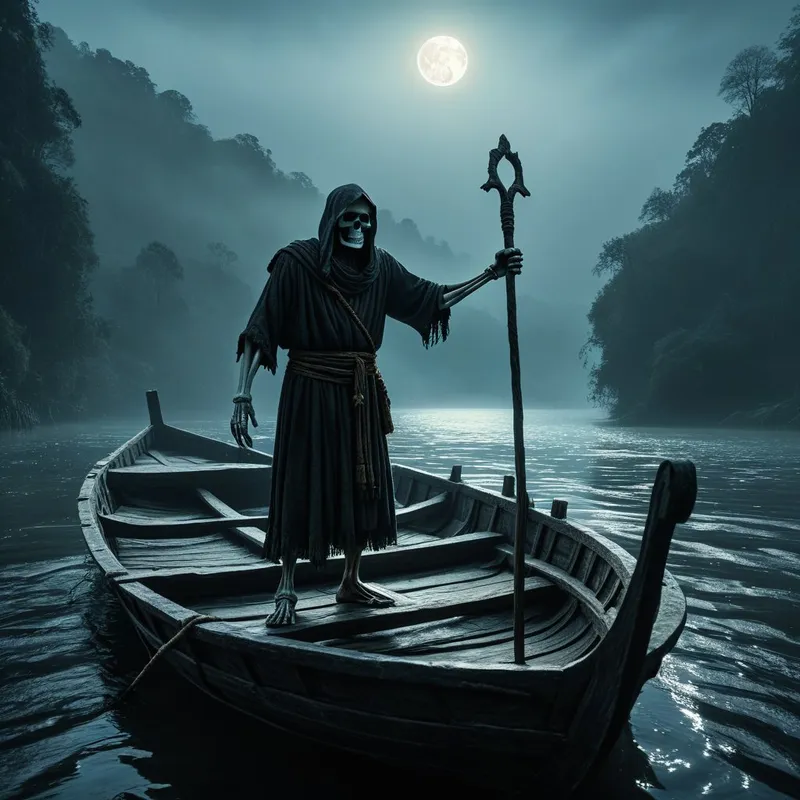
Hush now, and listen. The air grows cold, not with winter, but with a stillness that has never known the sun. You stand on a shore of black sand and polished bone, before a river wider than memory and darker than a closed eye. This is the Acheron, though some whisper it is the Styx. Its waters do not flow; they coil, thick and silent, a liquid night.
From [the mist](/myths/the-mist “Myth from Celtic culture.”/), a shape resolves. Not a wave, but a prow. A boat of worm-eaten wood, so old it seems grown from the riverbed itself, glides soundlessly to the bank. At its stern stands [the Ferryman](/myths/the-ferryman “Myth from Various culture.”/). He is not a god, but something older, a function made flesh: [Charon](/myths/charon “Myth from Greek culture.”/). His form is shrouded in a tattered cloak, his face shadowed, but you feel the weight of his gaze—a gaze that has counted countless souls.
You are not alone on this shore. A silent crowd gathers, their forms faint, their eyes holding the last echoes of earthly light: love, fear, regret. They are the newly dead. And as each steps forward, Charon extends a hand, palm upturned. It is not a request.
One shade approaches, a warrior still clad in the ghost of his armor. He moves to board, but Charon’s arm bars his way. The Ferryman’s hand remains open, empty. The warrior pats his chest, his ghostly belt, confusion turning to dawning horror. He has nothing. A low, grinding sound issues from Charon—a laugh or a sigh. The pole pushes against the bank, and the boat begins to drift. The warrior cries out a silent cry, reaching, but the black [water](/myths/water “Myth from Chinese culture.”/) between him and [the vessel](/myths/the-vessel “Myth from Alchemical culture.”/) widens. He is left. Condemned to wander the desolate shore for a hundred years, a whisper among the reeds.
Then comes another. An old woman, her form bent with memory. As she nears, a faint gleam catches the nonexistent light. Upon her lips rests a simple disk of bronze or silver. An obol. Charon’s fingers close around it with a final, metallic click. The sound is a key turning in a lock. He steps aside. The woman boards, and the craft, heavier now with its accepted cargo, slides back into the gloom, carrying her toward the gates of [Hades](/myths/hades “Myth from Greek culture.”/), toward judgment, toward whatever comes after.
This is [the law](/myths/the-law “Myth from Biblical culture.”/) of [the threshold](/myths/the-threshold “Myth from Folklore culture.”/). No coin, no passage. It is the first and most essential debt, paid not by the traveler, but by those left weeping on the other side of life.
Cultural Origins & Context
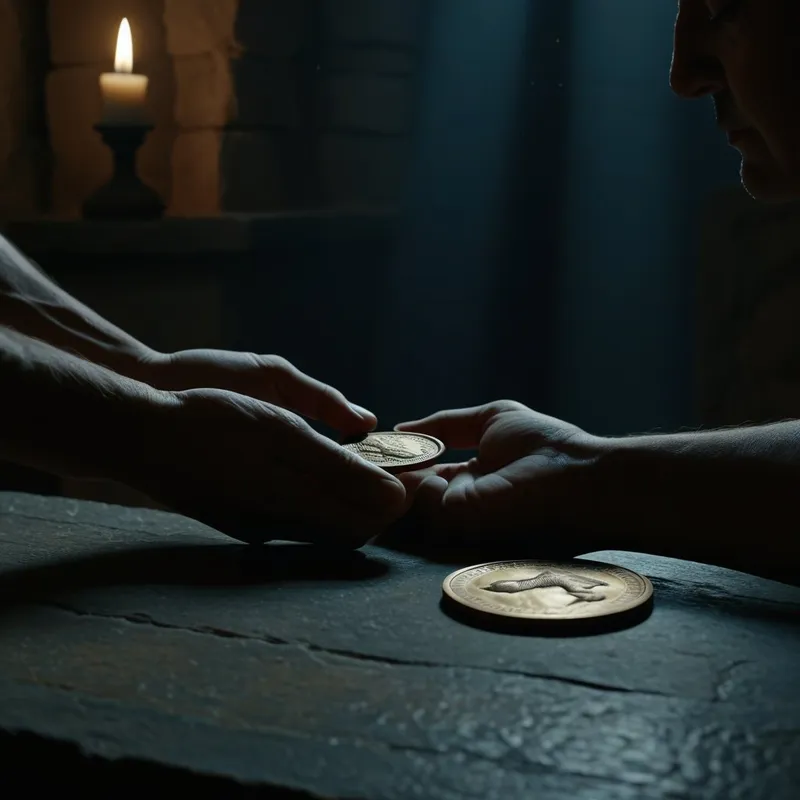
The ritual of Charon’s obol was not mere superstition; it was a vital social and religious practice embedded in the Greek [psyche](/myths/psyche “Myth from Greek culture.”/). From at least the 5th [century](/myths/century “Myth from Biblical culture.”/) BCE, archaeologists have found coins placed in the mouths, on the eyes, or in the hands of the deceased across the Greek world. The practice was a [cornerstone](/myths/cornerstone “Myth from Biblical culture.”/) of prothesis and ekphora, the elaborate rituals of laying out and burying the dead.
This was a duty of the living, specifically the family. As the body was prepared—washed, anointed, and dressed—a relative would perform the final, intimate act: placing the coin. It was a gesture of care, a last act of provision ensuring their loved one would not be stranded. The myth was propagated not by epic poets like [Homer](/myths/homer “Myth from Greek culture.”/) (who mentions Charon but not the coin in the Odyssey) but through the collective practice of everyday people, through the laments of mourners and the instructions passed down through generations. Its function was profoundly societal: to manage the anxiety of the unknown, to enact a controlled, ritualized transition that protected both the soul of the departed and the community of the living from the pollution and peril of an unfulfilled passage.
Symbolic Architecture
The myth constructs a profound symbolic [architecture](/symbols/architecture “Symbol: Architecture in dreams often signifies structure, stability, and the framing of personal identity or life’s journey.”/) around the most fundamental [human](/symbols/human “Symbol: The symbol of a human represents individuality, complexity of emotions, and social relationships.”/) threshold. The coin is far more than [currency](/symbols/currency “Symbol: Currency represents value exchange, personal worth, and societal power dynamics. It symbolizes resources, control, and the abstract systems governing human interaction.”/); it is a dense [node](/symbols/node “Symbol: A point of connection, intersection, or decision in a network, representing junctions in life paths, relationships, or systems.”/) of meaning.
It is, first, the [symbol](/symbols/symbol “Symbol: A symbol can represent an idea, concept, or belief, serving as a powerful tool for communication and understanding.”/) of completion. [Life](/symbols/life “Symbol: The symbol of ‘Life’ represents a journey of growth, interconnectedness, and existential meaning, encompassing both the joys and challenges that define human experience.”/) is framed as a contract, with this final [payment](/symbols/payment “Symbol: Symbolizes exchange, obligation, and value. Represents what one gives to receive something in return, often tied to fairness, debt, or spiritual balance.”/) balancing the accounts. The obol marks a [life](/symbols/life “Symbol: The symbol of ‘Life’ represents a journey of growth, interconnectedness, and existential meaning, encompassing both the joys and challenges that define human experience.”/) as finished, its debts to the [material](/symbols/material “Symbol: Material signifies the tangible aspects of life, often representing physical resources, desires, and the physical world’s influence on our existence.”/) world settled.
The coin on the lips is the period at the end of the sentence of a life. It seals the story, allowing the book to be closed and shelved in the library of memory.
Second, it represents the necessary sacrifice for transition. Nothing of value is gained without a corresponding release. To move from one state of being to another—from life to [death](/symbols/death “Symbol: Symbolizes transformation, endings, and new beginnings; often associated with fear of the unknown.”/), ignorance to [knowledge](/symbols/knowledge “Symbol: Knowledge symbolizes learning, understanding, and wisdom, embodying the acquisition of information and enlightenment.”/), dependency to independence—requires a payment. The coin is the tangible form of that sacrifice, [the thing](/myths/the-thing “Myth from Norse culture.”/) we must let go of to proceed.
Most critically, the obol symbolizes the [debt](/symbols/debt “Symbol: A symbolic representation of obligations, burdens, or imbalances that extend beyond financial matters into psychological and moral realms.”/) to the Other. Charon is not evil; he is impersonal, a force of [nature](/symbols/nature “Symbol: Nature symbolizes growth, connectivity, and the primal forces of existence.”/) like [gravity](/symbols/gravity “Symbol: The fundamental force that pulls objects toward each other, representing attraction, inevitability, and the weight of existence.”/). His fee acknowledges that we do not navigate existential transitions alone or by right. We rely on intermediaries, on structures, on the help of guides (psychopomps) who operate by their own laws. The payment is a recognition of and respect for that autonomous, archetypal power.
The Dreamer’s Resonance
When this myth stirs in the modern psyche, it rarely appears as a classical tableau. Instead, we dream of being at an airport without a ticket, of missing a crucial ferry, of fumbling for change at a tollbooth as the cars behind us honk. The somatic feeling is one of acute anxiety, paralysis, and profound unpreparedness.
Such dreams signal that the dreamer is at a psychological threshold—the end of a relationship, a career, an identity, a deeply held belief—but is resisting the “payment” required to cross. The “coin” may be a cherished grievance, an outworn self-image, a comfortable illusion, or a simple admission of truth. The dream asks: What have you not paid? What are you refusing to sacrifice to move forward? The figure of Charon in these dreams is the implacable face of [the Self](/myths/the-self “Myth from Jungian culture.”/), the inner authority that enforces the laws of psychic growth. To be left on the shore is to be condemned to a limbo of one’s own making, stuck in a pattern because the price of leaving it feels too high.

Alchemical Translation
In the alchemy of individuation, the journey to wholeness requires many crossings. Each stage of psychological development demands its own Charon’s obol. The myth models the process of psychic transmutation with stark clarity.
The first step is recognition of the threshold. We must see the dark river before us, acknowledge that our old world is ending. The “boat” is the new potential, the next stage of consciousness, but it will not carry us for free.
The core alchemical operation is the offering. This is the solve—the dissolution. We must identify and willingly place on the “lips” of our dying state the required payment. It may be our pride, our victimhood, our need for control, or an attachment to a past trauma. This offering is not a loss but an essential exchange.
To give the coin is to perform an act of faith in a process larger than the ego. It is to trust that the ferryman, though grim, is part of a lawful cosmos, and that the far shore, though unknown, is the necessary next destination for the soul.
Finally, with the click of acceptance, comes the crossing—the coagula, the re-formation. The old self dissolves in the waters, and a reconstituted consciousness approaches the gates of a new understanding. The myth teaches that we are not entitled to growth; we must purchase it with the only currency that has value in the realm of the soul: conscious sacrifice. In this light, every obol we pay is an investment in our own becoming, a small, metallic key to the next chapter of the great journey.
Associated Symbols
Explore related symbols from the CaleaDream lexicon: