Chaos Myth Meaning & Symbolism
The primordial void from which all existence emerged, a yawning chasm of potential preceding the ordered cosmos and the gods themselves.
The Tale of Chaos
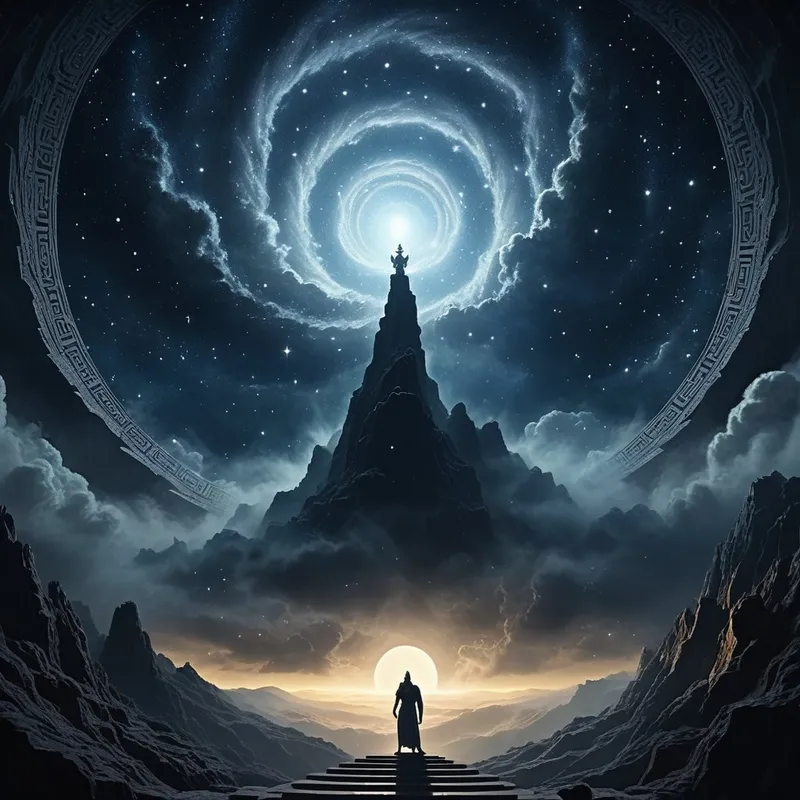
Before time had a name, there was no sun to cast a shadow, no earth to stand upon, no sea to whisper against a shore. There was only a breath held in the throat of eternity. A silent, aching absence so complete it was a presence. This was Chaos—not disorder, but the yawning, gaping chasm of all that was not yet.
It was a place without place, a depth without bottom, a darkness that was not the absence of light but the substance before light was conceived. Within its boundless, formless embrace, the seeds of everything slept. Not as shapes, but as yearnings. The yearning for depth became Erebus. The yearning for the veil that covers depth became Nyx. They emerged not as children from a womb, but as distinctions from the indistinct, the first whispers of separation in the eternal silence.
From their union, a lighter yearning was born: Aether, the bright upper air, and Hemera, the day. And so, the first great act was not a battle, but a gentle, inevitable unfolding. From the undifferentiated void, pairs emerged: Dark and Night, Light and Day. The chasm began to define itself by what it was not, by the spaces between the emerging principles.
Then, from the fecund body of Chaos herself, without consort, arose the solid yearning: Gaia, broad-breasted and steadfast. She was the first thing to be here, as opposed to there. She gave the void a surface, a reference point. And deep within her, a darker, deeper yearning stirred: Tartarus, the pit of torment, and Eros, the force of attraction that would bind all things to come.
Chaos did not recede. It became the background from which the tapestry of the cosmos was woven. It was the canvas upon which Gaia painted the mountains, the reservoir from which Pontus sprang. The story of the gods, the titans, the heroes—all their loves and wars and triumphs—would be a brilliant, chaotic embroidery upon the enduring, silent, dark fabric of that first, nameless opening.
Cultural Origins & Context
The myth of Chaos is the foundational bedrock of Greek cosmogony, the story of how the cosmos (kosmos, meaning "order" or "adornment") came to be arranged from non-cosmos. Our primary source is Hesiod's Theogony, composed around 700 BCE. Hesiod was not inventing in a vacuum; he was a bard synthesizing and formalizing oral traditions that stretched back into the misty Bronze Age, stories told by farmers and sailors under the vast Mediterranean sky to explain the terrifying and magnificent world around them.
This was a pre-philosophical, pre-scientific worldview. The myth served a crucial societal function: it established a sacred genealogy, a divine "family tree" that explained the origins of natural forces (night, day, earth, sea) and social principles (love, conflict, justice). By starting with Chaos, the Greeks anchored their reality in a moment of profound, sacred emergence. It provided a narrative answer to the most fundamental human question: "What was here before here?" The answer was not a creator god, but a primordial condition—a state of potential that made creation possible and necessary.
Symbolic Architecture
Chaos is not merely empty space. It is the ultimate symbol of undifferentiated potential, the psychological and cosmic prima materia (first matter). It represents the state of being before consciousness, before the ego draws boundaries and makes distinctions.
Chaos is the unthought thought, the unfelt feeling, the universe before the first word of its story is spoken.
In a psychological sense, Chaos corresponds to the unconscious in its most raw, collective form. It is not personal chaos (a messy room, a disordered schedule), but transpersonal, existential Chaos—the ground of being itself. Gaia represents the emergent consciousness, the "I am" that begins to form out of this boundless inner space. Erebus and Nyx symbolize the first, fundamental differentiations within the psyche: the recognition of hidden depths (the shadow, the repressed) and the mysterious, generative darkness of the unknown.
The myth tells us that order (Kosmos) is not the default state. It is a hard-won, beautiful, and temporary arrangement born from a more fundamental, enduring state of fertile void. The void is not evil or destructive; it is creative. All form arises from the formless and will eventually return to it.
The Dreamer's Resonance
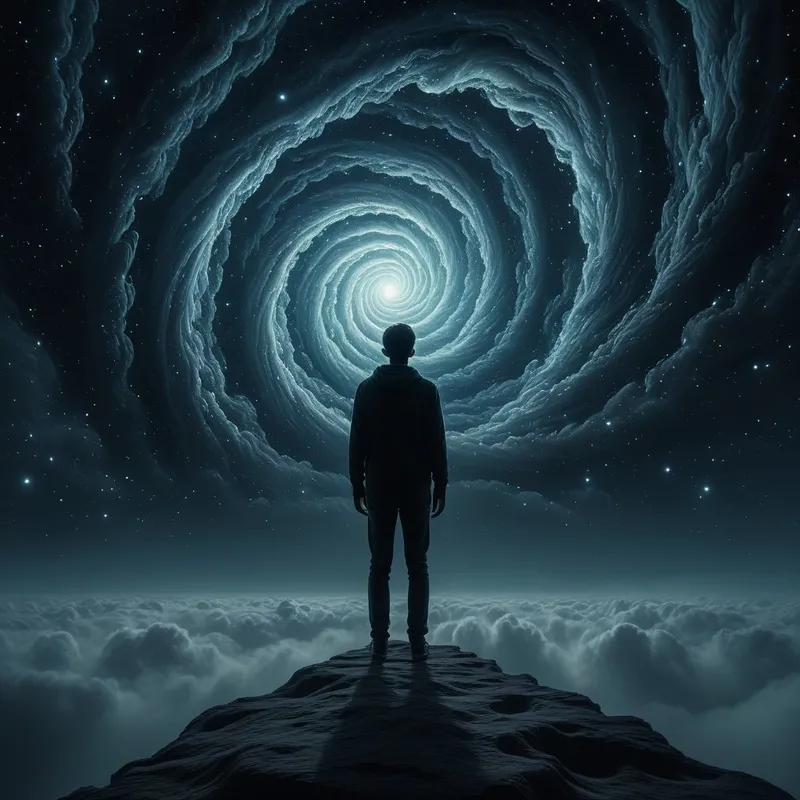
When the archetype of Chaos stirs in the modern dreamer, it rarely appears as a classical deity. Instead, it manifests as an atmosphere, a landscape, or a somatic experience. You may dream of standing at the edge of a bottomless pit inside your own home, of looking into a mirror and seeing only a swirling grey mist where your face should be, or of being in a familiar place that has lost all its features, becoming an empty, white expanse.
These dreams often accompany periods of profound transition: the end of a relationship, the loss of a job, a spiritual crisis, or the unsettling quiet after a major life achievement. The ego's familiar structures—the "cosmos" of your identity—are dissolving back into potential. This is terrifying because it feels like annihilation. The dream is not a prophecy of doom, but a truthful depiction of the inner process. The psyche is returning to its source to be reconstituted. You are experiencing the unmaking that necessarily precedes a new making.
The somatic feeling is one of groundlessness, vertigo, and a deep, quiet anxiety. It is the feeling of being between stories, where the old chapter has ended and the first word of the new one has not yet been written.
Alchemical Translation
The journey of individuation—becoming who you truly are—mirrors the myth of Chaos. It is not a linear path of accumulating more order, control, and light. It is a cyclical process of periodic dissolution and re-formation.
The alchemical work begins in the nigredo, the blackening, which is a voluntary descent into one's personal Chaos.
We spend much of our lives building a stable "cosmos": a persona, a career, a set of beliefs. To grow, we must occasionally have the courage to de-integrate. This is the alchemical solve (to dissolve). We allow outdated parts of our identity, rigid patterns, and compulsive thoughts to fall back into the inner void. This feels like chaos—a loss of meaning, direction, and solidity.
But this is where the myth guides us. Chaos is not an end; it is the womb. In that fertile darkness (the coniunctio or sacred marriage of Erebus and Nyx within us), new possibilities gestate. The emergent force is Eros—not merely sexual love, but the power of connection, attraction, and creative desire. It pulls new forms from the void. A new insight (Gaia) solidifies. A new way of being in the world finds its ground.
The modern individual's triumph is not to defeat Chaos, but to learn to dwell at its edge, to recognize it as the source of all renewal. To become whole is to make peace with the void within, to understand that your most authentic self is not just the well-ordered city you've built, but also the vast, dark, and star-filled wilderness from which its stones were quarried. The goal is not to live in Chaos, but to be in conscious relationship with it, allowing its creative potential to periodically refresh the ordered world of the self.
Associated Symbols
Explore related symbols from the CaleaDream lexicon:
- Vacuum
- Gap
- Blank
- Non
- None
- Structured Chaos
- Chaotic Harmony
- Nebula
- Stellar Nursery
- Void Space
- Cosmic Cloud
- Blank Page
- Nebulous Essence
- Abstract Shapes
- Primordial Chaos
- Primal Chaos
- Digital Void
- Chaos
- Zero Point
- Emergent Property
- Infinitive
- Genericity
- Dilation
- Abyss
- Blackhole
- Whitehole
- Slurry
- Abstract
- Messy Desk
- Quantum Realm