Chanoyu Myth Meaning & Symbolism
A ritual born from myth, where preparing and sharing tea becomes a sacred act of presence, dissolving boundaries between host, guest, and the universe.
The Tale of Chanoyu
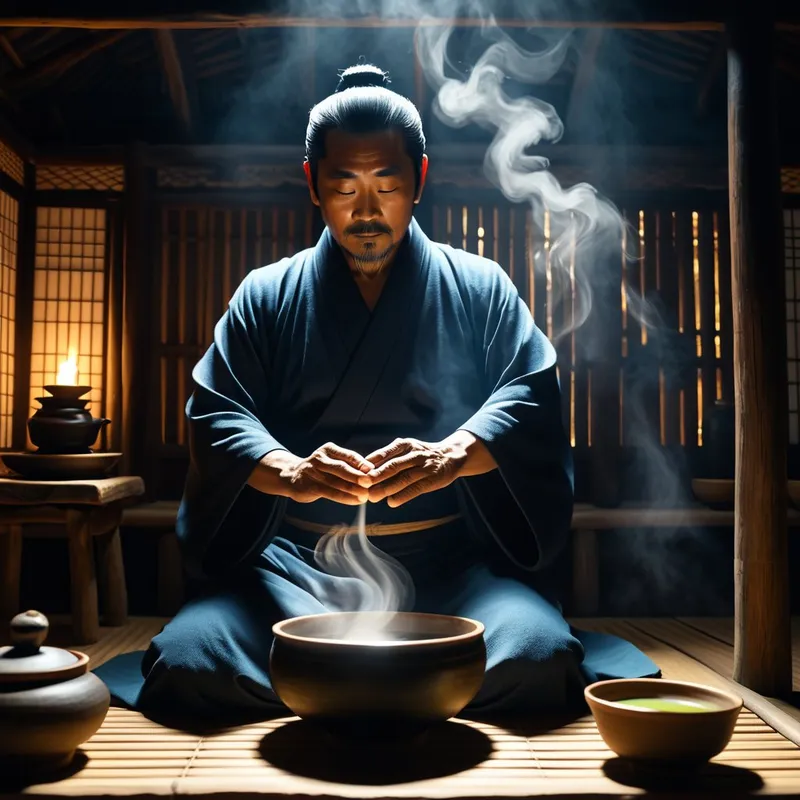
Listen. In the age when gods walked just behind the paper screen of the world, there was no ceremony. There was only thirst, and the leaf, and the water, and the fire. It was a time of clamor, where warriors clashed and poets wept, and the human spirit was a storm-tossed sea with no harbor.
Then came a whisper, not from the mouth of a kami, but from the space between breaths. It spoke to a weary traveler, a soul battered by the world's noise. He was no emperor, no general. He was a man who had lost his way. One evening, as the sun bled into the western mountains, he stumbled into a humble hut. An old man, whose eyes held the stillness of a deep pool, said nothing. He merely built a small fire, filled a kama with water from a spring, and began to prepare a bowl of whipped green tea.
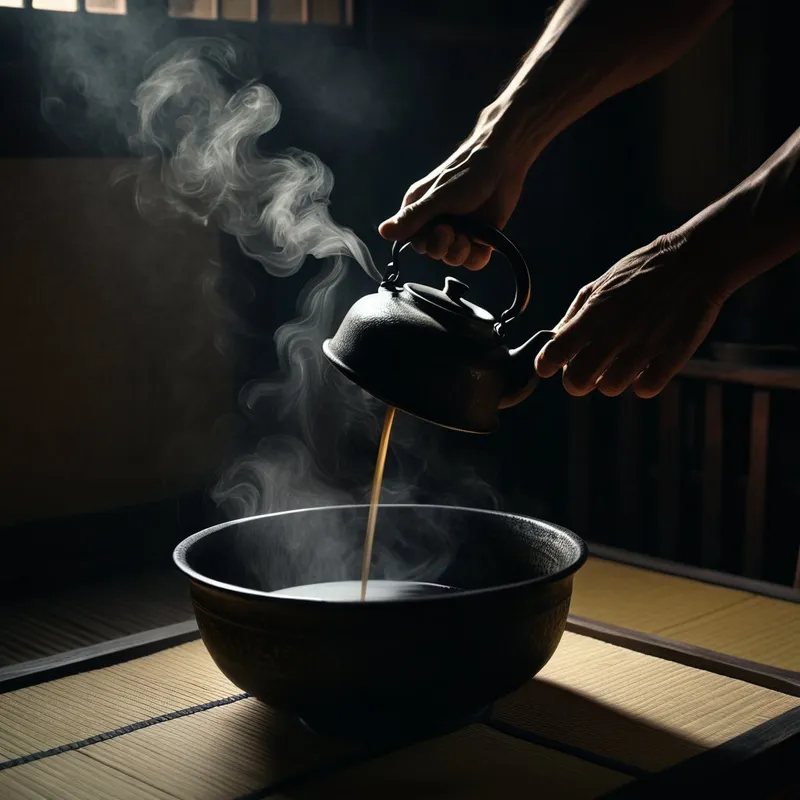
The traveler watched, his impatience a knot in his chest. But as he watched, time began to warp. The old man’s every movement was not hurried, but inevitable—the scooping of the powdered matcha, the ladling of the hot water, the slow, deliberate whisking. The sound was not a clatter, but a rhythm: the hiss of the fire, the pour of the water, the soft brush of bamboo on ceramic. The air grew thick with the scent of earth and green vitality.
When the bowl was placed before him, the traveler saw not a drink, but a universe. The froth was like jade mountain peaks in a misty sea. He lifted the chawan, its rough texture a shock of reality against his lips. He drank. And in that moment, the storm inside him ceased. The boundaries of his skin dissolved. He was no longer a separate self in a hut, but part of the fire’s warmth, the water’s flow, the tea’s bitterness, and the old man’s silent grace. He tasted the whole world in that single, bitter-sweet bowl. The ritual was not invented that day; it was remembered. It was the echo of a primordial harmony, waiting to be heard again in the simple acts of making, offering, and receiving.
Cultural Origins & Context
This is not a myth with a single named deity or a canonical scripture. The myth of Chanoyu is a living, evolving story woven into the fabric of Japanese history from the 9th century onward. It began with the practical importation of tea from China, a medicinal and monastic drink. Its transformation into a profound cultural myth is credited to figures like the monk Murasaki Shikibu, who infused it with Zen Buddhist principles, and later, the tea master Sen no Rikyū in the 16th century.
Rikyū is the central myth-maker. In the brutal, treacherous world of the Sengoku period—the age of warring states—he codified the wabi-sabi spirit of the ceremony. He taught that the ritual was not an escape from the world, but a deeper entry into it. It was passed down not through grand epics, but through direct transmission from master to student, in the intimate space of the chashitsu. Its societal function was paradoxical: it was a rigorous discipline for samurai to cultivate a mind unmoved by chaos, and a spiritual practice that leveled social hierarchies within the tearoom, where the only titles that mattered were teishu (host) and kyaku.
Symbolic Architecture
The myth is an architecture of consciousness built from four pillars: wa (harmony), kei (respect), sei (purity), and jaku (tranquility). These are not mere rules, but layers of symbolic meaning.
The chashitsu itself is a symbolic womb—a bounded universe where ordinary time and status are suspended. The nijiriguchi, through which all must crawl, is a birth canal into this new state of being, forcing a literal bowing and shedding of the outer world's ego. The utensils, each chosen with care, often imperfect or aged, are not just tools but vessels of history and transience, embodying wabi-sabi.
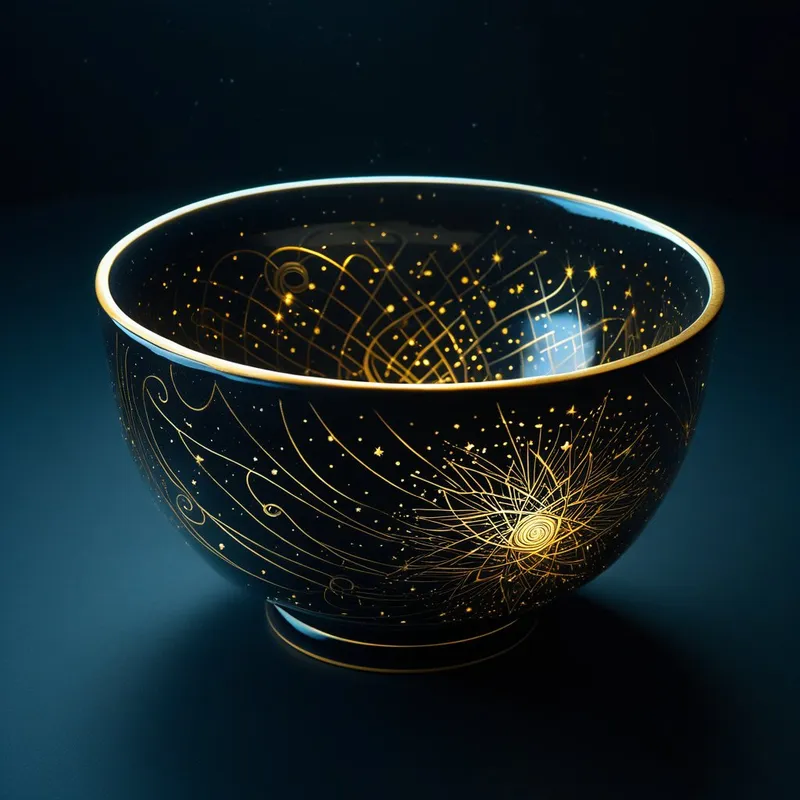
The bowl does not hold tea; it holds the space between host and guest, the suspended moment where giving and receiving are one action.
Psychologically, the host represents the conscious ego, undertaking a prescribed, disciplined ritual. The guest represents the other—the stranger, the unconscious, the world. The ritual is a container where these two poles are brought into deliberate, respectful relationship. The act of cleansing (temae) is a symbolic purification of intention and perception. The shared bowl is the transcendent function, the symbol of a connection that transcends individual psyche.
The Dreamer's Resonance
When this myth stirs in the modern unconscious, it rarely appears as a formal tea ceremony. Instead, one might dream of rituals of meticulous preparation for an event that never arrives, or of offering a simple, perfect object to a silent, significant other. One may dream of a small, incredibly peaceful room that appears within a chaotic house, or of cleaning and arranging objects with profound, inexplicable care.
These dreams signal a somatic and psychological process of seeking containment. The psyche is overwhelmed by the noise, speed, and complexity of modern life—the digital sengoku. The dream is creating a chashitsu within the self. The meticulous action, the focus on a simple sensory object (the bowl, the water), is the mind's attempt to ground itself, to pull awareness from the abstract and anxious future into the tangible, procedural present. It is a somatic cry for jaku—tranquility—not as passive escape, but as a state achieved through purposeful, embodied action.

Alchemical Translation
The alchemical process modeled by Chanoyu is the transmutation of ordinary, fragmented consciousness into a state of unified, embodied presence—a core goal of Jungian individuation. The base materials are the chaotic elements of our daily experience: our scattered thoughts (the unwhisked tea powder), our turbulent emotions (the unheated water), our egoic drives (the separate host and guest).
The vas or sacred vessel is the ritual itself, the bounded time and space held by intention. The fire is the focused attention applied to each step. Through the disciplined practice of the ritual—the measuring, the pouring, the whisking—these disparate elements are combined and agitated.
The goal is not to create a perfect cup of tea, but to dissolve the one who seeks perfection into the act of making.
The lapis, the philosopher's stone produced, is not a thing but a state of relationship. It is the moment of serving and receiving, where the distinction between "I" and "Thou," between inner and outer, is temporarily suspended. The bitterness of the matcha is essential; it is the assimilation of life's inevitable bitterness (suffering, imperfection) into the experience, not its negation. For the modern individual, the alchemy translates to any deliberate practice where full attention to a simple, sensory process becomes a gateway to psychological integration—where doing becomes being, and in the shared space of that being, the Self, momentarily and profoundly, is made whole.
Associated Symbols
Explore related symbols from the CaleaDream lexicon: