Chandra Myth Meaning & Symbolism
The myth of Chandra, the luminous Moon God, tells of his curse to wane, his penance, and his cyclical restoration, mapping the soul's journey through light and darkness.
The Tale of Chandra
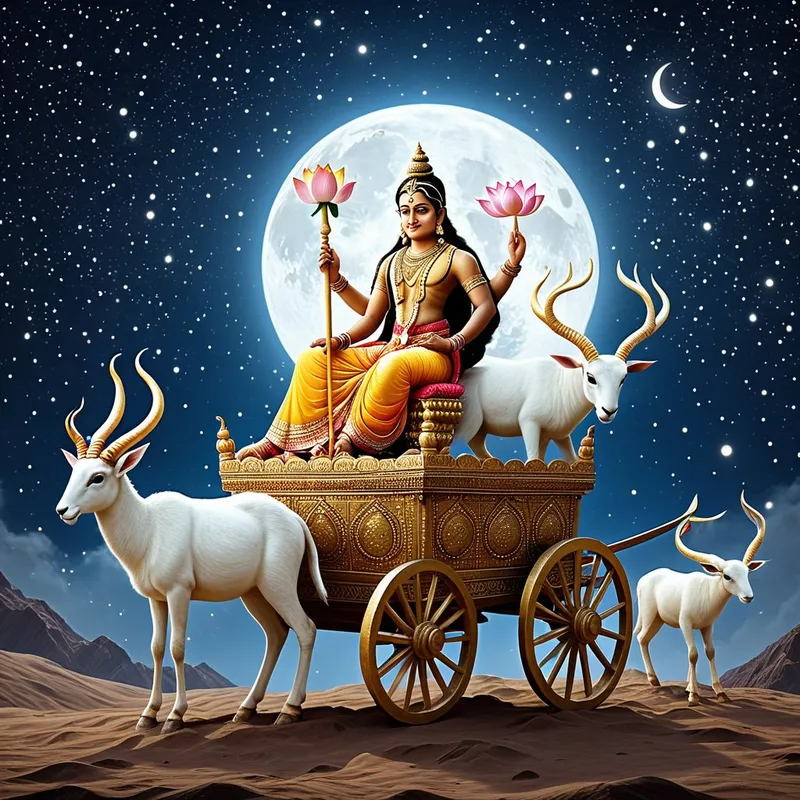
Listen, and let the night sky tell its oldest story. Before time was measured in days, but in the ebb and flow of light, there was Chandra. He was born from the churning of the cosmic ocean, a being of pure, cool radiance, his beauty so potent it was a form of nectar. The gods anointed him as the sovereign of the stars, the ruler of herbs, and the lord of the mind. He rode a chariot of ethereal silver, drawn by ten antelopes—ten directions of the cosmos—tracing his silent, sovereign path across the vault of heaven.
His light was not a blaze, but a balm. It coaxed seeds from the soil, swelled the tides in a loving embrace, and whispered to the sleepless. But sovereignty, especially one so luminous, casts long shadows. Chandra’s brilliance ignited a terrible desire. He desired Rohini, the most radiant of the twenty-seven Nakshatras, his celestial wives. In her company, he found a reflection of his own splendor, and he lingered. For nights that stretched into seasons, he dwelt with Rohini alone, leaving his other twenty-six wives in cold, lightless neglect.
Their despair turned to a silent, gathering frost. They went to their father, the great progenitor Daksha, their voices a chorus of sorrow. Daksha’s wrath was not a fire, but a decree, cold and absolute as space itself. He summoned Chandra. “You are a lord who has forgotten his duty,” Daksha thundered. “Your light is a gift to all, not a prize for one. For this arrogance, for this heartless favor, you shall be consumed. Your form will waste away, day by day, until nothing but darkness remains.”
The curse took hold like a chilling wind. From his glorious fullness, Chandra began to wane. A sliver of silver vanished each night, eaten by an invisible hunger. The world felt his diminishment. Plants grew listless, the ocean’s pulse grew faint, and the minds of creatures grew clouded with uncertainty. The glorious Moon God was dying, and with him, a fundamental rhythm of the world.
Driven by terror and a dawning understanding of his transgression, Chandra fled his throne in the sky. He descended to the mortal realm, to the most sacred of confluences, the Triveni Sangam. There, under the very sky he could no longer bear to rule, he knelt. He performed a penance of unimaginable intensity, pouring his diminishing essence into prayers to Shiva, the lord of dissolution and regeneration.
For an age, he prayed as his body faded. Just as the last sliver of his light was about to be extinguished, a presence filled the space. It was Shiva, the great ascetic, his matted hair like a storm cloud. Moved by Chandra’s desperate devotion and the world’s need for balance, Shiva intervened. He could not revoke Daksha’s curse, for a sage’s word is law. But he could transmute it. He lifted Chandra and placed him as a shining ornament upon his own head. “You will wane,” Shiva declared, his voice the rumble of distant thunder, “but you will also wax. Your light will decrease for fifteen days, consumed by shadow. Then, from that same shadow, it will be reborn and increase for fifteen more. You will become the measure of time itself, a perpetual promise of return.”
And so it was. Chandra, saved yet forever changed, cycles eternally. He is the constant traveler, forever moving from fullness to emptiness and back again, a celestial sigh of loss and recovery, wearing the mark of his flaw and his redemption as his very nature.

Cultural Origins & Context
The myth of Chandra is woven into the earliest layers of Vedic and post-Vedic literature, including the Puranas and the great epics. He is Soma in the Vedas, both a deity and the sacred ritual drink of immortality, linking him directly to the essence of life, nourishment, and ecstatic vision. This story was not merely entertainment; it was a cosmological and sociological map. Passed down through bardic recitation and temple sculpture, it explained the most visible celestial clock: the lunar phases.
Societally, it reinforced the dharmic ideal of equitable duty (Dharma). Chandra’s failure was a failure of impartiality, a lesson for kings and householders alike. Furthermore, his intimate link with the twenty-seven Nakshatras provided the mythological bedrock for Jyotisha, integrating his cycle into the fabric of timekeeping, agriculture, and destiny. The moon’s influence on tides and growth made this myth a narrative of natural law, where divine action and cosmic order are inseparable.
Symbolic Architecture
Chandra is the archetypal principle of the reflective mind, emotion, and the cyclical nature of life. He is not the blazing, constant sun of consciousness, but the softer, fluctuating light of the subconscious, the receptive, and the feminine.
The moon does not generate light; it receives, reflects, and undergoes. It is the psyche’s capacity to feel, to change, and to be vulnerable.
His twenty-seven wives, the Nakshatras, represent the multiplicity of experiences and influences the mind must hold in balance. His favoritism for Rohini symbolizes the psyche’s dangerous tendency to identify with only one facet of itself—a single mood, a cherished complex, a dominant narrative—while neglecting the rest. This partiality leads to psychic decay, the “waning” of the whole self.
Daksha’s curse is the inevitable law of psychological consequence: what you neglect, atrophies; what you over-identify with, consumes you. The waning is not a punishment from an external god, but the natural result of inner imbalance. Shiva’s intervention represents the transcendent function, the archetype of the Senex or the unifying Self. He does not remove the cycle but sanctifies it. The mind’s fluctuations are not a flaw to be eradicated but a rhythm to be integrated, worn as an ornament on the crown of higher awareness.
The Dreamer's Resonance
When the pattern of Chandra’s myth stirs in the modern dreamer, it speaks to a profound experience of cyclical depletion and renewal. To dream of a fading or disappearing moon is to somatically experience a loss of psychic nourishment, a drying up of creativity, intuition, or emotional vitality. One may feel “cursed” by a draining job, a relationship, or an inner critic (the Daksha figure), feeling one’s very essence being consumed.
Dreams of searching for water in a dry landscape, or of plants withering, mirror the world’s suffering in the myth and reflect the dreamer’s own arid inner state. The pivotal dream moment is the act of penance—not groveling, but the sincere, desperate kneeling before one’s own deepest truth (the Shiva principle). This is the moment of surrender, of acknowledging one’s part in the imbalance. The subsequent feeling of being lifted, of finding a place of rest amidst the cycle, signals the beginning of integration. The dream-ego is learning to accept its own phases of light and shadow as part of a sacred, necessary process, not a personal failure.

Alchemical Translation
The alchemy of Chandra is the transmutation of a curse of fragmentation into a sacrament of rhythm. For the individual on the path of individuation, the myth models a crucial transformation: moving from identifying with a single, brilliant complex (the “Rohini” of our personality) to embracing the full mandala of the self.
Individuation is not the achievement of permanent, solar fullness. It is the conscious participation in the lunar cycle, where the dark phase of introspection and the bright phase of expression are both seen as essential.
The initial “waning” is a necessary nigredo, a darkening. It is the painful but vital dissolution of ego-inflation and one-sidedness. The penance at the river confluence is the albedo, the washing clean—the honest self-confrontation and submission to a process larger than the ego’s desires. Shiva’s act is the rubedo, the final reddening or enlivening: the flawed, cyclical self is not discarded but is placed in a sacred context. The ego-complex (Chandra) finds its rightful, beautiful, but subordinate place upon the crown of the Self (Shiva).
Thus, the modern seeker learns that their periods of depression, doubt, and withdrawal are not a falling away from the path, but the path itself. The goal becomes not to shine constantly, but to learn the sacred art of waning with grace and waxing with humility, to wear one’s own cycles as an ornament of wisdom. One becomes, like Chandra, a living measure of soul-time, a testament that loss is the prelude to return, and that within the very heart of our flaws lies the pattern of our redemption.
Associated Symbols
Explore related symbols from the CaleaDream lexicon: