Chan Chu Myth Meaning & Symbolism
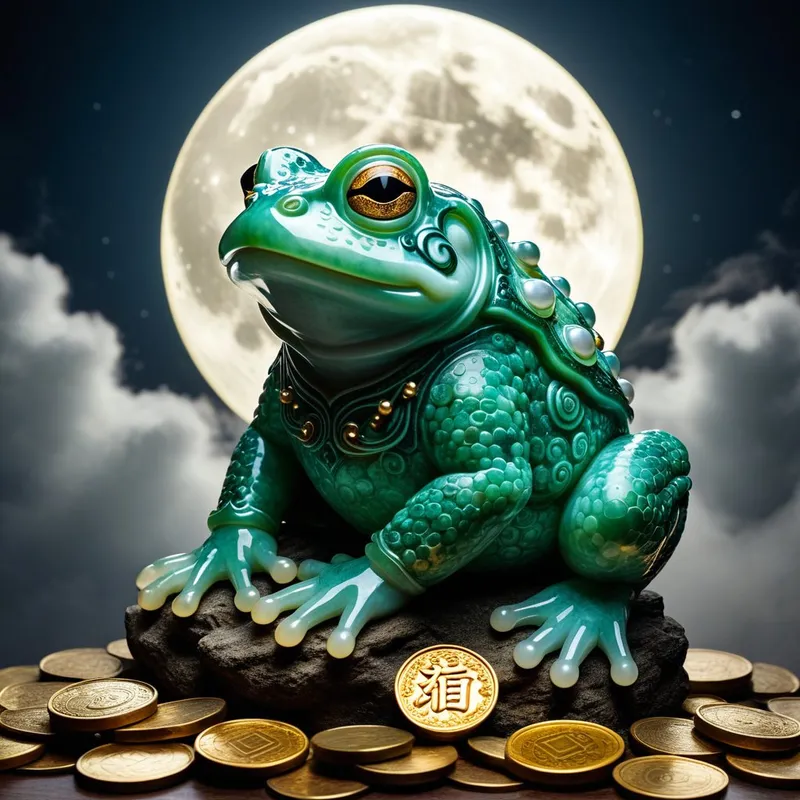
A myth of a celestial toad, punished and cast down, who learns to transmute poison into gold, becoming a guardian of hidden treasures and a symbol of profound transformation.
The Tale of Chan Chu
In the celestial heights, where the Xi Wangmu tended her gardens of immortality, there lived a creature of profound and unusual beauty. He was Chan Chu, the three-legged toad, whose skin held the sheen of the moon itself. He was no humble pond-dweller, but a guardian of the Moon Palace, a companion to the lunar goddess Chang'e. His duty was sacred: to hold within his form the pure, cold essence of the moon, a living vessel of celestial yin.
But the heart of a celestial being is not immune to temptation. In the quiet solitude of the palace, a hunger awoke in Chan Chu—a hunger not for sustenance, but for possession, for the radiant beauty he was sworn to protect. One fateful night, as the elixir of life shimmered in its jade vessel, its scent a promise of eternal perfection, the toad’s resolve crumbled. With a swift, desperate motion, he swallowed the priceless treasure, hoping to internalize its power, to become not just a guardian, but a god.
The theft did not go unnoticed. The harmony of the heavens trembled. The Jade Emperor, ruler of all, felt the discord. His judgment was swift and severe. The punishment for such celestial greed was exile. Chan Chu, his form now forever marked by the stolen power within, was cast down from the silvery ramparts. He fell through layers of cloud and star, not as a radiant being, but as a falling star of disgrace, plummeting to the hard, unforgiving earth.
He crashed into the mud of a mountain stream, his celestial light dimmed. The elixir within him, mingling with his shame and the toxins of the earthly realm, underwent a terrible alchemy. It did not grant godhood; it twisted his nature. From his mouth, instead of celestial song, dripped a poisonous venom. He became a creature of the damp, dark places, a symbol of lack and venomous spite.
Yet, within his corrupted form, the seed of the elixir still slept. Over long, lonely years, a slow transformation began. The poison he carried, born of his own fall, began to interact with the latent celestial energy. In the deepest dark, under the watchful eye of the same moon he once served, a miracle of transmutation occurred. The venom, through a process of cosmic digestion, began to crystallize. Not into bitterness, but into gold. From his mouth, he now produced coins and precious pearls. The very substance of his punishment became the source of a new, hidden power. He became the guardian not of the moon, but of the earth’s secret wealth, a hidden king in the watery underworld, waiting for the worthy to discover that poison, fully faced, can become the greatest treasure.
Cultural Origins & Context
The myth of Chan Chu finds its roots in the rich tapestry of Chinese folk religion, Daoist cosmology, and popular symbolism. It is not a myth confined to a single, canonical text like the Classics of Mountains and Seas, but one that evolved through oral tradition, temple art, and commercial culture. Its most enduring association is with the Daoist immortal Liu Hai, who is often depicted teasing or guiding the three-legged toad. This partnership solidified Chan Chu’s role in the popular imagination as a bringer of prosperity.
The myth served multiple societal functions. On one level, it was a moral fable about the consequences of greed and the possibility of redemption through transformation. On a more practical, folkloric level, Chan Chu became a ubiquitous symbol of wealth and business success. His image, often with a coin in his mouth, adorned shops and homes, a talisman to attract fortune and protect savings. The myth also reflects a core Daoist principle observable in nature: the interdependence of opposites (yin and yang). The toad, a creature of water (yin) and earth, who produces metal (gold, yang), embodies this transformative cycle, teaching that value often emerges from the most unexpected and humble origins.
Symbolic Architecture
Chan Chu is a master symbol of psychic alchemy. His three legs are his first clue to deeper meaning; in numerology, three represents dynamic balance and the synthesis of opposites, a trinity that moves beyond duality. He is not a perfect, four-square creature, but one whose very form suggests an unconventional, magical stability.
His fall from the celestial to the muddy earthly realm represents the inevitable descent of the spirit into the material, often experienced as a crisis, a failure, or a profound humiliation. The stolen elixir is the undeveloped potential, the "gold" of the personality, which when seized by ego (greed) becomes a poison—a complex, a neurosis, a destructive habit.
The greatest treasures are not found in the light of heaven, but forged in the dark mud of our failures.
The core alchemy of the myth lies in Chan Chu’s long, silent incubation. The poison does not leave him; he metabolizes it. This is the symbolic key to shadow work. We do not eradicate our flaws, our venomous thoughts, or our shame. We must contain them, hold them in the vessel of consciousness (the toad’s body), and through the slow, patient work of attention and acceptance, allow a transmutation to occur. The gold he produces is not innocent wealth; it is earned wisdom, the psychological capital gained only by facing and integrating our darkest aspects.
The Dreamer's Resonance
When the pattern of Chan Chu stirs in the modern dreamer, it often signals a profound process of psychic digestion. To dream of a toad, especially a large, imposing, or three-legged one, is to encounter a powerful aspect of the instinctual, earthy shadow. It may feel ugly, repellent, or frightening—a symbol of something "poisonous" the dreamer carries: a resentment, a secret greed, a deep-seated envy, or a sense of unworthiness from a past "fall."
The dream may feature the act of the toad producing coins or gems. This is a magnificent sign from the unconscious. It indicates that the dreamer is in the midst of, or is being called to, the alchemical process. The very thing that feels like a toxic burden—a difficult childhood, a career setback, a personal flaw—is beginning to be seen as the raw material for creation. The somatic sensation accompanying such dreams can be one of pressure in the gut or throat (the site of digestion and expression), followed by a strange, unexpected sense of relief or hidden wealth.
Alchemical Translation
For the individual on the path of individuation, the myth of Chan Chu provides a non-linear map. The journey does not start with striving upward, but with an acknowledgment of the "fall." We must first identify our "stolen elixir"—the idealized self-image or potential we tried to seize prematurely—and recognize how it has turned to poison in our psychological system, perhaps as arrogance, addiction, or chronic dissatisfaction.
The next, crucial phase is the descent into the "muddy stream." This is the often-depressing but necessary work of shadow integration. It involves sitting with our unattractive qualities, our venom, without denial or immediate attempts to expel it. This is the incubation.
Individuation is the art of turning the lead of the personal complex into the gold of the transcendent function.
The final stage is the slow, patient cultivation of the inner alchemist. Through reflection, creative expression, and honest relationship, we provide the "lunar" container—the cool, reflective light of consciousness—that allows the transmutation to proceed. The "gold" that emerges is a newfound resilience, a deep sense of self-acceptance that includes our flaws, and an authentic personal power that can nourish ourselves and others. We become, like Chan Chu, a guardian of a hidden treasure that was always there, waiting to be transformed from the very substance of our struggle.
Associated Symbols
Explore related symbols from the CaleaDream lexicon: