Chalchiuhtlicue Jade Skirt Goddess Myth Meaning & Symbolism
The goddess of rivers and lakes whose tears of grief flood the world, cleansing it for rebirth, embodying the necessary cycle of dissolution and renewal.
The Tale of Chalchiuhtlicue Jade Skirt Goddess
Listen. The world was young, and the Fifth Sun burned hot and dry in the sky. The people, the Mexica, built their great city upon the lake, and for a time, the corn grew tall. But the earth was thirsty, and the hearts of men were heavy with stone.
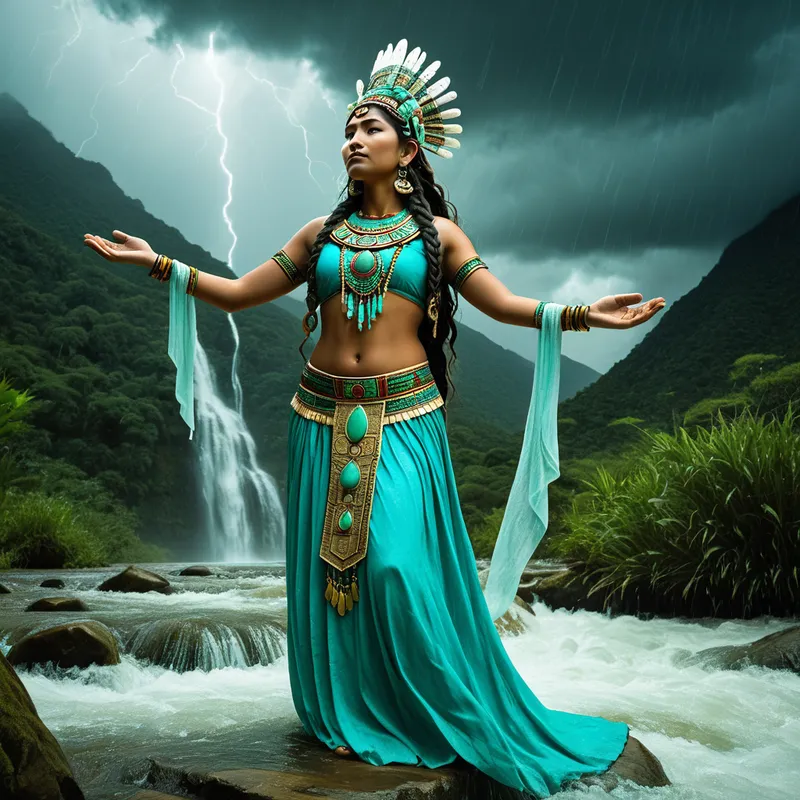
Then, she came. Not with a roar, but with a whisper that began in the deep places. She was Chalchiuhtlicue, sister and wife to the Rain God Tlaloc. Where he brought the vertical, striking gift of rain, she was the horizontal embrace. Her skirt was not woven of thread, but of the cool, living green of jade, and when she walked, it sounded like a thousand streams trickling over smooth stones. Her hair was the blue-black of the deepest lake at midnight, and in her hands, she carried not weapons, but the sustaining gift of sweet water.
For fifty-two years—a full xiuhmolpilli—she ruled as the sun. It was a time of gentle abundance. Canals were full, children laughed by the riverbanks, and the maize drank deeply. She loved her people with the patient, encompassing love of a lake for its shores. But love is a deep well, and it can overflow.
A shadow fell upon her heart. Some say it was a great betrayal among the gods; others whisper it was the weight of human suffering she absorbed from the waters—the tears wept into rivers, the blood spilled in sacrifice that found its way to her streams. Her sorrow began as a mist, then a steady rain, then a downpour that did not cease. The heavens opened not with Tlaloc’s thunder, but with Chalchiuhtlicue’s silent, grieving tears.
The waters rose. They slipped over the banks of the great lake Texcoco. They swallowed the chinampas, the floating gardens. They climbed the steps of the temples and poured into the homes. The people cried out, but her grief was a flood tide that could not be commanded. The world drowned in her sorrow. Mountains became islands, and the sky and the water became one grey, weeping entity. It was not a violent end, but a slow, inevitable embrace. The Fifth Sun was extinguished not by earthquake or jaguar, but by water, and the world fell into a silent, aquatic darkness.
And then… a stillness. The rain stopped. The waters, having expressed their full measure, began to recede. In the vast, muddy silence, something new stirred. From the receding waters, the survivors emerged—transformed. They were no longer the people of the Fifth Sun, but the fish-people, the new beings for a new age. Chalchiuhtlicue, her tears spent, looked upon the cleansed world. The flood was not malice, but a terrible, necessary baptism. Her love had to dissolve the old world so a new one could be born from the fertile silt. She returned to her quiet depths, the Jade Skirt now the bed of new rivers, her story a memory held in every drop of flowing water.

Cultural Origins & Context
This myth of the 4-Atl (Four Water) destruction was a central pillar of Nahua cosmology, recorded in post-Conquest texts like the Codex Chimalpopoca. It was not merely a story of disaster, but a foundational explanation of cosmic cycles. The Aztecs lived with the profound awareness that their world, the Fifth Sun, was preceded by four other creations, each destroyed by elemental forces. Chalchiuhtlicue’s flood was the cataclysm that ended the Fourth Sun.
This narrative was likely preserved and recited by tlamatinime (wise ones) and during major festivals. Its societal function was multifaceted: it explained the origins of their current era, justified the necessity of ritual and sacrifice to maintain cosmic balance and stave off a similar collapse, and instilled a deep, respectful fear of the power of water. Chalchiuhtlicue was a deeply ambivalent figure—a life-giver who could also take life on a cosmic scale. Her worship was essential for agricultural fertility, but her myth served as a constant reminder of the fragile, borrowed nature of existence.
Symbolic Architecture
Chalchiuhtlicue embodies the archetype of the Great Mother in her most fluid and paradoxical form. She is not the static Earth Mother, but the Mother of Flows—of emotions, time, and psychic energy.
The flood is not an attack from the outside, but the inevitable overflow of that which has been contained too long without release.
Her jade skirt symbolizes the beautiful, hard surface of contained emotion. Jade is cool, precious, and durable, yet it is born of water and pressure. The skirt itself, a horizontal plane, represents the surface of a lake or the conscious mind. The flood occurs when the pressure beneath this polished surface—the unconscious accumulation of grief, love, or trauma—becomes too great. The myth maps the psychological journey from contained nurturance (the calm lake) to emotional cataclysm (the flood) to a new, integrated state (the fertile silt).
The transformation of humans into fish-people is a profound symbol of adaptation and psychic evolution. To survive the flood of unconscious material, one must change one’s very nature—learn to breathe in the emotional waters, not just tread them.
The Dreamer's Resonance
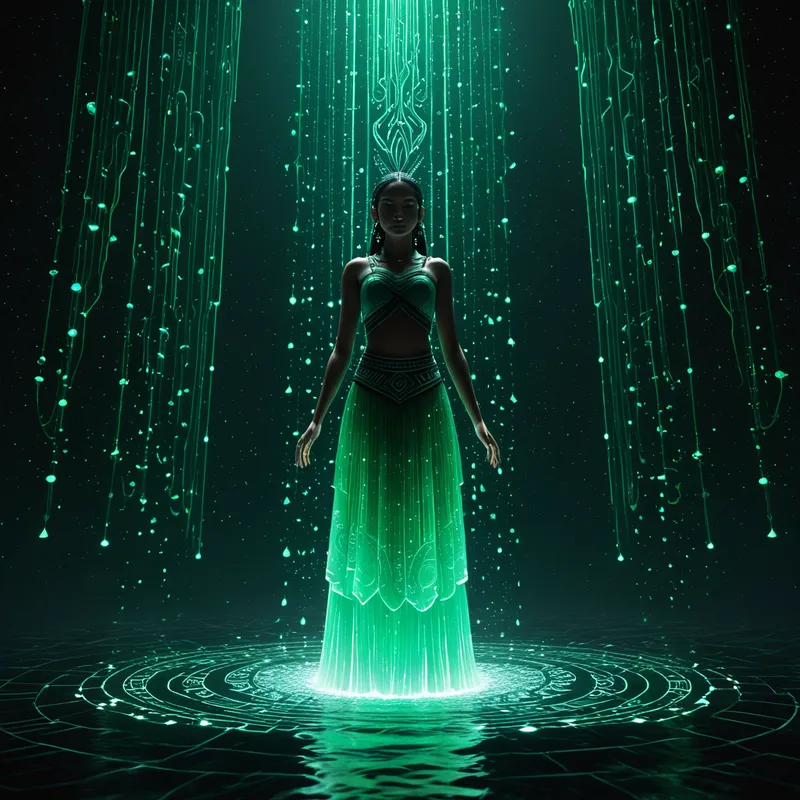
When this myth stirs in the modern psyche, it often manifests in dreams of overwhelming water: slow-rising floods in one’s childhood home, tidal waves seen from a place of eerie calm, or finding oneself able to breathe underwater. These are not dreams of fear, but dreams of profound somatic and emotional process.
The dreamer experiencing the “Chalchiuhtlicue pattern” is undergoing a necessary dissolution. Psychologically, they are at the point where a long-held container—a role, a self-image, a pattern of repressed feeling (the Jade Skirt)—is failing. The flood in the dream is the unconscious finally spilling into consciousness. It feels catastrophic because it dismantles the known world of the ego. The somatic sensation is often one of weight, pressure, and then release into a fluid state where distinctions blur. This is the psyche’s way of forcing a cleansing that the conscious mind has resisted. The dream is an invitation to stop building dams and to learn to swim in the depths of one’s own emotional truth.
Alchemical Translation
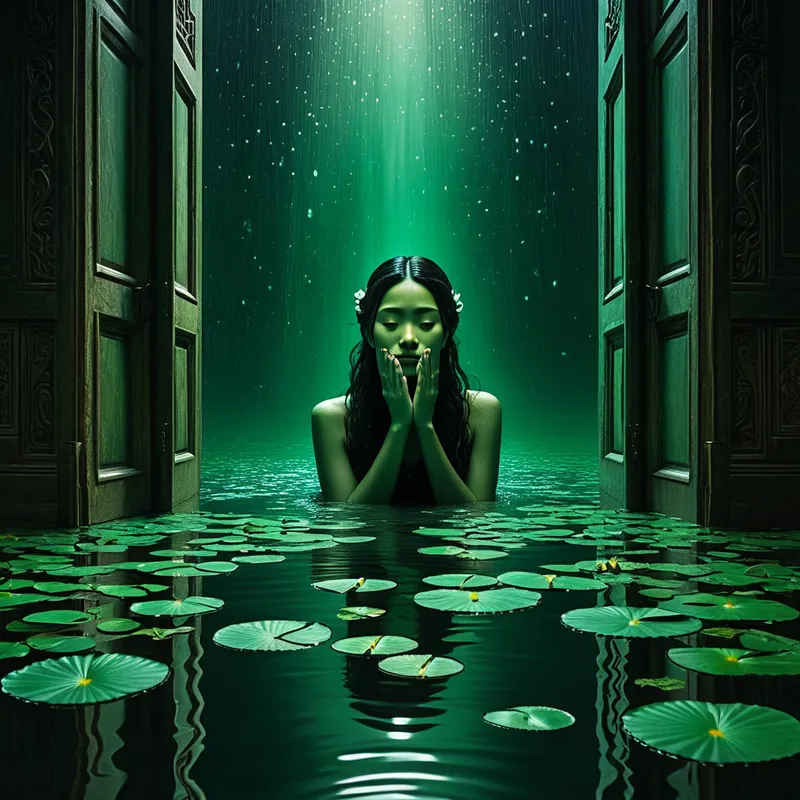
In the alchemy of individuation, Chalchiuhtlicue’s myth models the stage of solutio—dissolution. This is not a failure, but a crucial phase where rigid structures must be liquefied so they can be reconstituted at a higher level of integration.
The ego, like the Fourth Sun, must be mercifully drowned so the Self can emerge from the waters, transformed.
The modern individual’s “Jade Skirt” is the persona—the polished, socially acceptable identity we present to the world. It is valuable and beautiful, but it is also a container. The alchemical work begins when the contents of the unconscious (personal grief, ancestral trauma, unlived life) press against this container. The ensuing “flood” might be a life crisis, a breakdown, or a period of intense depression and emotional volatility. This is the terrifying, yet sacred, process of nekyia, or descent into the waters of the unconscious.
The triumph is not in stopping the flood, but in surviving it and being changed by it. The goal is to become the “fish-person”—to develop the psychic gills to process deep emotion, to find orientation in the fluid realm of the unconscious, and to eventually emerge onto the “new land” of a more authentic Self. This new land is the psyche after integration, fertile with potential because it has been soaked in and cleansed by the very waters that once threatened to destroy it. One learns that Chalchiuhtlicue’s love was in the flood itself, for it was the only force capable of washing away the old, calcified world to make space for new growth.
Associated Symbols
Explore related symbols from the CaleaDream lexicon:
- Goddess — The divine feminine principle in its nurturing, sustaining, and ultimately transformative and devouring aspect, as embodied by Chalchiuhtlicue’s dual nature.
- Water — The primordial element of emotion, the unconscious, flow, and cleansing dissolution, representing both the source of life and the agent of cosmic renewal in the myth.
- River — The specific manifestation of Chalchiuhtlicue’s domain, symbolizing the directional flow of time, emotion, and destiny that can overflow its banks in a moment of profound release.
- Flood — The catastrophic yet necessary overflow of contained emotional or psychic energy, representing the breakdown of old structures to allow for rebirth.
- Jade — The stone of her skirt, symbolizing the beautiful, hard surface of contained vitality and emotion that, under pressure, reveals its aqueous, life-giving origins.
- Tears — The literal and symbolic expression of divine and human grief, the initial droplets that accumulate into a world-altering deluge of feeling.
- Rebirth — The core promise after the flood, the emergence of a new mode of being (the fish-people) from the dissolved remains of the old world.
- Mother — Chalchiuhtlicue as the archetypal mother who, in her fullest expression, does not just nurture but also dissolves the child’s old form so a new self can be born.
- Circle — The cyclical nature of creation, destruction, and re-creation as depicted in the succession of world ages, or Suns, in Aztec cosmology.
- Dream — The modern, internalized realm where the flood myth now plays out, as the unconscious mind processes its own necessary dissolutions and renewals.