Chakra Vyuha Myth Meaning & Symbolism
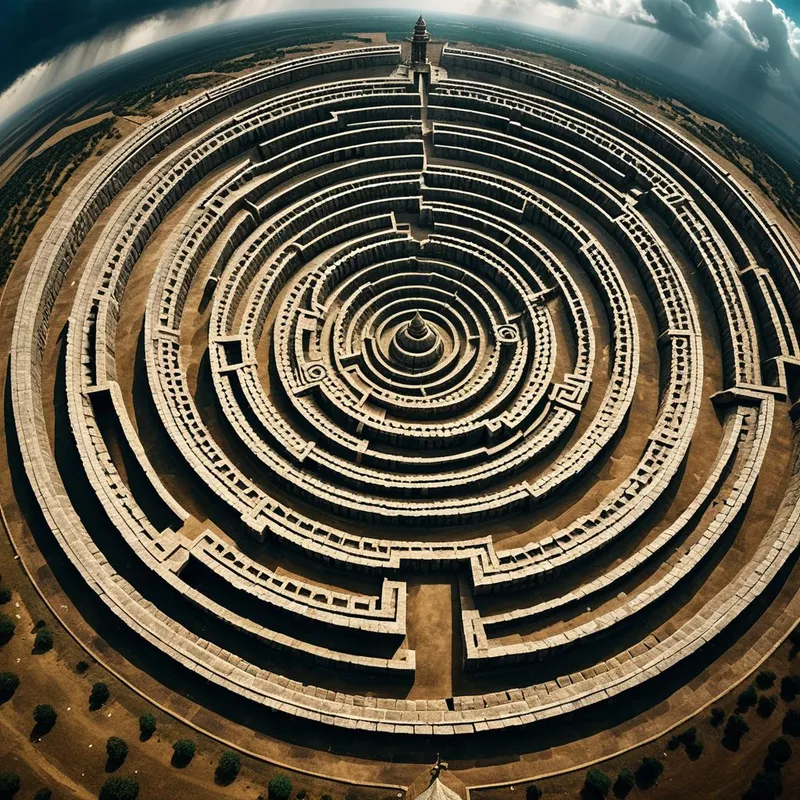
A mythic labyrinth from the Mahabharata, a spiral of warriors that only the initiated can penetrate, representing the psyche's most complex and inescapable patterns.
The Tale of Chakra Vyuha
Hear now the tale of the turning wheel, the vortex of destiny spun on the field of Kurukshetra. The air was thick with the scent of dust, sweat, and impending doom. Two colossal armies, the Pandavas and the Kauravas, stood arrayed for a war that would decide the fate of [the world](/myths/the-world “Myth from Tarot culture.”/). On the thirteenth day, a silence fell, more terrifying than any war cry. The Kaurava commander, the venerable Bhishma, had fallen. In his place rose [Dronacharya](/myths/dronacharya “Myth from Hindu culture.”/), a teacher of unparalleled skill, and his mind conceived a weapon not of steel, but of order itself: the [Chakra](/myths/chakra “Myth from Hindu culture.”/) Vyuha.
It unfolded upon the plain like a living, breathing [mandala](/myths/mandala “Myth from Buddhist culture.”/) of destruction. Warriors and chariots locked into a precise, swirling pattern, a [labyrinth](/myths/labyrinth “Myth from Various culture.”/) with moving walls. To enter was to be consumed. Its concentric rings turned inwards, drawing the brave and the foolish into a vortex from which there was no escape, save by one who knew the secret of its heart—the knowledge of how to penetrate each spinning gate and, crucially, how to exit.
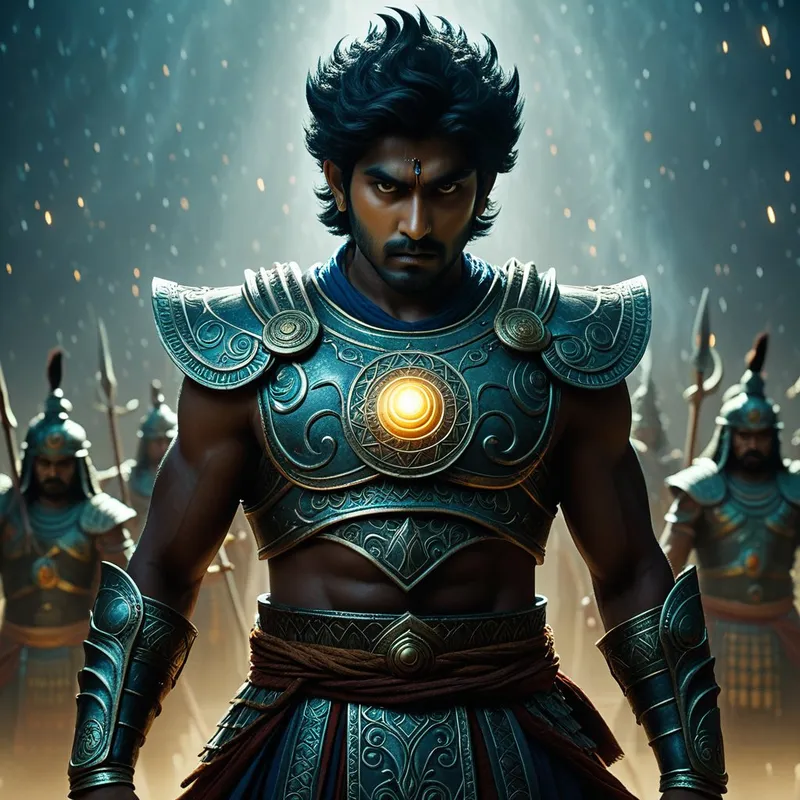
The Pandava host trembled. None among them, save the great [Arjuna](/myths/arjuna “Myth from Hindu culture.”/), possessed the full knowledge to breach and dismantle this living maze. But [Arjuna](/myths/arjuna “Myth from Hindu culture.”/) was drawn away, lured by a distant feint. Despair threatened to unravel their cause. Then, from among them, a youth stepped forward. He was Abhimanyu, sixteen summers old, his eyes burning with a fire inherited from his father and his uncle, Sri [Krishna](/myths/krishna “Myth from Hindu culture.”/).
He had heard the secret once, in [the womb](/myths/the-womb “Myth from Various culture.”/). His mother, Subhadra, had listened as Krishna narrated the art of entering the invincible formation to Arjuna. But she had fallen asleep before hearing [the way](/myths/the-way “Myth from Taoist culture.”/) out. This partial knowledge—this half-heard song of strategy—was now the only hope. With the blessings of his elders, Abhimanyu mounted his chariot. He was not a boy riding to war; he was a spark flying into the heart of a whirlwind.
He breached the outer wheel with the fury of a monsoon wind, his arrows creating a tempest. He passed the second, then the third, his movements a divine dance of destruction, following the half-remembered map etched in his soul. The Kaurava warriors fell before him, astonished by this tempest in human form. He reached the very core, the eye of the storm, a lone hero surrounded by a sea of enemies. But there, the music stopped. The knowledge ended. The exit was a door he had never been shown.
The rules of war were abandoned. On the order of Dronacharya himself, seven great Kaurava warriors—including his uncle [Karna](/myths/karna “Myth from Hindu culture.”/) and the cunning Duryodhana—simultaneously attacked the single, isolated youth. His chariot was shattered, his bowstring cut, his horses slain. On the ground, weaponless, he fought with the wheel of his broken chariot, a final, futile turning against the greater wheel that enclosed him. And thus, the luminous spark was extinguished, not by a worthy duel, but by the crushing, inexorable turning of the wheel he had dared to enter with only half the key.
Cultural Origins & Context
The myth of the Chakra Vyuha is a pivotal episode from the Mahabharata, an epic of staggering complexity that serves as a foundational cultural, philosophical, and narrative pillar for the Hindu world. It was not merely a story of battle, but a teaching parable embedded within a greater teaching parable. Passed down orally for centuries by [bards](/myths/bards “Myth from Celtic culture.”/) and ritual reciters known as kusilavas, before being codified in Sanskrit, its function was multifaceted.
In the warrior Kshatriya culture it depicts, it glorified specific martial virtues: valor (shaurya), duty ([dharma](/myths/dharma “Myth from Hindu culture.”/)), and sacrificial heroism. Yet, simultaneously, it served as a profound critique of the very war it described. Abhimanyu’s [death](/myths/death “Myth from Tarot culture.”/) is not a clean, heroic end but a brutal, unjust slaughter that highlights the moral decay and adharmic compromises of the Kurukshetra war. The story was a societal mirror, used to discuss the ethics of conflict, the burdens of partial knowledge, and the tragic cost when elders fail the young. It was a collective warning and a lament, ensuring that the listener admired the hero’s courage while grieving the failure of the world that surrounded him.
Symbolic Architecture
At its core, the [Chakra](/symbols/chakra “Symbol: In Hindu and yogic traditions, chakras are energy centers along the spine that govern physical, emotional, and spiritual well-being.”/) Vyuha is the archetypal [symbol](/symbols/symbol “Symbol: A symbol can represent an idea, concept, or belief, serving as a powerful tool for communication and understanding.”/) of the inescapable complex. It is not a random [maze](/symbols/maze “Symbol: A maze represents confusion, complexity, or a search for truth, often reflecting life’s challenges or inner turmoil.”/) but a perfect, logical, and beautiful [pattern](/symbols/pattern “Symbol: A ‘Pattern’ in dreams often signifies the underlying structure of experiences and thoughts, representing both order and the repetitiveness of life’s situations.”/) that becomes a [prison](/symbols/prison “Symbol: Prison in dreams typically represents feelings of restriction, confinement, or a lack of freedom in one’s life or mind.”/). It represents any self-reinforcing [system](/symbols/system “Symbol: A system represents structure, organization, and interrelated components functioning together, often reflecting personal or social order.”/)—psychological, social, or karmic—that draws one in with apparent promise or necessity, only to trap and consume.
The labyrinth is not made of stone, but of the logic of your own life, turning inwards until the center is a cage.
Abhimanyu symbolizes the nascent, courageous [consciousness](/symbols/consciousness “Symbol: Consciousness represents the state of awareness and perception, encompassing thoughts, feelings, and experiences.”/), the heroic [impulse](/symbols/impulse “Symbol: A sudden, powerful urge or drive that arises without conscious deliberation, often linked to primal instincts or emotional surges.”/) of [the ego](/myths/the-ego “Myth from Jungian culture.”/) that must confront the overwhelming structures of the unconscious or the world. His partial [knowledge](/symbols/knowledge “Symbol: Knowledge symbolizes learning, understanding, and wisdom, embodying the acquisition of information and enlightenment.”/) is the universal [human](/symbols/human “Symbol: The symbol of a human represents individuality, complexity of emotions, and social relationships.”/) [condition](/symbols/condition “Symbol: Condition reflects the state of being, often focusing on physical, emotional, or situational aspects of life.”/): we enter [life](/symbols/life “Symbol: The symbol of ‘Life’ represents a journey of growth, interconnectedness, and existential meaning, encompassing both the joys and challenges that define human experience.”/)’s great challenges—relationships, careers, spiritual quests—with only half the instructions. We know how to begin, driven by instinct and half-understood wisdom, but the knowledge of how to navigate the full consequence, or how to exit a toxic pattern, is often learned only through devastating experience.
Dronacharya represents the [archetype](/symbols/archetype “Symbol: A universal, primordial pattern or prototype in the collective unconscious that shapes human experience, behavior, and creative expression.”/) of the Ambiguous [Father](/symbols/father “Symbol: The father figure in dreams often symbolizes authority, protection, guidance, and the quest for approval or validation.”/) or the [Guru](/symbols/guru “Symbol: A Guru represents a teacher or guide, often embodying wisdom, knowledge, and spiritual insight.”/) in [Shadow](/symbols/shadow “Symbol: The ‘shadow’ embodies the unconscious, repressed aspects of the self and often represents fears or hidden emotions.”/). He is the [creator](/symbols/creator “Symbol: A figure representing ultimate origin, divine power, or profound authorship. Often embodies the source of existence, innovation, or personal destiny.”/) of the perfect, deadly system, the representative of an order that has become rigid and destructive. His breaking of the [warrior](/symbols/warrior “Symbol: A spiritual archetype representing inner strength, discipline, and the struggle for higher purpose or self-mastery.”/)’s code to kill Abhimanyu signifies the [moment](/symbols/moment “Symbol: The symbol of a ‘moment’ embodies the significance of transient experiences that encapsulate emotional depth or pivotal transformations in life.”/) when the structures meant to protect and educate (society, tradition, the superego) turn against the individual’s authentic, brave becoming.
The Dreamer’s Resonance
When the Chakra Vyuha appears in the modern dreamscape, it rarely manifests as ancient warriors. Instead, the dreamer may find themselves in a endlessly turning parking garage, a corporate office where every hallway leads back to the same stressful meeting, or a social situation that spirals into inescapable anxiety. The somatic feeling is one of mounting dread, constriction, and futility—the heart pounding as the walls (literal or metaphorical) close in.
This is the [psyche](/myths/psyche “Myth from Greek culture.”/) signaling a state of entrapment within a complex. The dreamer is in the position of Abhimanyu: they have courageously entered a situation (a job, a relationship, a personal project) but now feel isolated, overwhelmed, and attacked from all sides by competing demands or internal critics. The missing “knowledge of exit” is the unconscious insight or [the self](/myths/the-self “Myth from Jungian culture.”/)-permission they have not yet granted themselves—the ability to say “no,” to change course, or to seek help. The dream is a stark depiction of a psychological process where the ego feels shattered by a pattern it cannot solve with its current awareness.

Alchemical Translation
The alchemical journey modeled by this myth is not one of triumphant conquest, but of sacred sacrifice and the transmutation of partial knowledge into tragic wisdom. The individuation process often requires an “Abhimanyu phase.” We must, with the courage of the hero, enter the deepest, most complex patterns of our psyche—our childhood wounds, our inherited traumas, our addictive loops. We enter with only partial consciousness, the little light we have.
The shattering of the heroic ego at the center of the wheel is not the end of the story, but the necessary condition for a deeper intelligence to be born.
The “death” of Abhimanyu is the symbolic death of the ego’s illusion that it can solve the deepest complexes through force of will alone. His destruction by the collective shadow (the seven warriors) represents the painful but necessary dissolution of an old attitude. This death, however, is not futile. In the epic, it becomes the turning point, the unforgivable act that galvanizes [the Pandavas](/myths/the-pandavas “Myth from Hindu culture.”/) and deepens their resolve. Psychologically, this translates to the moment a painful failure or breakdown ceases to be a source of shame and becomes the non-negotiable catalyst for profound change.
The alchemical gold is forged here. The knowledge of how to enter (our ambitions, our relationships) is common. The sacred knowledge, earned through the sacrifice of our innocent striving, is learning how and when to exit—to dissolve the pattern from within by withdrawing our identification with it. We integrate the lesson of Abhimanyu not by avoiding [the spiral](/myths/the-spiral “Myth from Celtic culture.”/), but by entering it consciously, knowing we may be broken, but trusting that from that breaking, a more complete knowing—one that includes the exit—will eventually arise. The wheel turns, and from the center of its crushing logic, a new consciousness is pressed into being.
Associated Symbols
Explore related symbols from the CaleaDream lexicon: