Chado Myth Meaning & Symbolism
A mythic journey where a simple bowl of tea becomes a sacred ritual, weaving together heaven, earth, and humanity in a moment of profound stillness.
The Tale of Chado
Listen, and let the steam of the story rise before you.
In a time when the world was a tapestry of warring clans and restless spirits, there lived a profound weariness in the human heart. The air was thick with ambition and the clatter of swords. Yet, in the quiet mountains, a different kind of seeking was stirring. It was not for land or title, but for a moment—a single, perfect moment of peace.
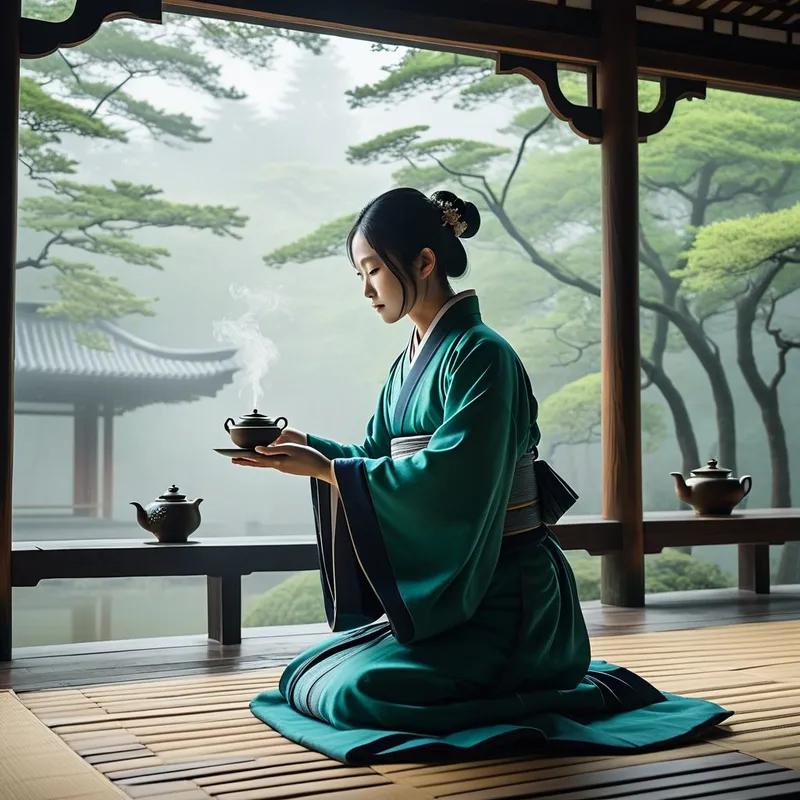
Our tale does not begin with a thunderclap, but with a whisper: the sound of water coming to a boil. In a humble hermitage, a figure sat in absolute stillness. He was no deity, but a seeker, a monk whose eyes had seen too much of the world’s dust. He watched the iron kettle, its lid trembling with the pent-up song of the heated water. Outside, a single leaf, gold and crimson, spiraled down from the maple tree and came to rest upon the moss.
With a cloth as worn as time, he purified the utensils: the bamboo whisk, the tea caddy of lacquer, the bowl born from fire and earth. Each motion was not a chore, but a prayer—a deliberate erasing of the self. He measured the powdered green tea, vibrant as crushed jade, and placed it into the bowl’s waiting hollow.
Then came the water. Not poured, but welcomed. A soft, cascading stream meeting the powder. And then, the whisking. In the silent hermitage, the sound was everything: a swift, rhythmic whisper, like wind through bamboo, like a heart finding its true tempo. A universe was being stirred into being in that clay vessel. A froth, fine and jade-green, blossomed on the surface, a fleeting island of perfect foam.
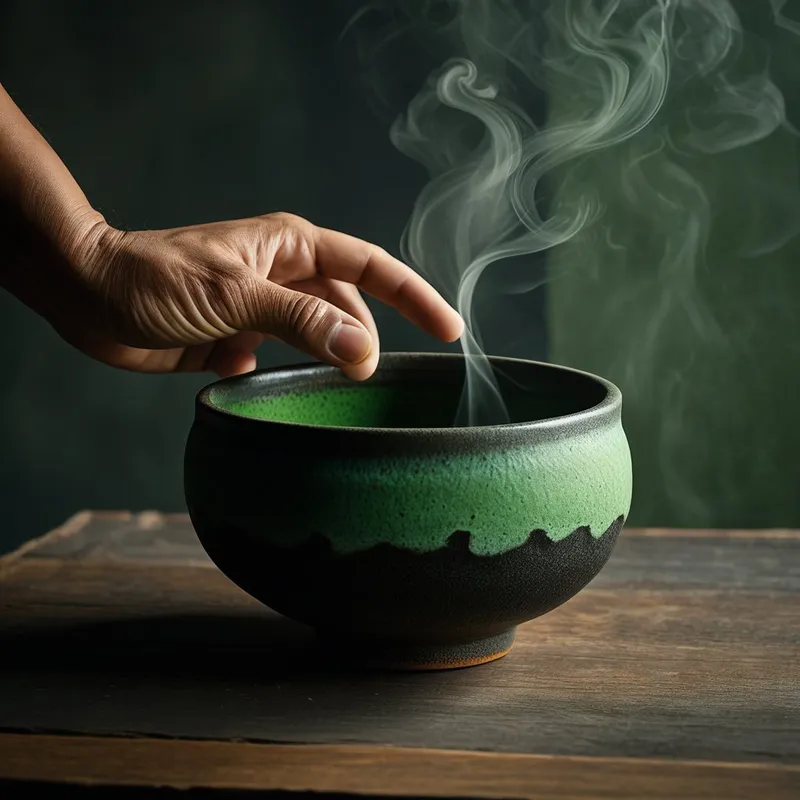
He lifted the bowl. He turned it, not to admire, but to honor its imperfection, the kiln-mark that was its soul. And then, he drank. Not to quench a thirst, but to meet the world. In that bitter-sweet sip, he tasted the mountain mist, the patience of the clay, the fire of the kiln, the labor of the grower, and the silence of his own mind, finally stilled. For a breath, heaven, earth, and humanity were not three things, but one single, seamless experience. The conflict of the age was not resolved by a sword, but dissolved in a bowl. The rising action was the breath before the sip; the resolution was the breath after.
Cultural Origins & Context
The myth of Chado, the Way of Tea, is not a singular story etched in an ancient text, but a living narrative woven into the fabric of Japanese history. Its origins are deeply entwined with the arrival of tea from China and its adoption within Zen Buddhist monasteries in the Kamakura and Muromachi periods. Here, tea was initially a medicinal aid to keep monks alert during long meditation sessions.
The societal function of Chado evolved dramatically. From monastic practice, it was adopted by the warrior samurai class, for whom the intense, ritualized focus of the tea ceremony became a form of spiritual and mental training—a way to cultivate composure and clarity before battle or political intrigue. Later, under masters like Sen no Rikyu, it transformed into a profound aesthetic and philosophical discipline. Rikyu championed wabi-sabi—the beauty of imperfection, impermanence, and rustic simplicity. The tea ceremony became a counter-cultural act, a silent critique of gaudy materialism and a way to forge genuine human connection (ichigo ichie—"one time, one meeting") in a rigidly hierarchical society. It was passed down not merely as a technique, but as an embodied story, told through the careful placement of a flower, the texture of a bowl, and the shared silence between host and guest.
Symbolic Architecture
The myth of Chado is a symbolic map for constructing a sacred world within the ordinary. Every element is an archetypal actor.
The chashitsu, the tiny tea hut, is the temenos—the sacred, bounded space where the profane world is left behind. The low entrance, the nijiriguchi, forces all who enter to bow, symbolically shedding social status and ego.
The bowl does not hold tea; it holds a universe in suspension. The host does not perform a ritual; they midwife a moment from eternity.
The utensils are the humble vessels of the divine. The raku bowl, with its deliberate asymmetry and rough texture, symbolizes the acceptance of one’s own flawed, earthly nature as the very container for grace. The act of whisking is the dynamic union of opposites—the vigorous, masculine action creating the soft, feminine froth—a coniunctio oppositorum in miniature. The bitter taste of the matcha is the necessary nigredo, the darkening, the acknowledgment of life’s suffering and impermanence, which makes the subsequent moment of harmony so profoundly sweet.
The Dreamer's Resonance
When the archetypal patterns of Chado surface in modern dreams, they often signal a psyche yearning for integration and conscious ritual. To dream of preparing tea with intense, slow focus may not be about tea at all. It is the somatic expression of a need to "prepare the self"—to purify one’s inner space, to measure out one’s energies with care, and to consciously blend disparate aspects of the personality.
A dream of being a guest, receiving a bowl, speaks to a readiness to accept a gift of insight or a moment of peace being offered, perhaps by the Self. Conversely, anxiety about spilling the tea or using the wrong utensil mirrors the ego’s fear of performing life incorrectly, of failing the ritual of being. The dream is initiating a psychological process of moving from chaotic, automatic living (profane time) into deliberate, embodied presence (sacred time). It is the unconscious advocating for a ceremony of the soul.

Alchemical Translation
The alchemy of Chado is a masterclass in psychic transmutation. It models the entire individuation process. First, the separatio: leaving the worldly concerns at the garden gate. Then, the purificatio: cleansing the tools, which is the cleansing of one’s perceptions and intentions. The mixing of the elements—earth (tea powder), water, air (whisking), and fire (the boiled water)—represents the conscious engagement with and blending of the four functional types of consciousness: sensation, feeling, thinking, and intuition.
The goal is not to become a master of tea, but to allow tea to master you—to dissolve the artificer into the art, until only the act remains.
The core triumph is not in creating a perfect bowl, but in fully inhabiting the flawed process. This is the alchemical gold: the realization that the sacred is not a distant realm, but the quality of attention brought to the here and now. The bitter powder of raw experience is whisked with the hot water of conscious engagement until it transforms into a unified, palatable whole. The modern individual, besieged by fragmentation and noise, is called to become both host and guest in their own life. To build a simple chashitsu within—a space of inner stillness—and to perform, again and again, the radical ritual of showing up, fully, for a single, steaming moment of their own existence. In this, the myth of Chado reveals its ultimate secret: the Way of Tea is, and has always been, the Way of Life, consciously lived.
Associated Symbols
Explore related symbols from the CaleaDream lexicon: