Cernunnos Myth Meaning & Symbolism
The myth of the antlered god who dwells at the world's heart, master of beasts and cycles, embodying the untamed soul of nature and psyche.
The Tale of Cernunnos
Listen. The world is not as flat as you believe. There are places where the veil is thin, where the roots of the great oaks plunge not into soil, but into the dark, singing heart of the earth. Go there, at the hinge of the day, when light bleeds into shadow. Push past the bramble and the birch, into the clearing that was never made by human hands.
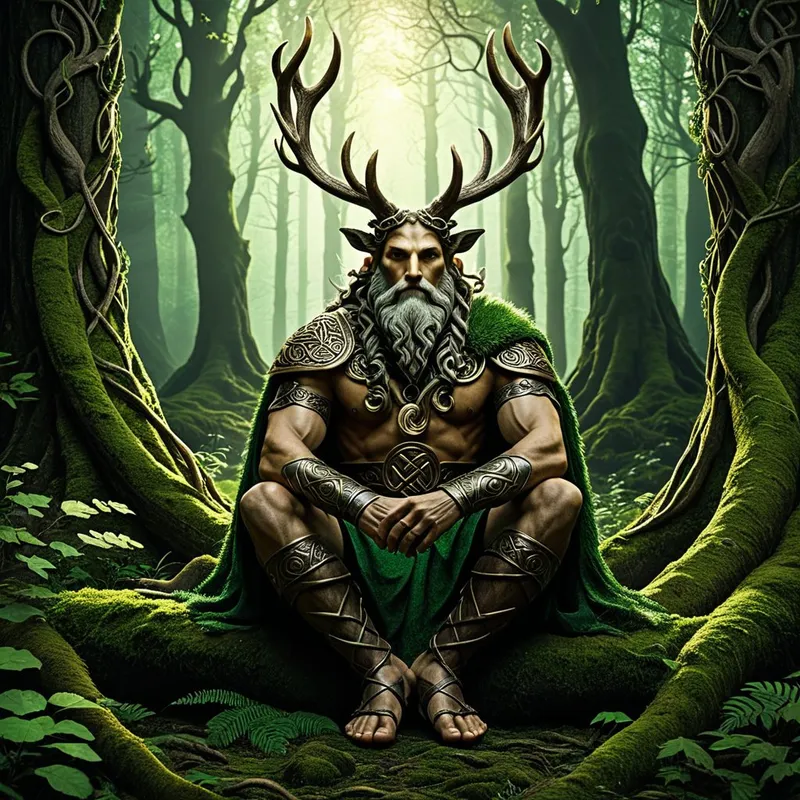
Here, the air is thick with the scent of damp moss, rich loam, and the musk of sleeping creatures. The light is a filtered gold, falling in shafts that illuminate motes of pollen like drifting stars. In the center, where the roots of the oldest tree rise from the ground to form a natural throne, he sits.
He is the Cernunnos. From his brow rise the antlers of a great stag, not as a helmet, but as a living crown, a branching testament to cycles of shedding and regrowth. They are hung with the vines of the forest, and at their tips, perhaps, a single, perfect apple of the Otherworld glows. His eyes are pools of ancient stillness, holding the patience of stone and the quickness of a hunting fox. In one hand, he holds a torc, the symbol of nobility and sovereignty, its open circle an invitation. Coiled around his other arm, or perhaps offered from his open palm, is a serpent with the head of a ram, a creature of chthonic wisdom and fertile power.
He does not speak. The language here is older. The rustle of his breath is the wind in the high branches. The beat of his heart is the slow, deep pulse of the land itself. To this silent court come the beasts: the proud stag, lord of the wood; the watchful wolf, keeper of the pack; the rooting boar, fierce and fertile. They do not cower or hunt. They gather. They are an assembly of the wild soul, a parliament of untamed instincts, and he is their calm center, the point of balance where predator and prey find a truce in a deeper belonging.
He offers the torc. It is an offering not of domination, but of connection—a binding to the law of the green world, a pact of mutual belonging. The ram-headed serpent whispers secrets of the underworld, of the riches that coil in the dark soil and in the dark of the mind. This is not a story of battle or quest, but of profound, still presence. It is the tale of the moment when the frantic human mind grows quiet enough to hear the older song, to see the lord who was always waiting at the crossroads of nature and spirit, holding the circle of life and death in his timeless hands.
Cultural Origins & Context
The figure we call Cernunnos emerges from the misty tapestry of pre-Roman Gaul and the wider Celtic world. Unlike the myths of Greece or Rome, preserved in epic poems, his story was not written down by his own people. The Celts held their sacred knowledge in an oral tradition, entrusted to the memory of the druids. What remains of him are whispers in stone: iconography on the Pillar of the Boatmen in Paris, and on the Gundestrup Cauldron.
These artifacts show us a god in the lotus position, a master of animals, adorned with torcs and accompanied by the stag and the serpent. His societal function was likely multifaceted. As a lord of animals, he governed the hunt and the bounty of the wild, a critical concern for survival. As a god depicted with torcs—symbols of tribal authority and wealth—he was a bestower of sovereignty and earthly prosperity. Most profoundly, his antlers, which shed and regrow annually, tied him irrevocably to the cycles of death and rebirth, the turning of the seasons, and the fertility of the land. He was the embodiment of the untamed, animating spirit of the natural world, a psychopomp figure who could navigate the boundaries between the human community, the wild forest, and the Otherworld.
Symbolic Architecture
Cernunnos is not a god of one thing, but of the synthesis of opposites. He is the symbolic architecture of the integrated Self.
The antlered one sits at the axis mundi, where the wild and the civilized, the mortal and the eternal, the beast and the god, are revealed as a single, breathing entity.
His antlers are his primary symbol: they reach toward the sky, connecting him to the celestial, yet they are grown from the body, a product of the earth. Their annual cycle is a perfect metaphor for the psyche's need for periodic dissolution (shedding old identities, patterns) and renewal. The torc represents the closed circle of the individual ego, but in his hand, it is often open, suggesting that true sovereignty comes from connecting this ego-circle to the greater, wild circle of nature and the unconscious. The ram-headed serpent is a profound hybrid: the serpent, a near-universal symbol of chthonic knowledge, instinct, and rebirth, fused with the ram, a symbol of assertive force (Aries) and fertility. This creature signifies the guiding, intelligent force within our deepest, most primal energies.
Finally, his role as Master of Animals symbolizes the integration of our own inner "animal" instincts—aggression, sexuality, fear, nurturing—not through domination, but through peaceful acknowledgment and governance. He represents the state where our complex, often conflicting inner drives are gathered into a harmonious whole.
The Dreamer's Resonance
When the archetype of the Horned God stirs in the modern dreamscape, it often signals a profound call from the deep psyche. One does not dream of Cernunnos in times of calm, linear progress, but at thresholds.
The dreamer may find themselves in a dense, ancient forest, feeling both lost and strangely at home. They may encounter a stag of impossible size and dignity, whose gaze holds a deep, silent intelligence. They may discover they are growing antlers, or feel the presence of a powerful, non-human consciousness in a natural setting. Somatic sensations often accompany these dreams: a feeling of roots growing from one's feet, the stirring of a deep, visceral energy in the gut or spine, or a profound, earthy calm.
Psychologically, this is the process of confronting and integrating the Shadow and the instinctual self. The civilized persona, built for efficiency and social approval, has perhaps grown too distant from the wild, creative, and cyclical nature of the soul. The dream is an invitation—or a demand—to sit in the inner clearing, to listen to the older rhythms, and to make peace with the untamed powers that dwell within. It is the psyche's way of initiating a reunion with the foundational, biological, and spiritual ground of being.
Alchemical Translation
The alchemical process mirrored in the myth of Cernunnos is that of the coniunctio oppositorum—the sacred marriage of opposites. For the modern individual, his silent vigil in the forest clearing models the core of Jungian individuation.
The journey is not to conquer the wilderness, but to become the clearing within it. To be the still point where all dualities—light and dark, growth and decay, spirit and matter—are held in conscious tension.
The first stage is Nigredo, the descent into the forest (the unconscious). We leave the well-trodden paths of our conditioned identity. This is often a dark, confusing, or fertile period of depression, creativity, or crisis, where our old "antlers" (identities, achievements) feel shed.
The second is Albedo, the encounter in the clearing. Here, in the reflective space of mindfulness, therapy, or deep introspection, we meet the archetype. We face our inner animals—our repressed passions, fears, and primal drives. We see the torc of our own sovereignty and the serpent of our deep wisdom. This is the whitening, the illumination, where we simply observe without judgment.
The final stage is Rubedo, the integration. This is not depicted as a battle, but as a seated, sovereign presence. The reddening is the warmth of life returning, but now coursing through a unified system. The individual learns to "wear" their antlers—their connection to cyclical growth and spiritual aspiration—while keeping their feet on the fertile ground of instinct and reality. They become the master of their own inner animals, not by caging them, but by granting them a respected place in the psychic ecology. The goal is to become, like Cernunnos, the mediating center of one's own world, rooted in nature, open to spirit, and sovereign in one's authentic, wholly integrated being.
Associated Symbols
Explore related symbols from the CaleaDream lexicon: