Centéotl Myth Meaning & Symbolism
The myth of the maize deity who descends into the underworld, is sacrificed, and is reborn as the sacred corn that sustains all life.
The Tale of Centéotl
Listen. The world was hungry. The sun, Tonatiuh, blazed across a barren sky, and the people’s bellies were hollow drums echoing with want. They had forgotten the taste of sustenance, the feel of fullness. Their prayers were dry whispers lost in the wind.
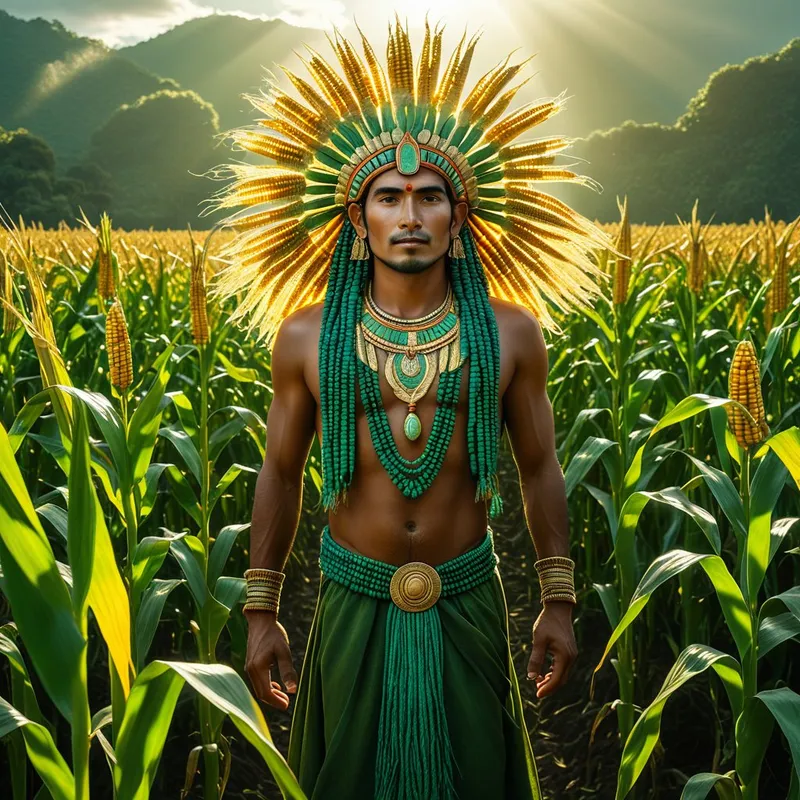
But in the verdant, hidden heart of Tamoanchan, a god was stirring. He was Centéotl, the essence of the young maize, son of the earth goddess Tlazolteotl. His skin was the pale green of a new shoot, his hair the fine silk of the corn tassel. He carried within him the secret of life—not the life of warriors or kings, but the humble, profound life of the stalk and the kernel. He heard the hunger of the world, and it pained him like a wound.
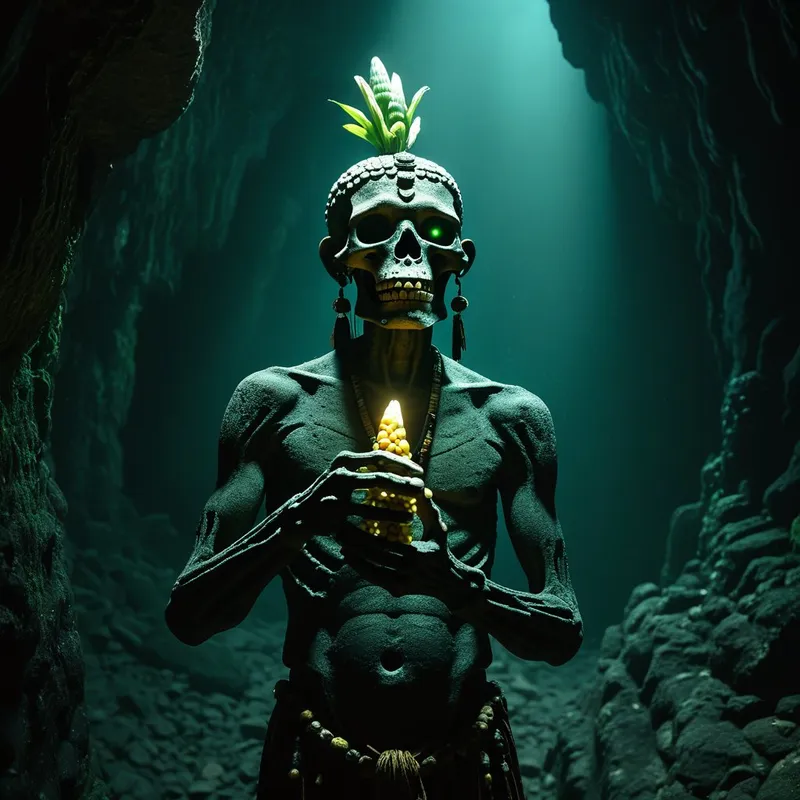
His journey was not to conquest, but to descent. He turned from the world of light and walked the path to Mictlan, the nine-layered realm of shadows ruled by the skeletal lord Mictlantecuhtli and his consort Mictecacihuatl. The air grew cold and thick. The laughter of birds was replaced by the sighing of lost souls. He crossed the river of blood with the help of the red-haired dog, Xoloitzcuintli, its eyes glowing like embers in the gloom.
In the deepest chamber, where darkness was a substance, he stood before the bone-throne. Mictlantecuhtli’s empty sockets regarded him. “Why does the green god come to the land of dust?” the death lord rasped. “I come for the seeds,” Centéotl said, his voice steady despite the chill. “The seeds of maize that were hidden here at the dawn of time. I will take them to the world above, to end the hunger.”
The Lord of the Dead let out a sound like grinding stones—a laugh. “Nothing leaves Mictlan. But you may try. If you can sound a conch shell that does not sound, and carry the seeds past my guardians without waking them, they are yours.”
Centéotl accepted. He took the silent conch and blew. No mortal breath could make it sound, but his breath was the wind of life itself. A deep, mournful note echoed through the silent halls, a sound of such longing it stirred the dust of millennia. The guardians, monstrous beings of shadow, did not stir; they were enchanted by the sound of a world they had forgotten.
He gathered the precious seeds—hard, jewel-like kernels of potential—into a pouch made of his own cloak. But as he turned to leave, Mictlantecuhtli, enraged by the god’s success, caused a great pit to open in the floor. Centéotl fell, and in the fall, the seeds were scattered across the cavern floor, lost in the dust and bones.
This was not defeat. It was the necessary step. Centéotl did not search for the seeds. Instead, he lay down upon the cold earth of Mictlan. He offered himself. “Take my body,” he said to the dark earth. “Let my flesh be the soil, my blood the water. From me, let the seeds grow.”
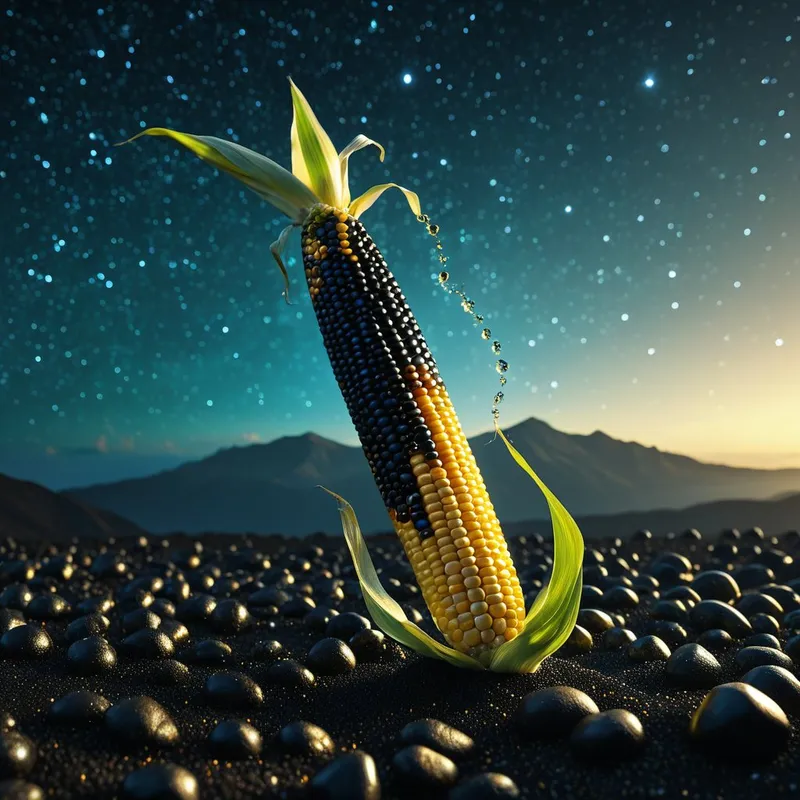
And so it was. The gods of death watched as the young god’s form dissolved into the underworld floor. Where his heart had been, a green shoot pushed through the stone. Where his limbs lay, roots spread deep. From his body, nourished by his own sacrifice, the scattered seeds sprouted. They grew with impossible speed, stalks piercing the layers of Mictlan, bursting through the crust of the mortal world into the blazing light of Tonatiuh.
The people saw a miracle: a field of golden maize where there had been only dust. They ate, and were filled. They understood. The food that sustained them was not simply a plant. It was a god who had journeyed into death and given himself utterly, so that life might continue. Centéotl was gone. And yet, in every kernel, in every bite, he was eternally reborn.
Cultural Origins & Context
The myth of Centéotl is woven deeply into the fabric of Mesoamerican civilizations, most prominently among the Nahua peoples, including the Aztecs (Mexica). This was not a mere story for entertainment; it was a sacred narrative that explained the fundamental, terrifying, and beautiful reality of existence. It was told by priests (tlamatinime, “knowers of things”) and elders during key moments in the agricultural calendar—at planting, during the anxious wait for rains, and at harvest.
Its societal function was multifaceted. Primarily, it was a cosmological map. It explained the origin of maize, the staple crop upon which these complex civilizations were utterly dependent. But more profoundly, it established the sacred contract between humanity, the divine, and the earth. The sustenance of life was revealed to be a direct product of divine sacrifice. This mirrored and justified the central ritual practice of these cultures: human sacrifice and bloodletting (autosacrifice). Just as Centéotl gave himself to the earth to produce food, so too did humans need to offer their most precious substance—life-force, embodied in blood and heart—to nourish the gods and ensure the continued cycle of sun, rain, and harvest. The myth was the theological bedrock for a world-view where death was not an end, but a necessary fertilizer for life.
Symbolic Architecture
At its core, the myth of Centéotl is an archetypal drama of nourishment and the price of creation. Centéotl is not a warrior-hero who conquers through strength, but a caregiver-hero who transforms through surrender. He represents the principle that what truly feeds us—be it physical food, love, knowledge, or spirit—must often undergo a dissolution of its previous form.
The seed cannot become the stalk unless it ceases to be a seed. The god cannot become food unless he ceases to be a separate god.
His descent into Mictlan symbolizes a journey into the unconscious, the fertile but terrifying realm of potential that exists before form. The seeds hidden there are latent possibilities, the unmanifested blueprints for life. The challenges set by Mictlantecuhtli represent the psyche’s resistance to releasing its hidden treasures; they guard their depth out of a kind of sterile inertia. Centéotl’s ultimate sacrifice—the willing dissolution of his own identity—is the critical alchemical moment. The ego-structure (the individual god) must break down and merge with the matrix (the underworld earth) to activate the potential within it. The resulting maize is the conjunctio, the sacred union of spirit (the god) and matter (the earth), producing a third, nourishing substance that sustains the world above.
The Dreamer's Resonance
When this myth stirs in the modern dreamer, it often manifests not as a literal narrative, but as a somatic and symbolic pattern centered on nourishment and its cost. You may dream of burying a precious possession—a jewel, a book, a photograph—in dark soil, feeling both grief and a strange certainty. You may dream of being lost in a vast, internal library or warehouse (the underworld) searching for a specific, vital ingredient or recipe. There is a profound hunger in these dreams, but it is often unclear what will satisfy it.
Psychologically, this indicates a process where a part of the psyche that has provided identity or comfort (a talent, a relationship, a long-held belief) is being called to undergo a death. The dream-ego feels the hunger for the next stage of growth, but the old form of nourishment is no longer sufficient. The descent is the necessary, often frightening, period of composting—of allowing old structures to break down in the dark so that a new, more nourishing form of energy can emerge. The anxiety in the dream is the resistance of the Mictlantecuhtli complex: the part of us that would rather keep things sterile, controlled, and separate, even if it means starvation.

Alchemical Translation
For the modern individual navigating the path of individuation, Centéotl’s myth models the process of psychic transmutation through nourishing sacrifice. Our culture often glorifies acquisition and accumulation—of wealth, status, achievements. The Centéotl archetype proposes the opposite path: fulfillment through deliberate, sacred expenditure.
The first step is hearing the “hunger of the world”—which is also the hunger of our own unlived life, our stifled creativity, or our arid spirituality. This calls us to descend, to voluntarily enter a period of introspection, withdrawal, or depression (nigredo). This is our Mictlan. Here, we must confront the “Lord of the Dead” within—our own rigidity, cynicism, or fear of loss—who guards the seeds of our potential.
The alchemy occurs not in the claiming of the treasure, but in the decision to become the soil for it.
The triumph is not in escaping the underworld with the prize intact, but in the courageous surrender. It is the decision to invest our life-force—our time, our passion, our vulnerability—into a project, a relationship, or a new way of being, with no guarantee of return in its original form. We scatter the seeds of our effort (the failed attempts, the rejected work, the emotional risks) and then we “lie down” upon them. We allow our old self-conception to decompose to feed the new growth.
What sprouts is the lapis, the philosopher’s stone of this process: not a golden statue of the self, but a sustainable, nourishing capacity. The transmuted individual doesn’t just “have” a skill or love; they become a source of genuine nourishment for themselves and their world. They understand, in their bones, that their deepest vitality is cyclical, requiring periods of death and rebirth. In every act of true creation or care, they, like Centéotl, are both the sacrifice and the everlasting harvest.
Associated Symbols
Explore related symbols from the CaleaDream lexicon: