
Centeotl Myth Meaning & Symbolism
A god of maize is born from sacrifice, buried, and reborn, embodying the sacred cycle where death becomes the sustenance for all life.
The Tale of Centeotl
Listen. The story begins not with a cry, but with a silence. The silence of the Fifth Sun, Tonatiuh, hanging motionless in a sky of polished turquoise. The earth below was a barren, cracked plate of stone and dust. The people, the Mexica, were hollow vessels, their bellies aching with a hunger that was more than physical. It was a hunger of the spirit, a longing for the world to be made.
In the celestial realms, the gods convened. Their voices were the rumble of distant thunder. The great Quetzalcoatl spoke, his plumes shimmering with the colors of dawn and storm. "The sun demands payment. The earth demands a gift. Life cannot be drawn from nothing. It must be transformed."
And so, the divine sacrifice was chosen. Not in anger, but in profound, terrible love. The goddess Xochiquetzal, more radiant than all flowers, descended to the barren world. She did not walk upon the dust; she lay upon it, her form merging with the cracked earth. From her divine flesh, a new life was seeded. It was a birth that was also a burial. The earth swallowed her offering, and for a count of days that felt like eternity, the world held its breath.
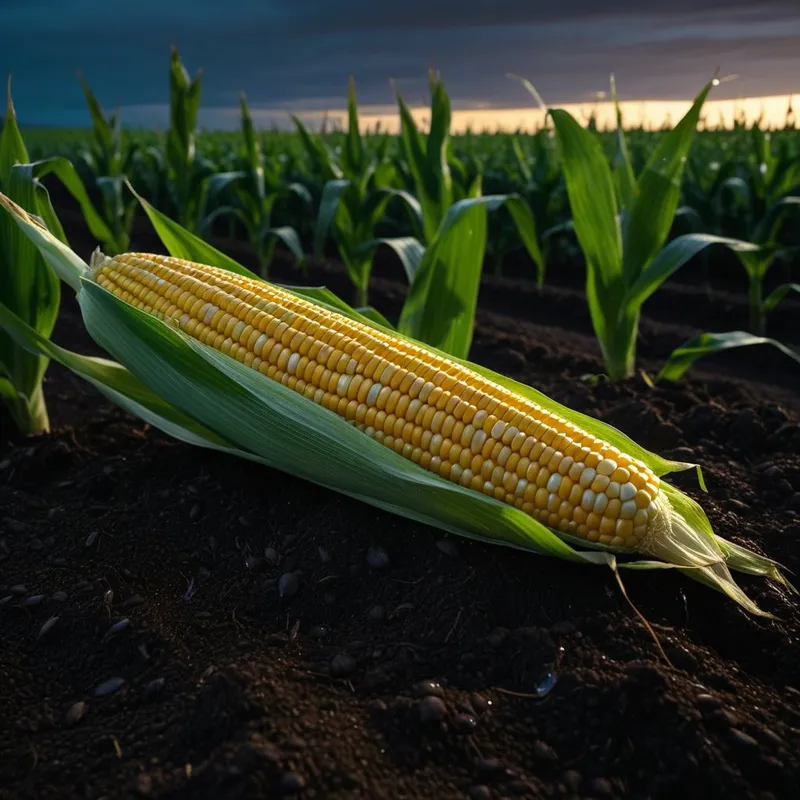
Then, a tremor. A single, green shoot, fragile as a hope, pierced the dark soil. It grew with a speed that was a prayer, unfurling leaves like jade banners, reaching for the demanding sun. From its heart burst a tassel of filaments, fine as spun moonlight. This was Cinteotl, the Young Lord of Maize. He was not born of a womb, but of a willing descent. His body was the stalk, his flesh the sweet kernels, his hair the silken threads. He was the promise made flesh.
But the story does not end with a sprout. The nourisher must himself be nourished. The cycle demands its turn. Cinteotl matured, his cobs swelling with golden life. And when the time of harvest came, it was not a reaping, but a sacred return. The first ripe ear was not taken; it was given back. It was buried in the same dark earth from which he sprang. The flint knife, the tecpatl, did not end him—it completed him. He returned to the dark, to the realm of Mictlantecuhtli, so that from his buried body, a thousand new lives might rise. Death was not an end, but the seed of a deeper beginning. The god who feeds us enters the earth so that we may live. This is the sacred bargain. This is the story written in every kernel.
Cultural Origins & Context
The myth of Cinteotl was not mere entertainment; it was the foundational liturgy of a civilization built on corn. For the Mexica and their neighbors, maize was not just a crop—it was the literal substance of humanity. Myths stated that the gods created humans from maize dough. Therefore, the story of the maize god was the story of humanity's own substance and sustenance.
This narrative was woven into the very fabric of the ritual calendar, particularly during the festivals of Huey Tozoztli and the harvest. It was told by priests, the tlamatinime (knowers of things), and enacted through ceremony. Young women representing Chicomecóatl, the goddess of sustenance and often seen as the mature, female aspect of the maize, carried bundles of seven ears. The first fruits were offered, not consumed. The myth served a critical societal function: it sanctified the agricultural cycle, justified the necessity of sacrifice (both literal and symbolic), and explained the terrifying, beautiful truth that life is utterly dependent on death. It was a cosmology of reciprocity, where humans, gods, and corn were locked in an eternal, sacred exchange.
Symbolic Architecture
At its core, the myth of Cinteotl dismantles the Western dichotomy between life and death, giver and receiver. It presents a model of existence where these states are phases of a single, continuous being.
The nourisher must be nourished. The one who gives life must submit to the earth to become life again. This is the ultimate law of the cosmos: to hold, you must first release.
Xochiquetzal's descent represents the initial investment of consciousness and beauty into the inert material world. Cinteotl is the result of that investment—the tangible, growing manifestation of potential. His subsequent "harvest" and burial symbolize the necessary deconstruction of a mature form. The ego, the individual stalk, must be cut down so that its essence (the seed) can be replanted and multiplied. Psychologically, Cinteotl represents the archetype of the Caregiver, but with a profound twist: this caregiver's strength lies in its vulnerability, its willingness to be consumed and transformed as part of its giving.
The Dreamer's Resonance
When this myth stirs in the modern unconscious, it often surfaces in dreams of profound personal cycles. You may dream of burying a treasured possession only to find a garden has grown from the spot. You may dream of eating a meal that then causes you to dissolve into the earth, feeling not fear but a strange, peaceful fulfillment. You may dream of a green shoot growing from your own chest.
These are somatic visions of a psychic process: the necessary end of a life-phase so a new one can begin. The "hunger" felt in the myth's beginning translates to a modern sense of emptiness, burnout, or creative sterility. The dream is pointing to the buried seed—an old talent, a forgotten passion, a past version of yourself that offered itself up and now awaits its season of rebirth. The process is one of composting the old identity to feed the new. The anxiety in such dreams is not about death, but about the surrender required to enter the fertile dark.
Alchemical Translation
For the individual navigating the path of individuation, Cinteotl offers a masterful blueprint for psychic transmutation. The alchemical solve et coagula (dissolve and coagulate) is vividly enacted: the dissolution of the goddess into earth (solve), the coagulation into the maize god (coagula), and the cycle's repetition at a higher level of yield.
Individuation is not about building a permanent monument of a self. It is about becoming fertile ground for oneself, season after season.
The modern struggle is often to cling to a mature, productive identity—the "ripe corn"—long after its season has passed, fearing the harvest, the knife, the dark earth. The myth insists that our greatest offerings to the world and to our own future selves come from our willingness to be cut down, to let our current form be buried. What we perceive as failure, loss, or ending is, in this symbolic architecture, the act of planting. The ego is the single stalk; the Self is the entire cyclical field. To live the myth is to recognize the moments when we must willingly offer our hard-won maturity back to the unconscious, to the dark, fertile soil of the soul, trusting—not knowing—that this sacrifice is the only way to feed the unimaginable harvests to come. We are both the sower and the seed, the harvester and the harvested, in an endless, sacred round.
Associated Symbols
Explore related symbols from the CaleaDream lexicon: