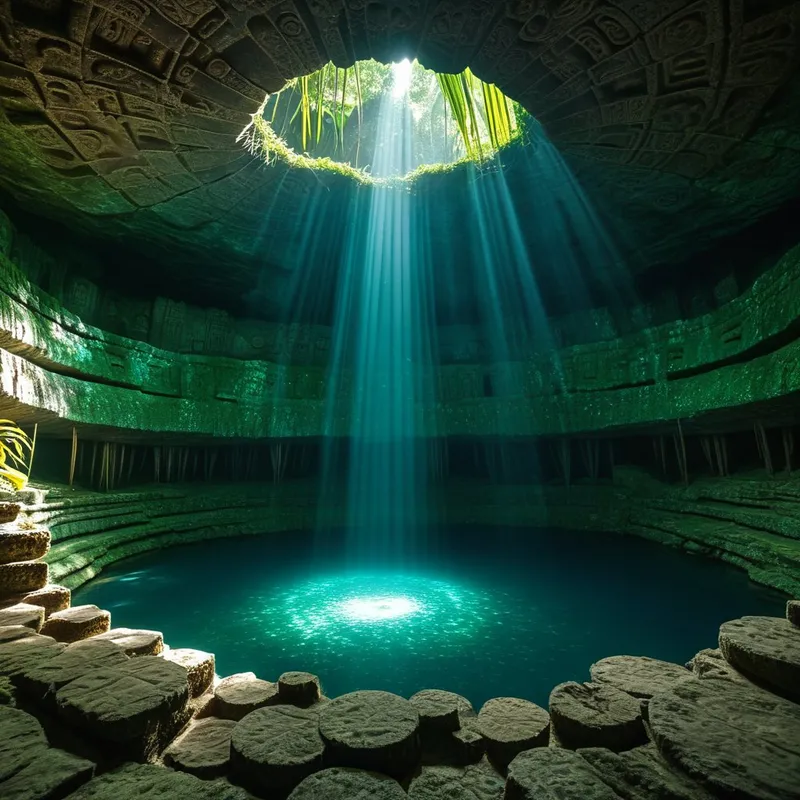
Cenotes Myth Meaning & Symbolism
A myth of sacred sinkholes as portals to the underworld, where life emerges from primordial darkness through sacrifice and the confrontation with death.
The Tale of Cenotes
Listen. The world is not as it seems. The solid earth beneath your feet is a thin crust, a fragile lid over a vast and humming darkness. This is the truth known to the people of the maize, the people of the jaguar sun. And in the land of the ceiba tree, where the howler monkeys cry, there are places where the lid has cracked open. These are the cenotes—the eyes of the earth, weeping clear water, staring into the heart of Xibalba.
In the beginning-time, before the first dawn painted the sky, there was only the black sea of the sky and the restless sea of the underworld. The Lords of Xibalba—One Death and Seven Death, Pus Master and Jaundice Master, Scab Stripper and Blood Gatherer—dwelt in their foul palaces of gloom. They were jealous of the world above, of the green and growing things, of the breath in living lungs. They hungered for it, and so they sent a great thirst upon the land.
The rains ceased. The rivers shrank to dust. The maize stalks withered and bowed. The people cried out to Chaac, he of the lightning axe and the serpentine gaze. But the sky remained a hard, blue bowl. The priests, their bodies painted blue in the color of sacrifice, climbed the pyramids and saw the truth in the smoke. The Lords Below demanded payment. The covenant was broken; life had been taken from the dark without offering something in return.
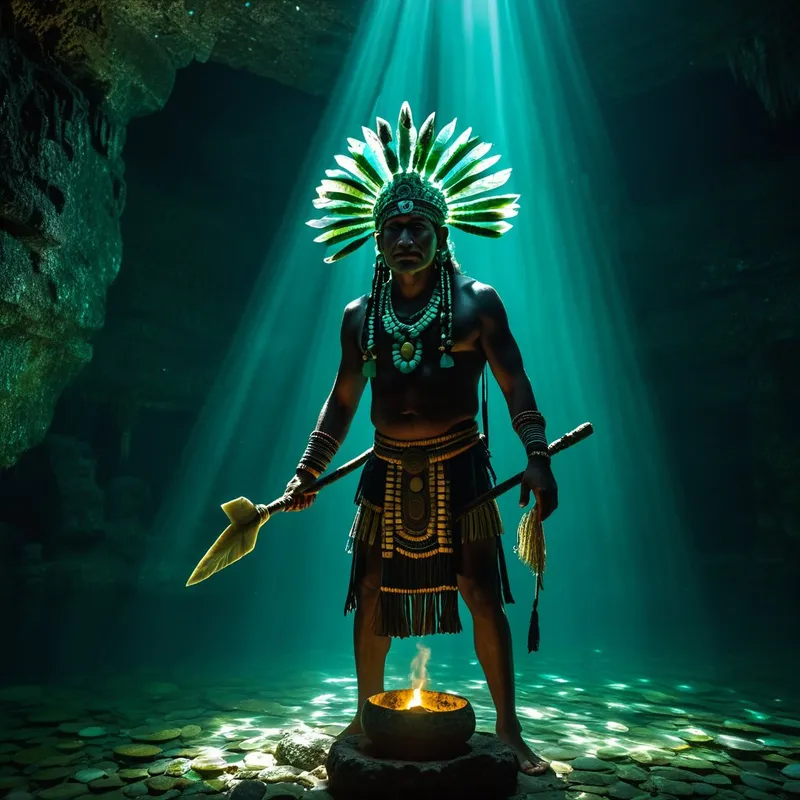
And so, at the lip of the great cenote at Chichén Itzá, the sacred drama unfolded. The air was thick with the scent of copal and fear. Drums beat a rhythm like a slowing heart. A young messenger, chosen for his purity and courage, was adorned not for life, but for the journey. His body was painted sacred blue. Jade beads, the stone of life and water, were placed upon him. He was not thrown, but lowered with reverence, a living prayer descending the rope into the mouth of the world.
Down he went, past the roots of the world tree, into the cool, echoing throat of stone. The shaft of sunlight from above became a distant coin, then vanished. In the absolute blackness, there was only the sound of his own breath and the drip of ancient water. This was the Road of the Hero Twins, the descent into the House of Gloom, the Lying Down Place of the Sun at night. He did not fight. He surrendered. He offered himself to the darkness, to the cold embrace of the water, to the grinning lords who waited in the silent halls.
And in that moment of ultimate offering, the alchemy of the depths began. The messenger did not simply die. He was transformed. His journey, his courage, his very essence became an argument in the court of death. He became an emissary, a seed planted in the dark soil of Xibalba. And from that seed, a miracle grew. Deep in the caverns, where stalactites wept stone tears, a new sound was heard. Not a scream, but a rumble. The echo of a thunder that was not thunder. It was the sound of Chaac’s axe striking the clouds from below.
And then, from the very cenote that had swallowed the offering, the water began to rise. Not as a trickle, but as a cool, clear wellspring, bubbling up from the heart of the darkness itself. The sacrifice had been accepted. The covenant was restored. The water of life, having passed through the realm of death, was returned, purified, and made sacred. The land drank, the maize stood tall, and the people understood: life does not defy death. It emerges from it. The cenote was not a grave. It was a womb.
Cultural Origins & Context
This understanding of cenotes as portals and fonts of sacred life is rooted deeply in the Maya civilization of the Yucatán Peninsula, a land devoid of surface rivers, where these natural limestone sinkholes were the sole source of perennial fresh water. They were not merely geographical features but axis mundi—points where the three realms of the Maya cosmos (heaven, earth, and Xibalba) met.
The myth was lived, not just told. It was enacted in rituals documented by Spanish chroniclers and confirmed by modern archaeology. The Sacred Cenote at Chichén Itzá yielded treasures of gold, jade, and incense burners, but also the bones of men, women, and children. These were likely offerings to Chaac, but also to the lords of Xibalba. The myth provided the sacred logic for this practice: the offering (whether precious object or person) was a symbolic seed cast into the dark to ensure the cyclical return of life-giving water. The story was passed down through priestly lineages, enacted in public ceremonies, and encoded in the very landscape that sustained the people. Its societal function was profound: it explained the terrifying necessity of the natural world, justified sacred rulership (as kings were intermediaries with these forces), and provided a cosmological map for navigating life, death, and renewal.
Symbolic Architecture
At its core, the cenote myth is a master symbol of the paradoxical source. It represents the unconscious itself—the dark, watery, and fecund depths of the psyche from which all consciousness emerges and to which it must periodically return for renewal.
The most vital waters do not fall from the sky, but rise from the confrontation with what lies beneath.
The cenote is the wound in the ego’s certainty, the crack through which the contents of the personal and collective unconscious can surge. The Lords of Xibalba symbolize the autonomous, often terrifying complexes of the shadow—the repressed fears, shames, and ignored aspects of the self that "rule" from below and can blight the conscious "land" if not acknowledged. The sacrificial messenger is the heroic ego, not in its conquering form, but in its role as the willing vessel. His journey is one of katabasis (a deliberate descent), where the goal is not to slay the dragon of the deep, but to be digested by it, to allow the self to be dismantled in service to a greater totality. The returning water is the symbol of transformed life energy—insight, creativity, or emotional renewal—that can only be accessed after such a profound engagement with the inner darkness.
The Dreamer's Resonance
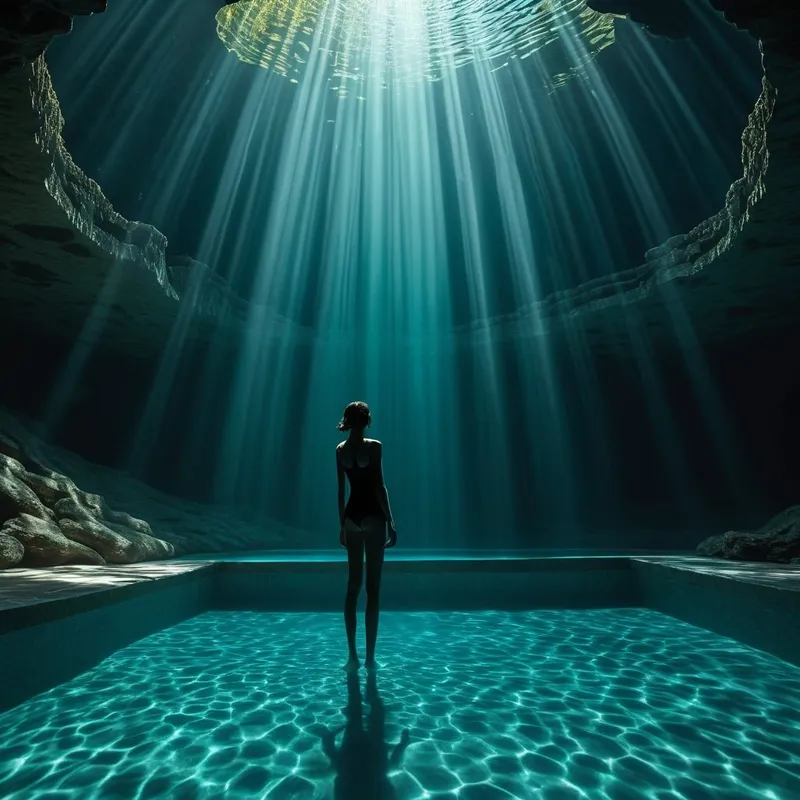
When this mythic pattern stirs in the modern dreamer, it often manifests as dreams of deep water, sudden holes or pits opening in familiar ground, or being drawn into subterranean caves. The somatic feeling is one of both dread and fascination—a gravitational pull toward the unknown depths. Psychologically, this signals a critical phase where the conscious attitude has become arid, one-sided, or stagnant. The psyche is initiating its own ritual of descent.
The dreamer may be the messenger, feeling called or compelled toward a frightening but necessary confrontation—perhaps with a past trauma, a buried emotion, or a life decision that requires the "death" of an old identity. The rising water in the dream, or the feeling of emerging from a dark place into light, signifies the beginning of the renewal phase. This is not a cognitive process but an embodied, often painful, restructuring. The dream is the cenote itself, an opening in the fabric of ordinary reality through which the underworld of the personal unconscious makes its demands known, promising revitalization at the cost of a sacrificial offering of the ego's current form.
Alchemical Translation
The myth of the cenote is a perfect map for the alchemical and Jungian process of individuation—the psychic transmutation of the base self into a more integrated whole. The prima materia, the raw lead of the psyche, is the arid, suffering conscious state, cut off from its instinctual and spiritual roots.
Individuation is not an ascent to purity, but a descent into the muddy, complex springs of one's own nature.
The descent (Nigredo) is the hero's journey into Xibalba: the voluntary confrontation with the shadow, the depression, the confusion, and the "death" of naive self-images. This is the sacrifice, the dissolution in the waters of the unconscious. The confrontation and transformation (Albedo) occurs in the silent darkness of the cenote's depths, where the ego-messenger is stripped and re-contextualized by the lords of the psyche's underworld. It is a passive, suffering stage where one is worked upon by forces greater than the will.
Finally, the return of the waters (Rubedo) symbolizes the creation of the aqua permanens, the permanent water of the philosophers—the flowing, adaptable, and revitalized consciousness that has integrated the lessons of the deep. The Self, in Jungian terms, is the cenote in its totality: the opening, the journey, the dark lords, and the returning spring. It is the paradoxical vessel where life and death, consciousness and unconsciousness, engage in their eternal, nourishing dialogue. To individuate is to become a living cenote—a place where the depths are honored, the sacrifices are made, and from whose dark heart, the clear water of authentic life eternally rises.
Associated Symbols
Explore related symbols from the CaleaDream lexicon: