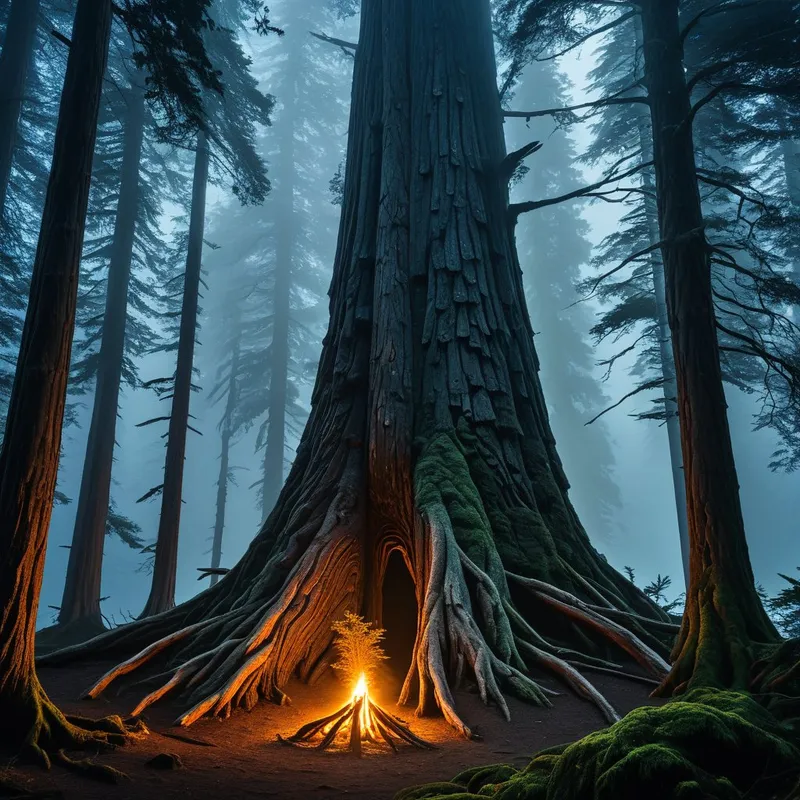
Cedar in Smudging Myth Meaning & Symbolism
A sacred story of a great spirit's sacrifice, becoming Cedar to cleanse and protect the people, embodying purification and enduring strength.
The Tale of Cedar in Smudging
Listen. In the time before memory, when the world was still soft from the dreaming culture."), the people lived in a shadowed valley. A great sickness had come, not of the body alone, but of the spirit. It was a clinging fog, a heaviness that dimmed the fire in the eyes of the children and stole the songs from the throats of the elders. Prayers seemed to fall to the ground like stones. The very air felt thick with forgotten grief and unseen fears.
Among the great spirits who watched from the mountain peaks and the river depths, one felt this sorrow most keenly. This was the spirit of the high, clean places, the one who breathed the first wind that chased the storms. It saw how the people’s hearts were becoming encrusted, how their lodges, though warm, held a stale and stagnant breath. The people were forgetting how to see the world as sacred.
The spirit descended, not in a form of terror, but as a presence of profound stillness. It stood at the edge of the village, where the forest began. “Your homes are heavy,” its voice was the sound of wind through high branches. “Your hearts are clouded. You cannot hear the earth-song through this fog you carry.”
The people wept, for they knew it was true. They had lost the way to make themselves clean for ceremony, for vision, for each other. “What can we do?” their chief asked, his voice weary. “The herbs we burn only make more smoke. The water we wash with does not touch this stain on the soul.”
The great spirit looked upon them, its heart vast with compassion. It saw the depth of their need, a need for a cleansing so complete it would require not just an act, but a transformation. A sacrifice of form for the sake of function.
Without another word, the spirit walked into the heart of the oldest grove. It pressed its hands—which were like light and air—against the trunk of a towering, ancient tree. It began to sing, a low, resonant hum that vibrated in the bones of the earth. The song was not one of power, but of offering. “Let my breath become fragrance,” it sang. “Let my body become shelter. Let my spirit become the purifying fire that does not consume, but releases.”
As it sang, its luminous form began to merge with the tree. The needles shimmered, taking on a deeper, eternal green. The bark grew rich with the pattern of its wisdom. The very sap within became infused with the spirit’s essence—a essence of clarity, protection, and relentless, gentle strength. The great spirit did not die; it became. It became the first Cedar.
A whisper traveled on the wind from the transformed tree. “Gather my boughs. Crush my leaves. Let my body meet the fire.” Hesitant, the people did so. They placed the green Cedar fronds on a bed of hot stones. A smoke arose, unlike any they had known. It was sharp, clean, and profoundly aromatic. It did not choke; it invaded—but with kindness. It drove the thick, sickly fog from the lodges. It seemed to seek out the hidden pockets of fear and sorrow in a person’s heart, wrapping them in its scent and carrying them up and away.
Where the Cedar smoke touched, space was made. Rooms felt larger, airier. Minds felt clearer. Hearts, unburdened, could feel joy again. The people understood. The great spirit had given them a perpetual gift: its own transformed being, to be used as a broom for the soul, a shield against unseen darkness, a constant reminder that cleansing is an act of love, and that true strength often lies in fragrant surrender.

Cultural Origins & Context
The story of Cedar, in its many variations, is woven into the oral traditions of numerous Indigenous nations across the Pacific Northwest, Plateau, and some Plains regions, including the Salish, Nlaka'pamux, and others. It was not a singular, fixed text but a living narrative told by elders and knowledge-keepers during times of teaching—when preparing for ceremony, when a child was sick, or when the community felt spiritually out of balance.
Its primary societal function was pedagogical and prescriptive. It explained why Cedar was used, embedding the practice of smudging within a cosmological framework of sacrifice and reciprocity. The myth taught that the cleansing tool was not merely a plant, but a conscious gift from the spirit world, demanding respect and gratitude. It framed purification not as an expulsion of “evil,” but as the restoration of balance and the clearing of space for sacred connection—to oneself, the community, and the more-than-human world. Passing the story down ensured the practice was maintained with the proper intentionality, transforming a daily or ritual act into a re-enactment of a primordial, compassionate sacrifice.
Symbolic Architecture
At its core, the myth presents Cedar not as an object, but as a verb—the act of cleansing made manifest. The spirit’s transformation is the ultimate alchemical process: spirit into matter, with its essential purpose intact.
The most profound protection is not a wall, but a clearing. It is the creation of sacred space, first within, then without.
The “sickness” in the tale symbolizes psychic congestion—the accumulated weight of unresolved emotion, ancestral trauma, or mundane worry that clouds perception and stifles vitality. The Cedar spirit represents the archetypal Caregiver, whose power lies not in domination but in benevolent infusion. Its sacrifice is one of permeation; it becomes an ever-available resource woven into the fabric of the natural world.
The smoke is the central symbol of mediation. It exists between states—solid plant becoming intangible vapor. It moves between realms—the earthly fire and the spiritual air. It performs the function of the myth itself: to carry away. It is the vehicle for transmutation, lifting the “heavy fog” of the psyche and dispersing it, making it no-thing. The enduring, evergreen nature of Cedar symbolizes that this capacity for cleansing and protection is perennial, resilient, and always accessible, a constant in a world of change.

The Dreamer's Resonance
When this myth pattern stirs in the modern dreamer, it often signals a profound somatic and psychological need for purification that transcends physical hygiene. Dreaming of dense, impenetrable fog or murky water mirrors the “shadowed valley” of the myth, indicating a felt sense of being spiritually or emotionally “clogged,” unable to think clearly or feel authentically.
Dreams of aromatic woods, of lighting fires that produce cleansing smoke, or of encountering a profoundly benevolent tree spirit point to the psyche’s own instinctive movement toward resolution. The body in the dream may feel a deep sense of relief, a literal “lightening,” as the smoke does its work. This is the unconscious initiating its own smudging ceremony. It is processing accumulated psychic toxins—perhaps the residue of a toxic relationship, the burnout from constant productivity, or the grief one hasn’t had space to feel. The dream is the internal elder, reaching for the Cedar of the soul, initiating a clearing to make room for new life, new vision, and authentic feeling to enter.

Alchemical Translation
For the individual on the path of individuation, the myth of Cedar models a critical stage of psychic transmutation: the sacrifice of a latent, potential state for an active, functional one.
We all harbor within us “great spirits”—potentials, gifts, and profound capacities. Yet, they often remain as intangible as the wind spirit, watching from a distance but not fully engaged with the “village” of our daily, messy lives. The alchemical challenge is to do what the Cedar spirit did: to willingly take that pure potential and embody it in a form that serves, cleanses, and protects the entirety of our being.
Individuation requires that we become our own sacred medicine. We must allow our highest nature to infuse our everyday matter, transforming our very presence into a cleansing agent.
This means allowing our compassion (the spirit) to become tangible, practical care (the tree). It means letting our clarity of insight become the “smoke” that clears the fog of confusion from our decisions. The “fire” is the heat of conscious attention and the courage of self-confrontation. We gather the boughs of our own experiences—even the painful ones—and offer them to this fire, not to be destroyed, but to be transmuted into wisdom that cleanses and clarifies our path forward.
The ultimate triumph is not conquest, but presence. The spirit didn’t defeat the fog by force; it provided a constant, abiding alternative. So, in our own psychic alchemy, we learn that healing is not about eradicating every shadow, but about developing a resilient, evergreen presence within ourselves—a Cedar heart—that continuously creates clear, sacred space for our authentic self to breathe, grow, and connect. We become both the sacrificer and the sacred gift.
Associated Symbols
Explore related symbols from the CaleaDream lexicon: