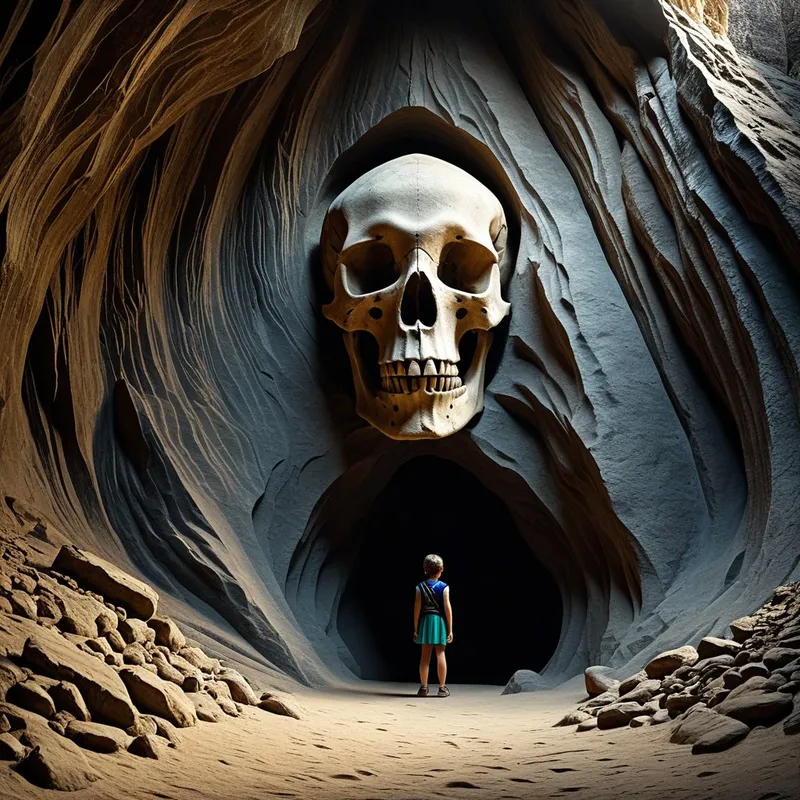
Cave as Womb/Tomb Myth Meaning & Symbolism
An ancient, universal myth of descent into a cave, a liminal space of dissolution and gestation, from which one emerges utterly transformed or never returns.
The Tale of Cave as Womb/Tomb
Listen. Before the names of cities, before the counting of years, there was the Mountain. And in the flank of the Mountain, there was the Mouth. It did not smile. It did not speak. It simply was: a gaping darkness, breathing out a chill, damp breath that smelled of stone, of time, of the deep earth’s secrets.
Into this breath stepped the One-Who-Sees. Not a king, not a warrior clad in bronze, but a soul painted with the dust of the long road, eyes holding the weariness of the sunlit world and a hunger that sunlight could not feed. The people watched from a distance, a silent circle on the plain. They had given him their fears, their questions, their unshaped hopes. They had whispered of a sickness in the tribe, a silence in the land, a forgetting of the old songs. He carried it all like a weight in his belly.
He did not look back. The light of day clung to his shoulders like a fading cloak as he crossed the threshold. The world of color and form dissolved. Sound changed. The wind became a low moan through unseen fissures. The drip of water was the heartbeat of the mountain. He moved by touch, hands sliding over walls that were sometimes smooth as a sleeping beast’s flank, sometimes jagged as broken teeth. The air grew thick, a palpable presence. It was not empty darkness, but a full darkness, pregnant with a pressure that pushed against his skin, his mind.
He journeyed for a time beyond time. He saw shapes in the blackness that were not there, heard voices in the water-drip that spoke a language of before words. Hunger became a hollow echo. Thirst was a memory of rain. His self—the man with a name, a history, a place by the fire—began to soften at the edges, to blur like ink in water. This was not an attack, but an absorption. The cave was taking him back. The fear was immense, a cold animal terror urging him to flee. But beneath it, a stranger feeling: a profound, terrifying surrender. To be unmade. To be dissolved into the dark hum of the world.
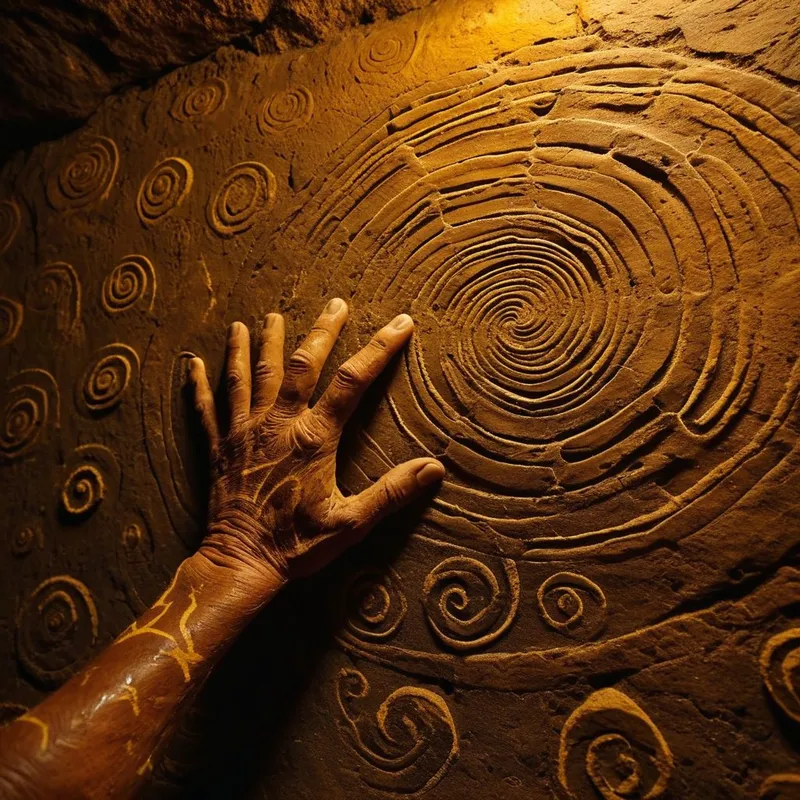
And in that nadir of unbeing, in the tomb of all he had been, a spark persisted. Not a thought, but a pulse. A recognition. The darkness was not an end, but a container. The pressure was not crushing, but holding. This was not a throat to swallow him, but a womb. And in that realization, a new sense awoke. His fingers, tracing the wall, felt not just cold stone, but curves and lines. With a piece of charcoal from a long-dead fire and ochre from his pouch, he began to give form to the forms swimming in the dark. A great, shaggy creature materialized on the wall, its breath hot in the still air. A spiral, turning inwards forever. The outline of his own hand, a testament of I was here in the belly of the All.
When he stumbled back into the light, he was a ghost to his own people. Skin pale as cave fungus, eyes wide and dark, reflecting not the sky but depths. He could barely speak the language of the sun. But in his gaze was a terrible, quiet knowledge. And on the air around him clung the scent of wet stone and ancient, sacred dark. He had died. He had been gestated. He was born. And he brought the mountain’s dream out into the day.
Cultural Origins & Context
This is not a myth belonging to any one scroll or epic. It is a psychic blueprint, etched into the human mind and repeated across the globe—from the initiatory ordeals in the Plutonian caves of Greece, to the ancestral Dreamtime journeys of Aboriginal Australians into sacred rock shelters, to the hero descents into the underworld in Mesoamerican and Mesopotamian lore. It was not merely a story told, but a ritual lived. Shamans, neophytes, and vision-seekers underwent literal and symbolic cave descents.
The story was passed down not just in words, but in the very act of entering such spaces. The cave art of Lascaux, Altamira, and Chauvet are not mere galleries; they are the visual scriptures of this myth, created in situ as part of the transformative encounter. The myth’s societal function was paramount: it was a technology of the soul. It explained the mystery of death, modeled the process of radical renewal for the community during crises, and provided a map for contacting the ancestral or spiritual world. The one who returned was a living bridge between the deep, unchanging structure of the world (the cave) and the fragile, temporal order of the tribe (the surface).
Symbolic Architecture
The cave is the ultimate symbol of the shadow and the collective unconscious. It represents the interiority of the Earth and, by projection, the interiority of the psyche. As womb, it symbolizes the primal, containing, creative darkness from which all form emerges. As tomb, it is the place of dissolution, where the ego’s constructs are broken down.
The cave does not create or destroy; it transmutes. It is the alchemical vessel where the lead of the conscious personality is reduced to prima materia, awaiting a new shape.
The hero’s journey is not a battle against monsters, but a confrontation with formlessness itself. The “treasure” he seeks is not a golden object, but a state of being—a direct experience of the psychic substrate. His painting on the walls is critical; it is the act of symbol-formation, the psyche’s imperative to create meaning (images, myths) from the raw, chaotic experience of the unconscious. He does not conquer the dark; he converses with it, and in doing so, brings back a fragment of its language—a symbol—which becomes a healing talisman for the surface world.

The Dreamer's Resonance
When a modern dreamer finds themselves in a cave, tunnel, basement, or any deep, enclosed subterranean space, they are encountering this ancient pattern. Somaticly, one might feel the oppressive pressure, the chill, the difficulty breathing, or a paradoxical, womblike comfort. Psychologically, this signals a process of involutio—a necessary descent.
This is not a nightmare to be dismissed, but a profound process to be honored. The dream-ego is being called to a retreat from the demands of the persona (the social mask). It may indicate depression, not as a clinical pathology alone, but as a psychic imperative to “go underground,” to digest an overwhelming life experience, a loss, or a forgotten aspect of the self. The dream cave is where we encounter what we have buried: unprocessed grief, primal fears, or untapped creative potentials that cannot grow in the harsh light of conscious scrutiny. To rush towards the light in such a dream is to abort a crucial psychic pregnancy.
Alchemical Translation
For the modern individual, the myth models the non-negotiable phase of nigredo in the individuation process. Our culture prizes ascent, achievement, and light. But the psyche’s wisdom demands a descent, a failure, a dark night.
The conscious will cannot initiate true transformation; it can only consent to be taken down into the vessel of the unconscious.
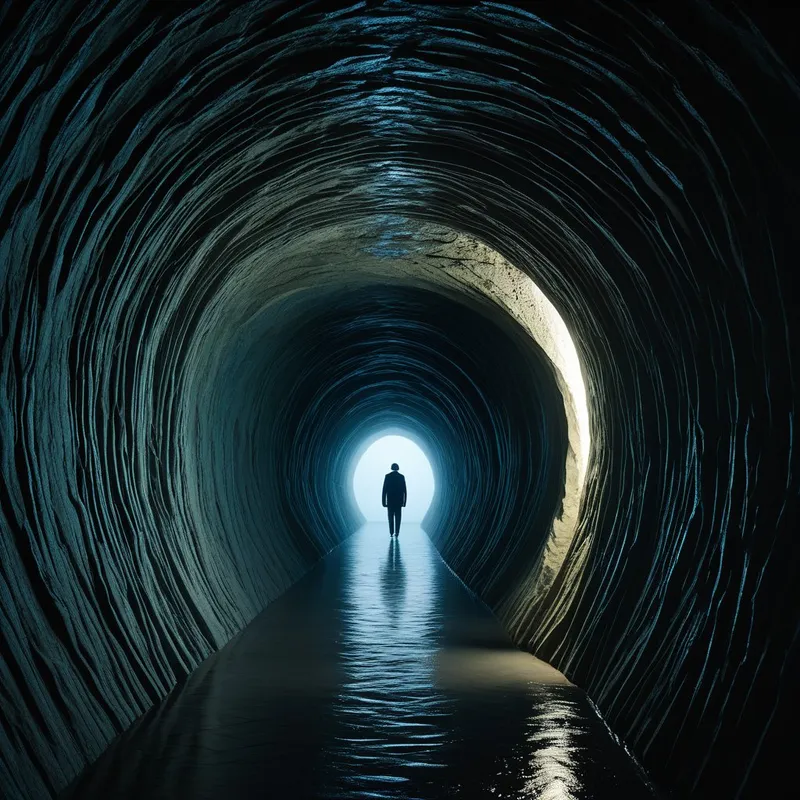
The “cave” becomes any container that holds us while we fall apart: a period of solitude, a therapy session, a creative block, a debilitating illness, or a profound grief. It is the liminal space where our old identity (the hero who entered) is de-structured. This feels like death—a tomb. The alchemical work is to endure this dissolution without fleeing into premature meaning or distraction, to tolerate the terrible ambiguity. In that holding, a slow, organic re-ordering begins. An insight, a new image, a forgotten memory, a creative impulse—the equivalent of painting on the wall—will spontaneously arise. This is the albedo, the first light in the dark.
Emerging is not a return to the old self, but a birth of a self that has integrated a piece of the darkness. One is quieter, heavier with insight, perhaps less certain but more grounded. The transformed individual carries the cave within them, a living connection to the creative/destructive depths, and becomes, in their own way, a source of renewal for their world.
Associated Symbols
Explore related symbols from the CaleaDream lexicon: