Cauldron of Memory Myth Meaning & Symbolism
A warrior drinks from a magical cauldron, forgets his life, and must reclaim his identity through a perilous journey of memory and sacrifice.
The Tale of Cauldron of Memory
Listen, and let the fire’s crackle become the whisper of the Otherworld. In a time when the mist clung to the hills like a ghost’s breath, there lived a warrior whose name was once a song of triumph. But grief had hollowed him, a cold wind where his heart had been. He sought an end, or a beginning so profound it could not be told from death.
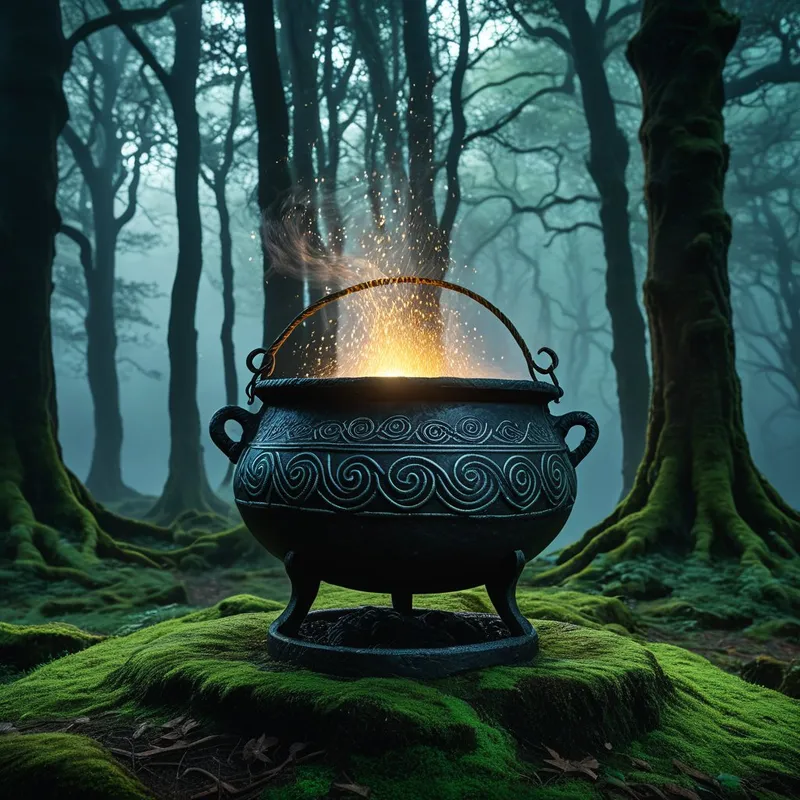
His feet, guided by sorrow, carried him beyond the known world, into the deep forest where the trees grew thick as centuries. There, in a clearing where moonlight never fully touched the ground, he found it. The Cauldron of the Dagda. It was not gold nor silver, but iron black as a starless night, etched with spirals that seemed to turn if you did not look directly. From its mouth rose a steam that smelled of damp earth, of crushed herbs, and of something older—the scent of time itself.
A figure emerged from the gloom, not as a man emerges, but as the shadow of the great oak coalesced. It was the guardian, a being of the Sídhe, its eyes holding the patience of stone. “You seek the draught of forgetting,” it intoned, its voice the sound of roots shifting deep underground. “The waters of Lethe. To drink is to die to all you have been. Your name, your loves, your battles—all will be as a story told of another. You will be born anew, empty. Do you choose this?”
The warrior, his eyes reflecting the cauldron’s eerie glow, nodded. His past was a wound; he would have it scoured clean. He took the heavy ladle, its weight the weight of his life, and drank. The liquid was cold and bright, a river of ice flowing into his core. He felt memories peel away like leaves in an autumn gale—his mother’s face, the grip of his first sword, the laughter of his lost kin—all dissolving into a formless, grey mist. He slumped to the moss, a vessel poured out.
He awoke. He was no one. He was a blank page in a world of dense text. The guardian spoke again. “Now, you must earn the second draught. The Cauldron of Memory. It does not give back what was taken. It gives the truth that was woven within it. To drink, you must journey to the Source of All Rivers and return with a cup of its water.”
The nameless one journeyed. Without a past to guide him, he was guided only by instinct and the subtle pull of the land. He faced trials not of muscle, but of essence. A Kelpie in a ford offered him an identity—a proud, violent name—if he would but ride. He refused, sensing the hollow pride within the offer. In a valley, he met a crone who wept over a broken cauldron, and with hands that remembered no craft, he found he could mend it. She gave him a single hazelnut, whispering, “Knowledge is not recollection, but recognition.”
Finally, at the world’s root, he found the Source—a spring bubbling from the heart of a stone, overhung by nine sacred hazels. He filled his cup. The return journey was different. The land was no longer strange; it spoke to him. The rustle of leaves held the echo of his old language. The flight of a hawk mirrored a strategy from a forgotten battle.
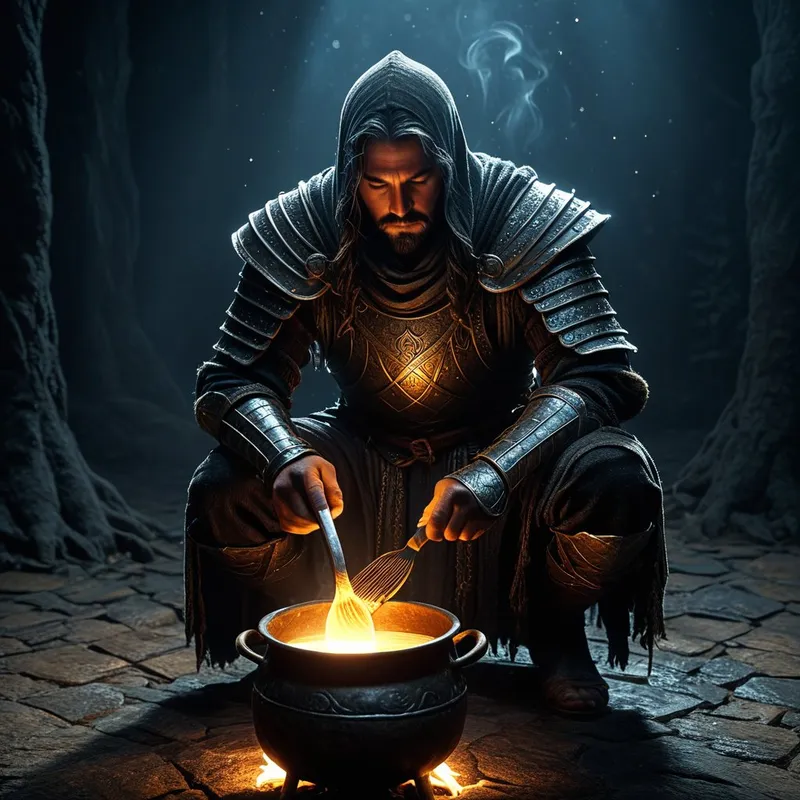
He stood again before the great Cauldron. He poured the water from the Source into its depths. The guardian stirred the waters with a branch of silver birch. “Drink now,” it said. He drank. This draught was warm, like blood, like summer sun. It did not return his old memories as a chronicle. Instead, it gave him the meaning of his life. The grief was still there, but now it was a sacred scar, a teacher. The love was there, not as a haunting loss, but as a permanent strength woven into his spirit. He remembered not just who he was, but what he was—a thread in the great tapestry. He had a name again, but it was a new name, forged in the crucible of forgetting and the alembic of remembrance.
Cultural Origins & Context
This tale, in its essence, is woven from the deep threads of Insular Celtic, particularly Irish, mythological tradition. It is not a single, standardized myth from one text, but a composite pattern drawn from several powerful motifs: the cauldrons of the Tuatha Dé Danann like the Cauldron of Plenty, the transformative cauldron of rebirth in tales like The Spoils of Annwn, and the profound concept of imbas forosnai, the “illumination that illuminates,” a poetic inspiration that could involve ritualistic incubation and altered states.
These stories were the province of the filid, the poet-seers. They were not mere entertainers but custodians of history, law, and cosmic truth. A myth like that of the Cauldron of Memory would have served multiple functions: as a metaphysical map of the afterlife or initiatory experience, as a narrative reinforcement of the value of wisdom (fios) over mere knowledge, and as a societal anchor, teaching that identity is not a static possession but a dynamic process earned through ordeal and integration.
Symbolic Architecture
The cauldron is the ultimate symbol of the vas, the vessel of transformation. It is the womb of the Goddess, the crucible of the alchemist, and the cranium holding the brain—the physical cauldron of consciousness. The two draughts represent the fundamental polarity of psychic life.
Forgetting is not a failure, but a sacred kenosis—an emptying necessary for a new pattern to be inscribed.
The first draught, the waters of Lethe, symbolizes the ego’s necessary dissolution. The conscious personality, burdened by its complexes, traumas, and fixed identity, must be de-structured. This is a psychological death. The hero’s subsequent nameless state represents the tabula rasa of the psyche, a terrifying but fertile state of potential where the individual is reduced to their core, archetypal humanity.
The journey for the water of the Source is the journey into the unconscious, not to retrieve personal souvenirs, but to connect with the objective, impersonal psyche—the collective unconscious. The hazelnut, symbol of concentrated wisdom in Celtic lore, is a seed of this new consciousness. The second draught from the Cauldron of Memory is not a simple restoration. It is the integration of the personal with the transpersonal. Memory here becomes anamnesis—Platonic recollection—a remembering of one’s essential, eternal nature and one’s place in the larger order.
The Dreamer's Resonance
When this myth stirs in modern dreams, it often manifests in periods of profound transition or identity crisis. The dreamer may find themselves in a featureless landscape, searching for a lost home they cannot describe. They may dream of drinking from a strange cup and feeling a wave of calm emptiness, or of being tasked with an impossible, obscure quest.
Somatically, this can correlate with feelings of dissociation, “brain fog,” or a sense of being untethered from one’s own history. Psychologically, it signals that the psyche is initiating its own ritual of renewal. The conscious ego is being invited, or forced, to release its rigid grip on a worn-out self-narrative. The dream is not depicting a pathology, but a process. The anxiety of forgetting is the labor pain of a broader, wiser consciousness preparing to be born. The dreamer is in the cauldron, being cooked by the fires of the unconscious.
Alchemical Translation
The myth of the Cauldron of Memory is a perfect allegory for the Jungian process of individuation. The first draught is the nigredo, the blackening. It is the confrontation with the shadow and the experience of despair, where all one’s conscious achievements turn to ash and meaning evaporates. This is a necessary descent.
The journey represents the albedo, the whitening, where the ego, now humbled and stripped, begins a dialogue with the archetypal guides of the unconscious (the crone, the kelpie as a shadow temptation). It is a period of purification and gathering of new, symbolic insights (the hazelnut).
The Cauldron of Memory does not give you back your story; it reveals the myth you have been living all along.
The final draught is the rubedo, the reddening, the culmination. Here, the “water of life” from the deep unconscious is integrated. The individual does not simply regain their old ego; they forge a new, more expansive center of personality—the Self. Memory is transmuted from autobiography into wisdom. The past is no longer a chain of cause and effect that binds, but a well of meaning that nourishes. The modern individual undergoing this alchemy moves from being a victim of history to becoming a conscious participant in a timeless, mythic reality, carrying their transformed memory as a source of authority and compassion.
Associated Symbols
Explore related symbols from the CaleaDream lexicon: