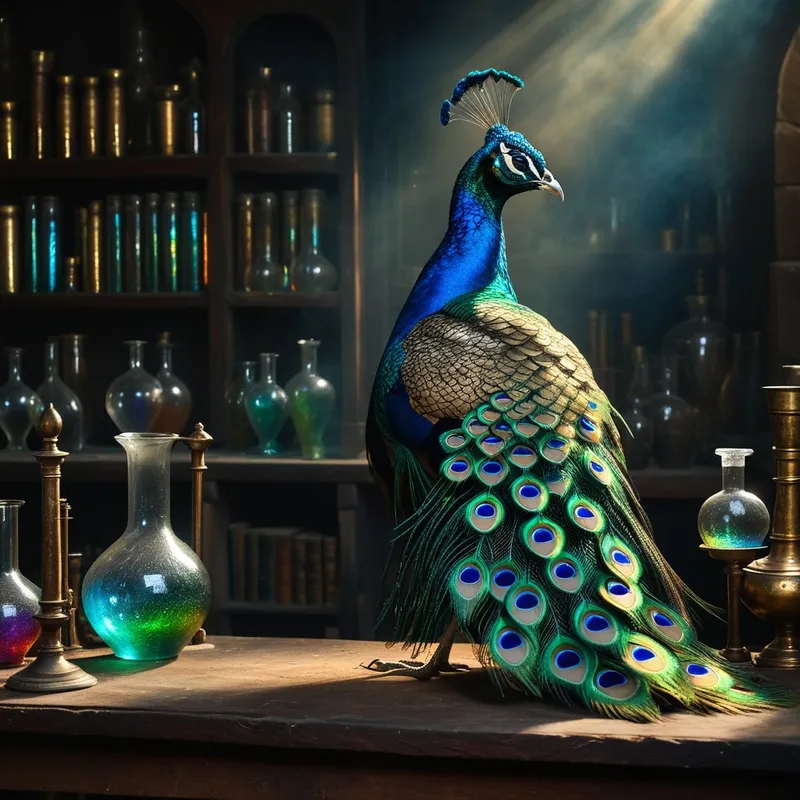
Cauda Pavonis Myth Meaning & Symbolism
The myth of the Peacock's Tail, where the prima materia's black despair shatters into a thousand colors, heralding the soul's imminent wholeness.
The Tale of Cauda Pavonis
Listen. In the beginning, there was only the Nigredo. A darkness not of night, but of the womb-tomb. A thick, silent blackness that clung to the soul like cold tar. It was the realm of the Prima Materia, a substance of pure potential and profound despair. For an age uncounted, it slept, a dragon coiled upon its own hoard of unformed dreams.
Then came the Fire. Not a gentle flame, but the relentless, purging heat of the alchemist’s will—the Calcinatio. The black mass screamed in silence. It cracked and boiled, releasing vapors of fear and long-buried shame. It was a death, a putrefaction, a dissolution into utter hopelessness. The substance wept a bitter, metallic dew. This was the necessary death, the stripping bare. The alchemist, their face gaunt in the furnace light, knew only to endure, to keep the fire true.
And then… a stillness. A silence deeper than the black. The crucible cooled from inferno red to a dull, ashen grey. The work seemed lost, a cinder of failure. In that moment of absolute surrender, when the will to force a result finally broke, a sigh passed through the laboratory.
It began as a whisper of color at the very heart of the ash. A hint of verdigris, like ancient copper. Then a streak of sulfur-yellow bloomed beside it. A blush of rose madder. A flash of celestial blue. From the dead, uniform grey, colors erupted—not in harmony, but in a glorious, chaotic riot. They swirled and fought, emerald against crimson, violet against gold, each vying for dominance in a dazzling, disorienting spectacle. This was the Cauda Pavonis.
The alchemist fell to their knees, not in prayer, but in awe. The air itself shimmered with iridescent motes. The chaotic dance of hues was not a failure, but a herald. It was the soul’s fragmented brilliance, all its conflicting passions, memories, and selves, finally brought to light after the long night of blackness. The colors did not yet unite, but for the first time, they shone. And in their shining, they whispered the secret: the work was not over. The final marriage, the Coniunctio, was now not just a hope, but a promise written in light.
Cultural Origins & Context
The Cauda Pavonis is not a myth with characters and plot in the traditional sense, but a core operative image from the Western esoteric tradition of alchemy, spanning from Hellenistic Egypt through the Islamic Golden Age to the Renaissance laboratories of Europe. It was passed down not by bards, but in cryptic manuscripts, emblem books, and oral teachings between master and apprentice. Its primary "societal function" was hermetic—it existed for the closed circles of practitioners who saw in the transformation of matter a parallel path for the transformation of the soul, the Opus Magnum.
This image served as a crucial navigational beacon in the long, perilous work. Alchemical texts are filled with warnings of the "Black Sun" of the Nigredo, a depression and spiritual crisis so profound many would abandon the work. The Cauda Pavonis was the sign that one had survived that stage. It was empirical evidence in the retort and psychological evidence in the heart: the utter deconstruction of the old self was complete, and the raw materials for the new were now visible, however chaotic they appeared. It was a moment of validation, a deeply personal myth of renewal witnessed in the secrecy of the laboratory.
Symbolic Architecture
Psychologically, the Cauda Pavonis represents the critical emergence of complex psychic content after a period of severe depression, stagnation, or ego-death (the Nigredo). It is not yet integration, but the dazzling, often overwhelming, presentation of all that was repressed, denied, or fragmented within the psyche.
The blackness of nigredo is the unity of oblivion; the thousand colors of the peacock are the terrifying, beautiful dawn of multiplicity.
The uniform blackness of despair shatters into the spectrum of human experience. Each color is an affect, a complex, a sub-personality: the red of rage, the blue of melancholy, the green of envy or growth, the gold of divine aspiration. They appear in chaos because the conscious ego, having been broken down, lacks the structure to organize them. The peacock’s tail is thus the soul in a state of glorious, disorganized integrity. The Albedo (the white stage) that traditionally follows is the work of accepting and ordering this riot of color into a coherent, reflective whole.
The Dreamer's Resonance
When this mythic pattern stirs in the modern unconscious, it manifests in dreams not of peacocks, but of sudden, inexplicable bursts of color in monochrome landscapes. A dreamer lost in a grey city might turn a corner to find a wall covered in vibrant, living graffiti. They might dream of opening a dull, leaden box to find a kaleidoscope inside, or of black ink spilled in water exploding into oil-slick rainbows.
Somatically, this can correspond to a feeling of energy returning after illness or burnout—a nervous, scattered energy. Psychologically, it is the phase after a "dark night of the soul" where insights flood in, memories resurface, and emotions feel heightened and contradictory. The dreamer may feel emotionally volatile, swinging between joy, grief, and inspiration. The process is one of reception: the ego is not yet directing this symphony of color, but learning to witness it without fear, understanding that this chaotic beauty is the raw material of their impending wholeness.

Alchemical Translation
For the individual on the path of individuation, the Cauda Pavonis models the pivotal transition from analysis to synthesis. The therapeutic "Nigredo" involves confronting the shadow, dismantling old personas, and facing core wounds. This is necessarily a dark, painful process of reduction.
The "Peacock's Tail moment" arrives when that analytical deconstruction ceases to be the focus, and the innate, multifaceted complexity of the self begins to spontaneously reveal itself. It is the moment a person in recovery moves from defining themselves by their trauma to discovering, often with surprise, their old loves, forgotten talents, dormant passions, and contradictory traits all re-awakening at once.
The goal is not to choose one brilliant color from the tail, but to become the whole peacock—the organism that holds and displays the entire spectrum without being identified with any single hue.
The modern alchemical work is to resist the urge to prematurely synthesize this chaos into a new, rigid identity. The task is to hold the tension of the opposites—to let the crimson of passion argue with the azure of calm, to allow the verdant growth to intertwine with the golden light of spirit. From this sustained tension, not from forced resolution, the final stage—the Rubedo, or the birth of the integrated Self—can naturally emerge. The Cauda Pavonis is the universe’s way of showing the soul its own breathtaking palette, whispering that the masterpiece can now begin.
Associated Symbols
Explore related symbols from the CaleaDream lexicon: