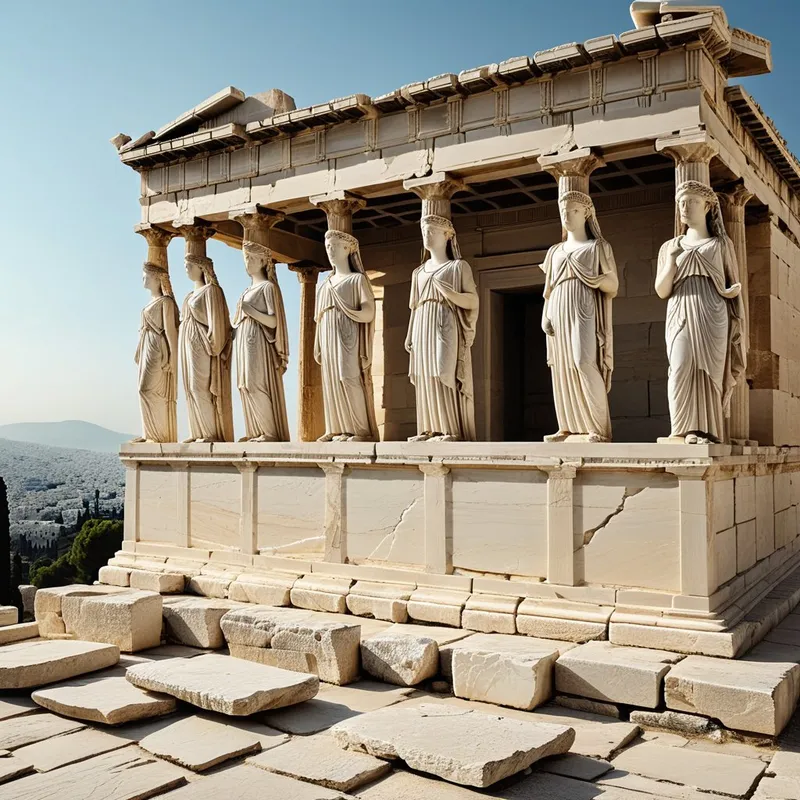
Caryatids Myth Meaning & Symbolism
Women of stone, eternally bearing the weight of sacred architecture, born from a city's defiance and a goddess's enduring, silent strength.
The Tale of Caryatids
Hear now a tale not of thunder, but of stone. Not of a god’s wrath, but of a city’s pride and its terrible, beautiful consequence.
In the lush, dancing groves of Karyai, where the air was sweet with the scent of mountain walnuts and the night echoed with the choral hymns to Artemis, there lived a people of fierce spirit. The women of Karyai were renowned, not merely for their grace as they wove through the sacred groves in worship, but for a loyalty that ran deeper than the roots of the oldest tree. They were priestesses of the wild goddess, their bodies moving in rhythms older than the polis itself.
But the great wheel of fate turned. War, that ever-hungry beast, came prowling. When the mighty Persian host swept across the land, the men of Karyai saw a chance for power, or perhaps merely survival. They broke their sacred oaths. They turned their backs on the united Hellenes and sided with the invader, the foreign king who sought to chain the gods of Olympus themselves.
The gamble was for naught. The Persians were driven back into the sea by the courage of Athens and Sparta. And then came the reckoning. The victorious Greek armies, their blood still hot with the memory of betrayal, marched to the gates of Karyai. The city fell not with a bang, but with a terrible, solemn silence of judgment. The men were put to the sword or dragged away in chains, their names cursed to oblivion. But what of the women? The daughters, the sisters, the priestesses of Artemis?
The Athenian generals, in their grim triumph, decreed a punishment that would echo through eternity. It would be a monument to treachery and a warning to all who would break faith. The women of Karyai would not be slain. No, their fate would be far more profound. They were stripped of their freedom, their homes, their very identities as women of the dance. And in their place, a new identity was forged in the unforgiving heat of shame and memory.
“You bore the weight of your city’s betrayal,” came the decree. “Now, you shall bear weight forever.”
And so, in the smithies of divine punishment and human artistry, their essence was translated. Their graceful forms, once fluid in the dance for Artemis, were stilled. The softness of flesh was replaced by the cold patience of marble from Paros. Their flowing peplos garments became frozen cascades of stone drapery. Their heads, once bowed in prayer or raised in song, were now set straight, eyes looking into an infinite distance. They were transformed into living pillars, Caryatids.
They were carried to the most sacred rock in Greece, the Acropolis of Athens, and placed upon the porch of the Erechtheion. There, they took the load of the temple’s entablature upon their heads, a burden they would carry through the bleaching sun, the weeping rain, and the silent march of centuries. They became the silent sisters of the rock, forever bearing the architecture of the gods, a permanent, beautiful, and heartbreaking testament to the price of a broken oath.
Cultural Origins & Context
The tale of the Caryatids is not a myth preserved in the epic cycles of Homer or the tragedies of the playwrights. It is an aetiological myth, recorded centuries later by the Roman architectural writer Vitruvius. His account, likely drawing on earlier Hellenistic sources, provides a stark, political rationale for a breathtaking artistic form.
In the Greek world, architecture was never merely functional; it was theological, political, and psychological narrative written in stone. The Caryatids of the Erechtheion (c. 421–406 BC) are a pinnacle of this practice. Their creation coincided with the height of Athenian power and cultural confidence following the Persian Wars. The myth Vitruvius relays serves a potent dual function: it glorifies Athenian victory and justice, while simultaneously providing a morally charged origin for an astonishing artistic innovation—replacing a standard column with a sculpted human figure.
The societal function is clear. It is a warning carved in beauty: disloyalty to the Hellenic cause has an eternal, visible cost. The women, often the symbolic bearers of a city’s culture and continuity, are transformed into literal bearers of another city’s—Athens’s—cultural and religious supremacy. The myth justifies and ennobles a stunning piece of propaganda art, embedding a political lesson within the very fabric of the sacred landscape.
Symbolic Architecture
To see a Caryatid is to witness a profound paradox frozen in marble. She is both load and support, punished and priestess, captive and monument. She represents the ultimate integration of the human form into the realm of structure and order.
The pillar is the axis between earth and sky; the Caryatid is the soul conscious of its place as that axis.
Psychologically, she symbolizes the immense, often silent, burdens borne by the feminine principle—not merely biological femininity, but the archetypal energy of containment, nurture, and foundational support. She is the psyche that holds up the edifice of culture, family, and civilization, often at great personal cost. Her stillness speaks of endurance, of a strength that is not expressed in action but in unwavering, resilient presence. She is the antithesis of the chaotic, fleeing Nymph; she is the Nymph who has stopped, taken root, and become the world-tree itself.
Yet, there is no agony in her face, only a serene, introspective solemnity. This is key. The burden has been alchemized from a crushing punishment into a sacred duty. She has not collapsed; she has become the foundation. In this, she mirrors the Greek ideal of sophrosyne—wise moderation and self-control—elevated to a superhuman level.
The Dreamer's Resonance
When the image of the Caryatid emerges from the dreamer’s unconscious, it signals a critical moment in the psyche’s relationship with structure and burden. This is not the dream of being chased (the unintegrated shadow) or of flying (escapist inflation). This is the dream of holding.
The dreamer may find themselves becoming a pillar in their own home, holding up a cracking ceiling. They may see a loved one slowly turning to stone while performing a routine task. The somatic sensation is one of immense pressure, often on the head, neck, or shoulders—a literalization of the phrase “the weight of the world.” This dream pattern emerges when the conscious ego has taken on a responsibility—for a family, a project, an identity—that feels eternal and immobilizing. The psyche is portraying the fear that one’s vitality, one’s fluidity and capacity for joy (the dance for Artemis), has been sacrificed permanently to a rigid role.
Yet, the Caryatid dream also contains its own medicine. The figure, though stone, stands. She is not crushed. The dream asks the dreamer: What is the temple you are holding up? Is it sacred to you, or was it built by another’s decree? The dream invites a profound discernment between a burden that is a meaningless punishment and a load that, though heavy, is an integral part of one’s own sacred architecture.
Alchemical Translation
The individuation process modeled by the Caryatid myth is not one of heroic quest, but of profound, conscious embodiment. It is the alchemy of the base lead of enforced burden into the gold of chosen foundation.
The first stage is the betrayal or the failed allegiance—the realization that an old identity (the citizen of Karyai) has colluded with a force (Persian tyranny/neurosis/collective shadow) that is antithetical to the soul’s true polity. The consequence is a psychic catastrophe: the death of the old, mobile, uncommitted self.
Transmutation begins when the punishment is accepted not as a sentence, but as a form.
The second, crucial stage is the transformation into the pillar. This is the most painful part of the work. It is the conscious decision to stop fleeing the burden, to stand one’s ground, and to allow the persona to harden into a defined, responsible shape. The dancing priestess must consent to become the still column. This is not a loss of soul, but a condensation of it. The fluid libido is channeled into a vertical, structural purpose.
Finally, there is the placement upon the sacred rock. This is the integration. The burdened self is no longer in the shameful grove of its failure (Karyai), but is given a central place in the temple of the conscious personality (the Acropolis). The weight being borne is now the entablature of one’s own values, one’s own earned wisdom, one’s connection to the divine (the Erechtheion). The Caryatid no longer bears the weight of another’s sin, but the architecture of her own soul. She has become both the support and the supported, the individual pillar and an essential part of a greater, sacred whole. In her silent endurance, she has found a dignity deeper than freedom—the dignity of being indispensable to the structure of meaning itself.
Associated Symbols
Explore related symbols from the CaleaDream lexicon: