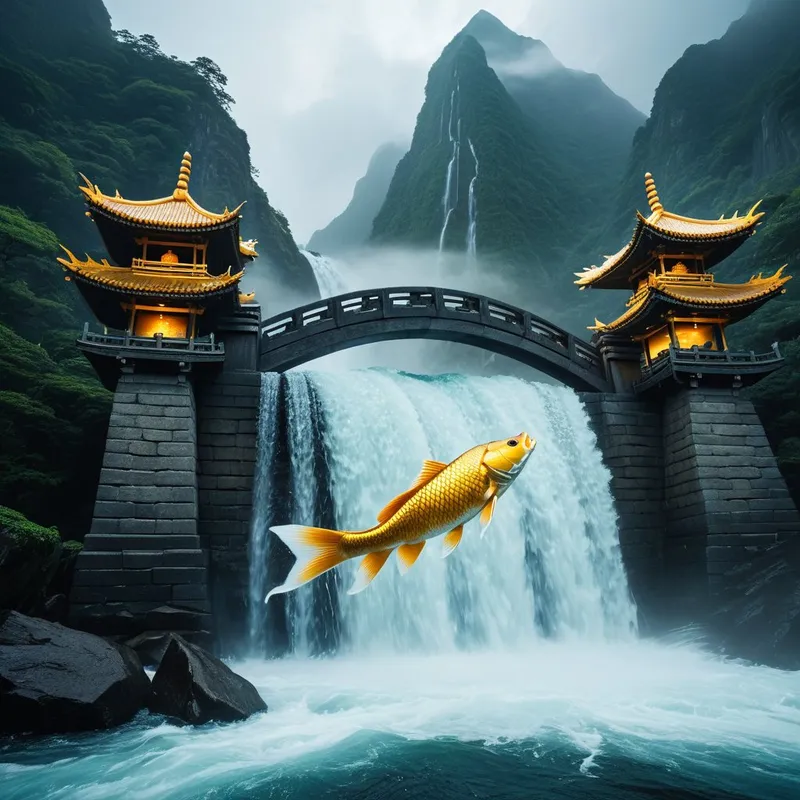
Carp Leaping the Dragon Gate Myth Meaning & Symbolism
A humble carp's epic struggle against a waterfall transforms it into a celestial dragon, symbolizing ultimate metamorphosis through perseverance.
The Tale of Carp Leaping the Dragon Gate
Listen, and hear the roar that shakes the very bones of the mountains. In the ancient, mist-wreathed heart of the land, where rivers are born from the tears of dragons and stones remember the first dawn, there lies a place of impossible ascent: the [Longmen](/myths/longmen “Myth from Chinese culture.”/), [the Dragon Gate](/myths/the-dragon-gate “Myth from Chinese/Japanese culture.”/).
Its cliffs are not of this earth, carved by no mortal hand, but by the celestial breath of the [Qinglong](/myths/qinglong “Myth from Chinese culture.”/) itself. The waters that thunder over its lip are the distilled essence of struggle, falling from a height that scatters clouds and daunts eagles. For an age, [the river](/myths/the-river “Myth from Buddhist culture.”/) below teemed with life unaware—until a whisper traveled on the current, a promise older than the hills: Any carp who can scale this cataract, who can defy the crushing weight of heaven’s descent and leap through [the mist](/myths/the-mist “Myth from Celtic culture.”/)-veiled arch at its summit, shall be transformed. It will shed its watery form and become a [dragon](/myths/dragon “Myth from Chinese culture.”/), sovereign of sky and storm.
For years uncounted, the carp of [the Yellow River](/myths/the-yellow-river “Myth from Chinese culture.”/) heard this call. Most dismissed it as folly, the fancy of minnows. But in the heart of one—a fish of no particular distinction, its scales the color of tarnished bronze—the whisper became a drumbeat. It began to swim against the gentle flow, feeling the pull of the distant thunder. It joined a gathering school of the brave and the desperate, their silver and gold and red bodies a shimmering arrow pointed upstream.
The journey was a gauntlet of hunger and predator, but these were mere preludes. Then, the Gate appeared. The air vibrated. [The world](/myths/the-world “Myth from Tarot culture.”/) was reduced to a wall of living, roaring white. One by one, the carp hurled themselves at the impossible. They were dashed upon rocks, beaten back by the hydraulic fist of [the fall](/myths/the-fall “Myth from Biblical culture.”/), their strength spent in moments. Many turned back, broken. Our carp, its muscles screaming, watched. It felt not courage, but a deep, undeniable must. It was not leaping for glory, but because to not leap was to deny its very soul.
It gathered itself in an eddy, a coil of focused life. Then it shot forward, not with blind fury, but with a terrible, precise grace. It rode the turbulent currents, using their very violence as stepping stones. [Water](/myths/water “Myth from Chinese culture.”/) hammered its gills; stone grazed its side. Up and up, a living bolt against a waterfall of stars. The world narrowed to the next inch, the next surge. Exhaustion became a fire in its blood. Just as its vision dimmed, it felt a change—not in the water, but in the air itself. A thinning. A lightness.
With a final, convulsive effort that seemed to draw power from the mountain’s core, it broke the surface of the falls. For a heartbeat, it hung in the spray-filled silence above [the abyss](/myths/the-abyss “Myth from Kabbalistic culture.”/), a perfect arc against [the sky](/myths/the-sky “Myth from Persian culture.”/). Then it passed through the arch of [the Dragon](/myths/the-dragon “Myth from Chinese culture.”/) Gate.
The transformation was not painless, but ecstatic. Scales ignited into golden plates. Fins stretched and broadened into vast, cloud-catching wings. Its body elongated, powerful, thrumming with the electricity of the storm. A mighty roar, not of water but of thunder, erupted from its new-formed throat. Where a carp had leaped, a dragon now soared, ascending on the very winds it had once merely dreamed of, its destiny forged in [the crucible](/myths/the-crucible “Myth from Alchemical culture.”/) of the fall.

Cultural Origins & Context
The myth of the Carp Leaping the Dragon Gate is a foundational allegory in the Chinese cultural imagination, with roots stretching back to the Shanhaijing (Classic of Mountains and Seas) and solidified in later folklore and historical records. It transcended mere storytelling to become a pervasive social and philosophical metaphor. Historically, the Longmen was geographically linked to a treacherous pass on the [Yellow River](/myths/yellow-river “Myth from Chinese culture.”/), a literal and figurative barrier.
The myth was perpetuated by scholars, poets, and storytellers, but its most powerful vehicle was the imperial Keju examination system. For over a millennium, this myth served as the definitive narrative for the scholar’s journey. The arduous study was the upstream swim. The grueling, famously competitive exams held in the capital were the Dragon Gate itself. Success meant a meteoric transformation in social status—from commoner (baixing) to mandarin official, a leap into the “dragon” class of the ruling elite, with all its attendant power and prestige. Thus, the myth functioned as a societal script, validating the Confucian ideals of self-cultivation, perseverance (hengxin), and the transformative power of merit.
Symbolic Architecture
At its core, the myth is a master [symbol](/symbols/symbol “Symbol: A symbol can represent an idea, concept, or belief, serving as a powerful tool for communication and understanding.”/) of alchemical change. The carp represents the latent, unrealized potential within the mundane. It is the unrefined ore, the dormant seed, the individual before their great ordeal. The Yellow [River](/symbols/river “Symbol: A river often symbolizes the flow of emotions, the passage of time, and life’s journey, reflecting transitions and movement in one’s life.”/) symbolizes the flow of [life](/symbols/life “Symbol: The symbol of ‘Life’ represents a journey of growth, interconnectedness, and existential meaning, encompassing both the joys and challenges that define human experience.”/), of time, and of collective [destiny](/symbols/destiny “Symbol: A predetermined course of events or ultimate purpose, often linked to spiritual forces or cosmic order, representing life’s inherent direction.”/), from which one must consciously turn away to pursue a singular [path](/symbols/path “Symbol: The ‘path’ symbolizes a journey, choices, and the direction one’s life is taking, often representing individual growth and exploration.”/).
The waterfall is not an obstacle, but the sacred instrument of transformation. It is the necessary friction that forges spirit from flesh.
The [Dragon Gate](/symbols/dragon-gate “Symbol: A powerful threshold symbol representing transformation, ascension, and overcoming impossible challenges through perseverance and destiny.”/) is the liminal threshold, the critical point of [passage](/symbols/passage “Symbol: A passage symbolizes transition, movement from one phase of life to another, or a journey towards personal growth.”/) where one law of existence (aquatic, earthly) is exchanged for another (celestial, sovereign). The transformation into a [dragon](/symbols/dragon “Symbol: Dragons are potent symbols of power, wisdom, and transformation, often embodying the duality of creation and destruction.”/) is not merely a reward, but the [revelation](/symbols/revelation “Symbol: A sudden, profound disclosure of truth or insight, often through artistic or musical means, that transforms understanding.”/) of a true, inherent [nature](/symbols/nature “Symbol: Nature symbolizes growth, connectivity, and the primal forces of existence.”/) that could only be earned through the ordeal. The [dragon](/symbols/dragon “Symbol: Dragons are potent symbols of power, wisdom, and transformation, often embodying the duality of creation and destruction.”/) is the symbol of yang [energy](/symbols/energy “Symbol: Energy symbolizes vitality, motivation, and the drive that fuels actions and ambitions.”/), imperial [authority](/symbols/authority “Symbol: A symbol representing power structures, rules, and control, often reflecting one’s relationship with societal or personal governance.”/), cosmic power, and spiritual [ascension](/symbols/ascension “Symbol: A profound sense of rising upward, often representing spiritual enlightenment, personal growth, or transcendence beyond physical limitations.”/). The myth asserts that divinity is not given, but uncovered through extreme endeavor.
Psychologically, the carp is [the ego](/myths/the-ego “Myth from Jungian culture.”/), bound by its limitations and environment. The dragon is the Self, the realization of one’s fullest, most potent archetypal nature. The leap is the terrifying, all-or-nothing commitment required to bridge the gap between who we are and who we are meant to become.

The Dreamer’s Resonance
When this myth stirs in the modern dreamscape, it rarely appears as a literal fish. Instead, the dreamer may find themselves at the foot of an immense, insurmountable staircase, a sheer cliff face, or a relentless wave about to crash. They are tasked with an ascent that feels both imperative and impossible. The somatic feeling is key: a burning exhaustion in the limbs, the gasp for air, the heart pounding against the ribs.
This is the [psyche](/myths/psyche “Myth from Greek culture.”/) signaling a critical moment of potential growth. The “waterfall” in the dream represents the accumulated pressure of a life transition—a career change, a creative breakthrough, the confrontation of a deep-seated fear, or the arduous work of therapy. The dreamer is the carp, feeling the full weight of their current form and its limitations. The dream rehearses the struggle, not to discourage, but to build the psychic muscle memory for perseverance. To dream of leaping, even unsuccessfully, indicates the unconscious is mobilizing energy for a profound effort. To dream of transformation mid-leap is a powerful affirmation from the deep Self that the struggle is meaningful and the potential for rebirth is real.

Alchemical Translation
For the individual on the path of individuation, the myth of the carp is a precise map of psychic transmutation. The first step is the [nigredo](/myths/nigredo “Myth from Alchemical culture.”/), the blackening: the carp’s conscious decision to swim against the current of convention, family expectations, or personal complacency. This is a dark, isolating, and often confusing period of withdrawal from the collective stream.
The arduous journey upstream is the [albedo](/myths/albedo “Myth from Alchemical culture.”/), the whitening: the long, grueling work of self-examination, discipline, and confronting [the shadow](/myths/the-shadow “Myth from Jungian culture.”/) elements that cling to one’s current form. Each rock struck is a resisted complex; each predator evaded is an old defense mechanism overcome.
The leap itself is the rubedo, the reddening—the fiery, total engagement of the will in a decisive act that cannot be taken back.
This is the moment of existential commitment, where one stakes their entire identity on the chance of becoming. The ego must be willing to be shattered upon the rocks of reality for the possibility of a greater synthesis.
Finally, passing through the Gate is the citrinitas, the yellowing or enlightenment: the emergence of the dragon-Self. This is not the inflation of the ego (“I am now powerful”), but the humble service of the individual to their own completed nature. The dragon does not rule for domination, but from a place of integrated power, creativity, and spiritual authority. The transformed individual operates under a new “celestial” law—[the law](/myths/the-law “Myth from Biblical culture.”/) of their own authentic being, having earned the right to soar by first mastering the fall.
Associated Symbols
Explore related symbols from the CaleaDream lexicon: