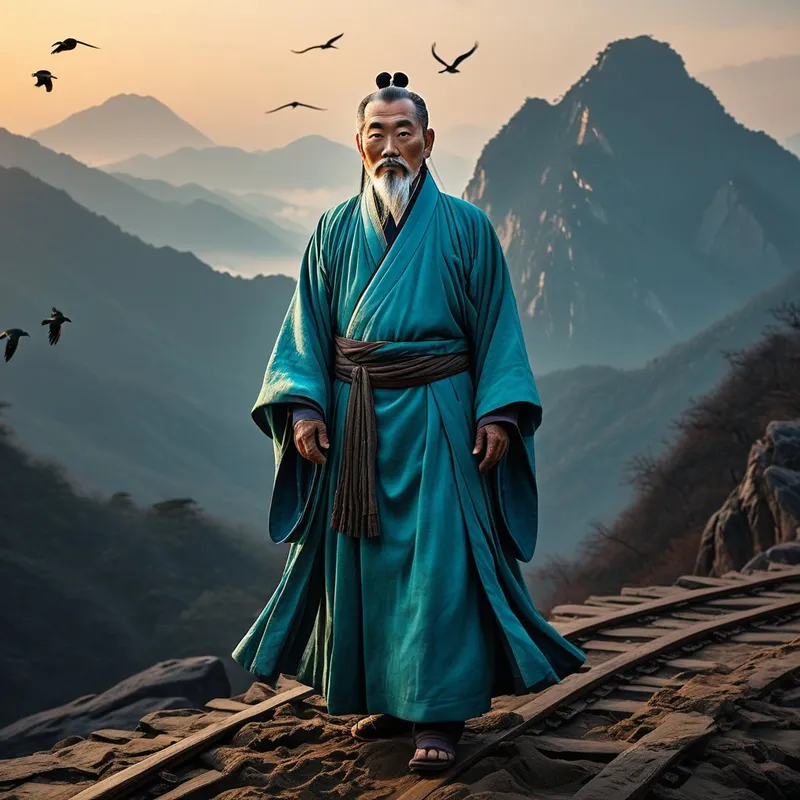
Cangjie Myth Meaning & Symbolism
The myth of Cangjie, who observed nature's patterns to invent writing, a feat so profound it caused the heavens to weep and ghosts to wail.
The Tale of Cangjie
In the time of the Yellow Emperor, the world was vast and full of whispers, but humanity had no way to hold them. Memory was a river, and wisdom flowed away like water. The Emperor, burdened by the weight of governing a realm that could not be recorded, turned his gaze to his most gifted historian, a man named Cangjie.
Cangjie was no ordinary man. He was born with four eyes, two gazing upon the world of form, and two peering into the world of essence. His task was monumental: to devise a method to trap the soul of things, to capture the flight of a thought, to give permanence to the impermanent. For years, he toiled with knots and tallies, but they were clumsy, mute things. Frustration was his constant companion.
Driven by a divine discontent, Cangjie retreated from the court. He wandered to the sacred slopes of Mount Yangwu. There, he sat in stillness, becoming a part of the landscape. He did not just look; he saw. He observed the stars charting their silent paths across the velvet night. He studied the intricate web a spider spun with geometric precision between two reeds. He followed the three-toed print of a pheasant in the riverbank mud, a signature left in clay. He marveled at the cracks upon a tortoise shell, a map of unseen forces.
And then, the veil tore.
The star-paths became lines. The spider’s web became a structure. The bird’s track became a shape. The shell’s crack became a prophecy. In a thunderclap of understanding, Cangjie saw that every thing in creation—every beast, every bird, every river, every star—carried within its form a secret mark, a fundamental pattern that was its true name. His four eyes blazed with celestial light. With a pointed stick, he began to draw. He did not invent; he transcribed. He translated the hidden language of the cosmos into visible form. The claw, the wing, the mountain, the sun—each yielded its essence, becoming the first characters.
As he inscribed the final, foundational character, the universe shuddered in recognition. The heavens, witnessing a secret now made plain, opened up and wept millet from the sky. The ghosts and spirits of the unseen world, whose realms depended on obscurity, let out a chorus of terrified wails, for now their names could be known, their natures pinned down. Creation had been given a mirror, and in its reflection, nothing could ever hide again.

Cultural Origins & Context
The myth of Cangjie is first recorded in texts from the late Zhou dynasty and early imperial periods, such as the Lüshi Chunqiu and the Shuowen Jiezi. It is not a folk tale from the agrarian villages, but a scholar-official’s myth, emerging from the very class whose identity and power were built upon the mastery of the written word. It served a crucial societal function: to sanctify the act of writing, elevating it from a practical tool to a cosmological event.
By attributing the origin of characters to a semi-divine sage acting under imperial mandate, the myth legitimized the authority of the state and the scholarly elite. It presented writing not as a human invention, but as a divine revelation, a uncovering of the universe’s own blueprints. This provided an unassailable foundation for the Chinese literary tradition, making the script inherently sacred, a bridge between the human order (wen) and the cosmic order (Dao).
Symbolic Architecture
At its heart, the myth of Cangjie is about the birth of consciousness itself—the moment the undifferentiated flow of experience is parsed, named, and made intelligible. Cangjie represents the archetypal witness, the part of the psyche that steps back from immersion in life to perceive its patterns.
His four eyes are the ultimate symbol of this dual perception. The two physical eyes see the phenomenal world—the bird, the track. The two spiritual eyes perceive the noumenal pattern—the essence of "bird-ness," the principle of "track-ness." His act is not creation ex nihilo, but profound recognition. He is the midwife of meaning, assisting at the birth of symbols from the womb of nature.
The invention of writing is not an act of making, but an act of seeing. It is the moment the soul recognizes its own thoughts in the face of the world.
The cosmic reactions are deeply symbolic. The "raining of millet" signifies a blessing from the celestial realm, a nourishment from heaven for this great leap in cultural evolution. The "wailing of ghosts" represents the necessary shadow of consciousness: the loss of primal, unconscious unity. To name a thing is to separate from it, to create a subject and an object. The spirits of the undifferentiated, formless realm lament this great divorce, the end of innocence where everything was one and nothing had a name.
The Dreamer's Resonance
When this myth stirs in the modern psyche, it often manifests in dreams of sudden, revelatory insight. One might dream of finding a secret code in nature—the grain of wood forming words, clouds arranging into letters, or hearing animals speak in clear, intelligible sentences. These are dreams of a consciousness ready to synthesize disparate elements of one’s life into a coherent narrative or identity.
Conversely, the dream may carry the terror of the ghosts. This can appear as dreams of being exposed, of one's private thoughts being broadcast, or of familiar objects becoming alien and hieroglyphic. This is the somatic fear of the emerging Self—the anxiety that comes with the burden of self-knowledge and the responsibility it entails. The dreamer is undergoing the psychological process of differentiation, pulling themselves out of the comfortable murk of unconscious habits and assumptions, and the psyche registers both the awe and the terror of this emergence.

Alchemical Translation
For the individual on the path of individuation, Cangjie’s journey is a master blueprint for psychic transmutation. The first stage is the "Imperial Mandate"—the inner imperative, often felt as a crisis or profound dissatisfaction with one’s unexamined life. This drives the retreat to the "mountain," a symbolic withdrawal from collective norms and external noise to engage in deep introspection.
The core alchemical work is Cangjie’s observation. This is the disciplined practice of active imagination or mindful reflection, where one does not just experience emotions, memories, and patterns, but observes them as phenomena. The bird's track is a repetitive behavior; the tortoise crack is a childhood wound; the star's path is a lifelong aspiration. The modern Cangjie sits with these impressions until their underlying, archetypal forms are revealed.
The characters we inscribe on the soul are not invented; they are the decoded signatures of the experiences that have shaped us.
The final, terrifying step is the inscription—giving form to this understanding through journaling, art, therapy, or simply a new, conscious narrative about one’s own life. This act of self-definition is the "raining millet," bringing the nourishing grain of meaning. But it also inevitably causes the "wailing of ghosts"—the protest of the old, unconscious personality, the shadow elements that thrived in obscurity and now resist being named and integrated. The triumph is not in silencing these wails, but in recognizing them as the necessary price of consciousness, the eternal echo of the unity we transcended in order to become our singular, named selves.
Associated Symbols
Explore related symbols from the CaleaDream lexicon: