Camazotz Myth Meaning & Symbolism
The tale of the Hero Twins' descent into Xibalba, where they confront Camazotz, the death bat, in a cosmic trial of courage and cunning.
The Tale of Camazotz
Listen. The world was young, and the sun was a promise yet to be kept. In the deep, breathless dark beneath the roots of the Ceiba, the lords of Xibalba laughed. Their laughter was the sound of bones rattling in jars, of stagnant water dripping in endless caves. To them came the Hero Twins, Hunahpu and Xbalanque, sons of a murdered father, walking the black road of vengeance and destiny.
Their journey was a descent into the belly of fear. They passed through rivers of scorpions and chambers of cold, crossed plains where jagged obsidian blades grew like grass. The Xibalbans tested them with poisoned food, with seats of burning stone, with the suffocating dark. The Twins, armed with wit and the breath of their ancestors, passed each test. But the lords had one final house, a house not of elements, but of pure, shrieking terror: the House of Bats.
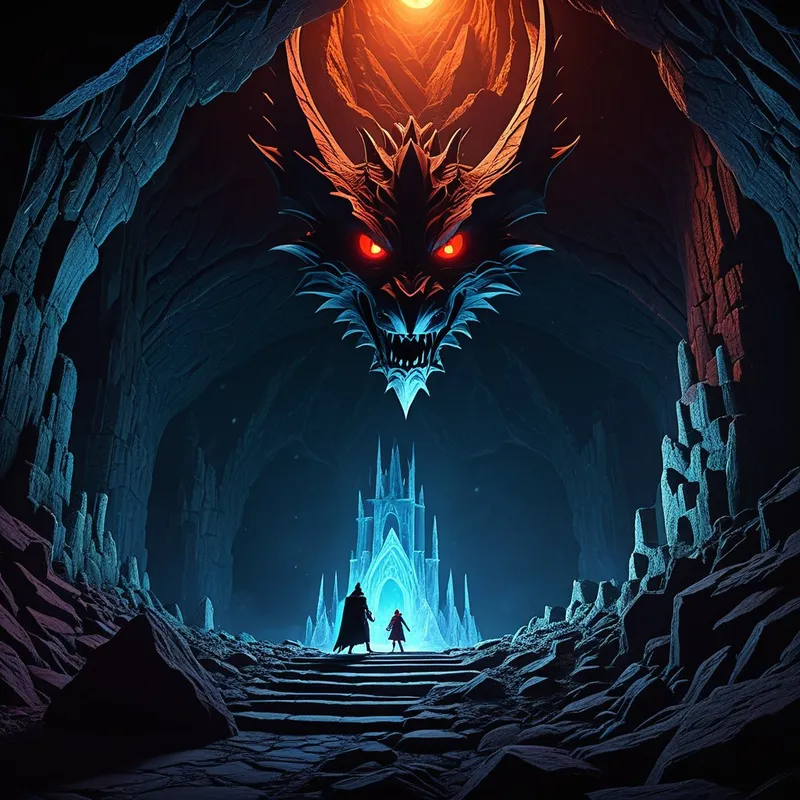
Its entrance was a gaping maw in the living rock. Inside, the air was thick and hot, smelling of damp earth and ancient guano. No light lived here, only a profound, swallowing blackness. The only sound was the ceaseless, high-pitched chittering and the leathery flutter of countless wings—a sound that crawled into the ears and coiled around the spine. The Twins were given a single instruction: survive until dawn, without sleep, without a single cry.
They squeezed themselves into the hollows of their blowguns, hiding from the swarming darkness. The night stretched, an eternity of listening to the skittering on stone. But as the deepest hour approached, a false, cold light seemed to creep into the cavern. Hunahpu, his vigilance worn thin by the endless noise, peeked out to see if dawn had come.
It was not dawn.
It was the gleam on a single, monstrous fang.
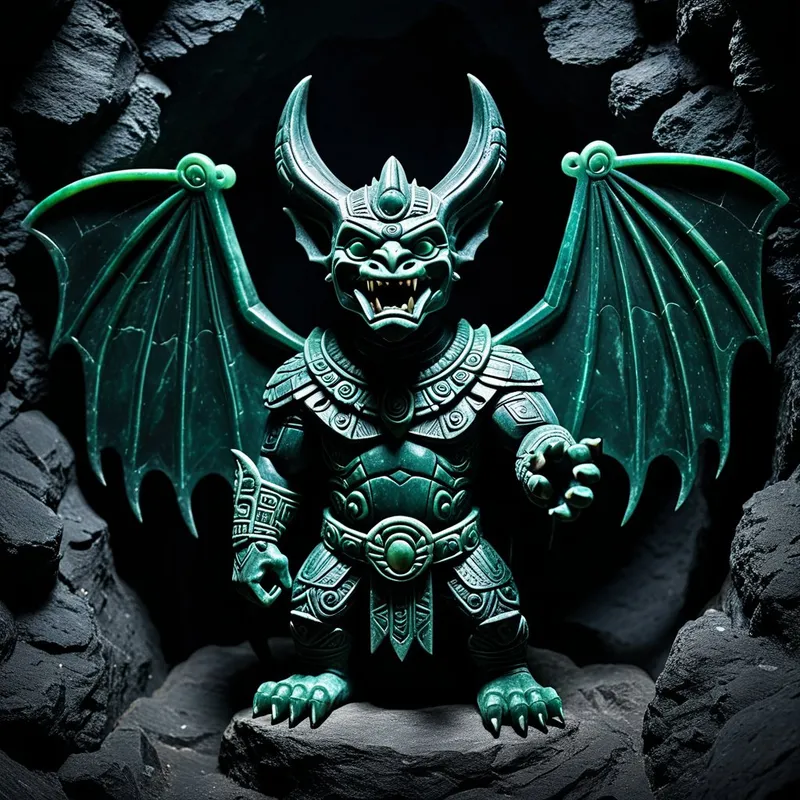
From the vault of the cave, a shape detached itself from the seething mass. It was not merely a bat, but the essence of bat, given god-form: Camazotz. Its body was the color of a deep bruise, its wings vast shrouds of night. Its head was a nightmare fusion—the snarling muzzle of a beast, crowned with the stylized hair of a warrior, and eyes that held the void of the cenote’s bottom. In one clawed hand it held a gleaming obsidian blade, the instrument of ritual death.
With a shriek that stopped the heart, it descended. In an instant, before Xbalanque could move, before a thought could form, the blade flashed. It was not a wound, but a severing. Camazotz snatched the head of Hunahpu clean from his shoulders, carrying it away as a trophy to be placed in the ballcourt of Xibalba. The body of the sun-heir lay still, a headless vessel in the dark. The story, it seemed, had ended in the cold, final way of all things in the underworld.
Cultural Origins & Context
This powerful narrative is preserved in the Popol Vuh, the "Book of the Community," transcribed in the 16th century but echoing traditions millennia old. For the Maya, the story was not mere entertainment but a foundational cosmology, recited by keepers of memory to explain the nature of reality, death, and the heroic struggle required for life itself—embodied in the daily journey of the sun through the dangerous night.
Camazotz itself (likely meaning "death bat" or "snatch bat") was a potent deity, not merely a monster in a story. It governed the dangerous liminal spaces: caves, the night, and most importantly, the moment of sacrifice. The bat’s association with caves linked it to the womb of the earth and the entrance to Xibalba. Its nocturnal flight made it a natural symbol of the unseen, the chaotic, and the deadly aspects of the cosmos that must be acknowledged and appeased. The myth functioned as a societal map for confronting ultimate fear, teaching that even the most brilliant hero (Hunahpu, associated with the sun) could be undone by a moment of impatience with the darkness, requiring the deeper, lunar cunning of his twin for redemption.
Symbolic Architecture
At its core, the encounter with Camazotz is the psyche’s inevitable confrontation with the Shadow in its most terrifying, autonomous form. The House of Bats is the chamber of the unconscious where our primal fears swarm and shriek. Hunahpu’s fatal peek represents the ego’s attempt to prematurely resolve the tension of the dark night of the soul, to force dawn before its time.
To look upon the Shadow without preparation is to be decapitated—to lose the seat of consciousness, identity, and rational control.
Camazotz is the archetypal reaper, not of life, but of illusion. Its blade severs the head from the body, symbolizing a radical disconnection between intellect (head) and instinct, feeling, and grounded being (body). The bat god is the necessary agent of a symbolic death. The head taken to the ballcourt is significant; the ballgame was a ritual reenactment of cosmic struggle, often culminating in sacrifice. Hunahpu’s head becomes the ball—the focal point of the next phase of the myth, where it will be used to trick the lords of death. Thus, the very thing that is lost (conscious control) becomes the essential tool for ultimate victory, but only after it has been transformed by its passage through the realm of the Shadow.
The Dreamer's Resonance
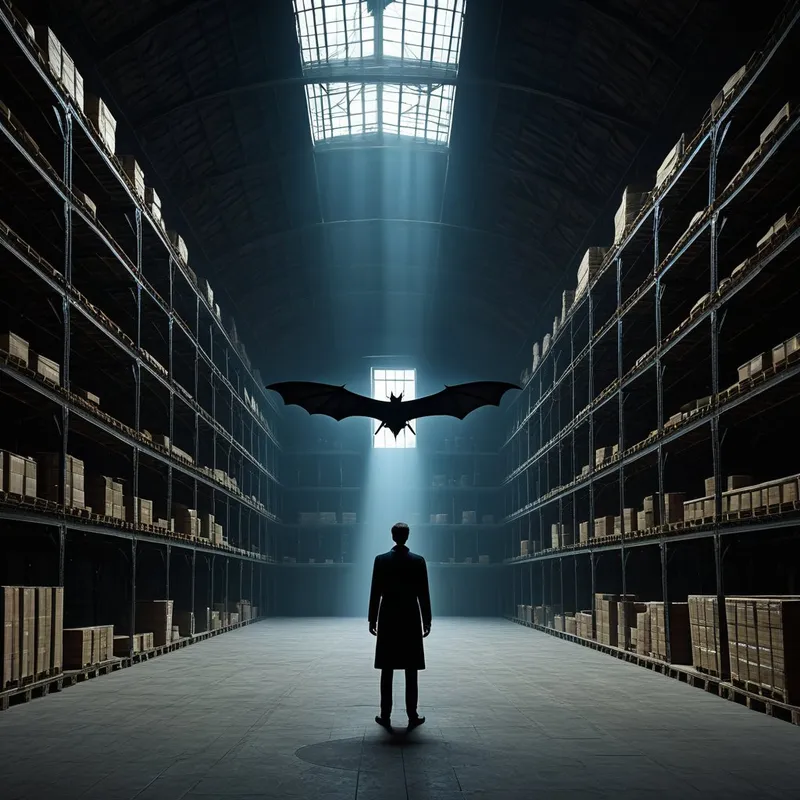
When this mythic pattern stirs in the modern dreamer, it often manifests as dreams of being pursued or attacked in dark, confined, or complex spaces like attics, basements, or labyrinthine buildings. The somatic feeling is one of visceral dread, a tightening in the gut and a literal chilling of the blood. The dream-entity may not be a literal bat-monster, but any form that embodies sudden, shocking severance or violation: a lurking figure with a blade, a silent predator, a force that "snatches" something vital away.
This is the psyche signaling a profound initiation. The dreamer is in their own House of Bats, enduring a necessary psychological ordeal. The process underway is the ego’s confrontation with a repressed complex or a tidal wave of unconscious material so overwhelming it feels annihilating. The "decapitation" symbolizes the felt experience of a loss of old identity, a cherished self-image, or a rigid way of thinking being violently dismantled. The dream is not a prophecy of literal doom, but a depiction of the inner landscape where a part of the self must seemingly die so that a more authentic whole can eventually be reconstituted.
Alchemical Translation
The alchemical journey mirrored in this myth is the nigredo, the blackening, where the prima materia of the psyche is dissolved in the darkness. Hunahpu’s decapitation is the ultimate nigredo experience: total ruin, the reduction of the heroic ego to a lifeless body and a stolen head. There is no bypassing this stage. All light, all conscious striving, is extinguished.
Yet, this is the crucible of transmutation. Xbalanque, the hidden twin who represents the deeper, intuitive, and resourceful Self, does not panic. He accepts the catastrophic loss and begins the work of reclamation. He does not resurrect his brother in the old form; instead, he collaborates with the natural world (securing a squash to serve as a temporary head) and uses cunning to retrieve the original. This is the movement from nigredo toward albedo. The lost consciousness (the head) is not merely recovered; it returns having been "in play" in the underworld, infused with the knowledge of death.
The triumph is not in avoiding the blade of Camazotz, but in surviving its cut and weaving its consequence into a greater strategy of being.
For the individual, the myth models that our most devastating psychological wounds—the sudden losses, the betrayals, the collapses of meaning—are our encounters with Camazotz. The path to individuation demands we enter that dark house and endure the screeching chaos. We must risk the symbolic decapitation, the death of who we thought we were. Only then can the deeper Self (the Xbalanque within) begin the ingenious, patient work of retrieving and reintegrating what was lost, not as it was, but transformed. The bat god’s blade, in the end, is not an instrument of final death, but of initiatory surgery, cutting away the mortal illusion to make way for a consciousness tempered in the blood-dark night of the soul.
Associated Symbols
Explore related symbols from the CaleaDream lexicon: