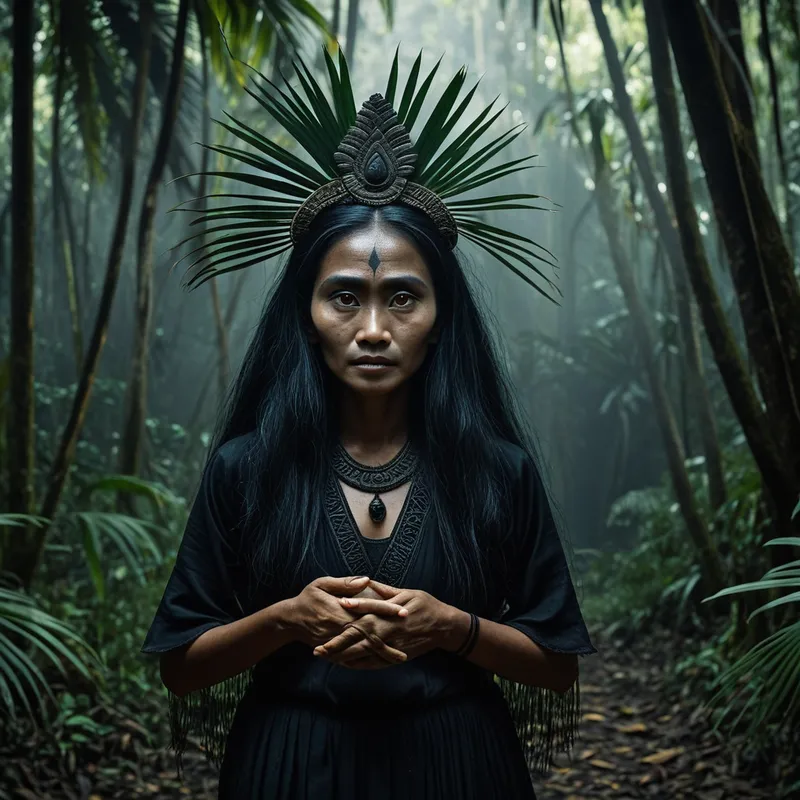
Calon Arang Myth Meaning & Symbolism
A Balinese myth of a powerful widow, Calon Arang, whose grief and rage manifest as black magic, requiring a sacred confrontation to restore cosmic balance.
The Tale of Calon Arang
Listen. In the ancient kingdom of Daha, under a sky heavy with unspoken judgment, there lived a widow. Her name was Calon Arang. She was a woman of profound knowledge, a master of the sacred and the unseen. Yet, the village saw only her solitude. They whispered. They feared her power and her independence. They called her a witch, and with that word, they cast a shadow greater than any she could conjure.
Her daughter, Ratna Manggali, grew into a woman of stunning grace, but the poison of the village’s fear tainted her too. No man would dare court the daughter of the widow-witch. Calon Arang’s grief, a deep and silent well, began to boil. It was not merely a mother’s sorrow; it was the rage of a spirit wronged, a sacred force denied its place in the community. Her love curdled into a sacred, terrible wrath.
From this cauldron of rejected love, she performed a leyak rite. In the dread silence of the graveyard, under a moon blotted by clouds, she opened the lontar of black magic. She called upon Durga in her most terrifying aspect. And the world answered. A plague descended upon Daha. Not of rats or locusts, but of spirit—a wasting sickness that stole breath from the young and strong. The land itself grew sick with her sorrow. The king was powerless. Priests’ prayers turned to ash on the wind.
In desperation, the king summoned the great mpu, Mpu Baradah. This sage did not reach for a weapon of steel, but for a weapon of spirit. He sent his most gifted student, Bahula, on a mission not of war, but of weaving. Bahula was to court Ratna Manggali, to win her heart, and to learn the secret of her mother’s power.
Love bloomed in the shadow of the plague. Bahula and Ratna Manggali married. And in the trusted intimacy of her new husband, Ratna revealed the source: the lontar. One night, as Calon Arang slept, Bahula took it. He fled through the dark forest, the manuscript burning like a cold coal in his hands, and delivered it to his master.
Mpu Baradah did not destroy the book. He understood its power was not evil, but misaligned. He went to meet Calon Arang at the crossroads of her fury. There was no epic battle of flames and steel. Instead, the sage offered her a reflection. He showed her the devastation, not as a king’s victory, but as the monstrous child of her own wounded heart. He spoke not of condemnation, but of the true source of her power, buried beneath the grief. In that moment of supreme confrontation, Calon Arang saw. The rage dissolved, not into nothing, but into a profound, aching recognition. She surrendered the destructive path. The plague ceased. And in many tellings, in that moment of integration, Calon Arang was transformed, released from her torment, her energy returned to the cosmic whole. Balance was restored, not by annihilation, but by sacred understanding.

Cultural Origins & Context
The myth of Calon Arang is rooted deeply in the spiritual soil of Bali, Indonesia. It is a wayang tale, historically performed in the dramatic, flickering light of oil lamps as both entertainment and profound spiritual teaching. Passed down through generations, it was not merely a spooky story but a societal narrative grappling with complex themes. It functioned as a cautionary tale about the dangers of ostracizing the powerful or the different, and the communal responsibility toward those in grief. Furthermore, it validated the immense spiritual authority of the mpu, who were seen as essential mediators not just between humanity and the gods, but between order and the chaotic, potent forces of the unseen world that could be tapped by those on the margins. The story served as a psychic container for the culture’s understanding of feminine power, sacred rage, and the necessary rituals to restore dharma.
Symbolic Architecture
Calon Arang is not a simple villain; she is the embodiment of the Shadow made manifest by collective rejection. Her black magic is the archetypal power of the psyche, turned destructive when denied expression, love, and honor. She represents the sacred rage of the marginalized—the widow, the elder, the knowledgeable woman—whose gifts are feared rather than integrated.
The true horror is not the witch in the forest, but the village that created her.
Mpu Baradah symbolizes the conscious ego, tasked with confronting the Shadow. His method is critical: he does not attack Calon Arang directly but seeks understanding (the stolen lontar). The final confrontation is an act of mirroring, forcing the Shadow to see its own consequences. The lontar itself is a potent symbol of esoteric knowledge—neutral in itself, but taking on the character of its wielder’s heart. Ratna Manggali and Bahula represent the bridge—the possibility of connection and trust that can disarm the most fortified defenses of a wounded soul.

The Dreamer's Resonance
When this myth stirs in modern dreams, it often signals a profound encounter with one’s own “widowed” or exiled power. You may dream of being falsely accused, of possessing a dangerous book or secret, or of unleashing a uncontrollable force that brings blight to your world. The somatic sensation is often one of intense, hot pressure in the chest—a grief-rage trapped and seeking outlet.
This dream pattern indicates a psychological process where a vital part of the self, often tied to deep grief, righteous anger, or potent creativity, has been socially or internally suppressed (“widowed”). The psyche, in its attempt to be heard, begins to manifest this energy in destructive, “plague-like” symptoms: sudden bouts of fury, self-sabotage, or a cynical bitterness that poisons relationships. The dream is the psyche’s dramatic enactment, urging a sacred confrontation, a Mpu Baradah moment within.

Alchemical Translation
The individuation process modeled here is the alchemy of sacred rage. The first matter is the raw, rejected substance: Calon Arang’s grief. The village’s fear acts as the separatio, isolating and corrupting this substance into a toxic force (the plague). Bahula’s courtship is the conjunctio—the building of a bridge between the conscious world and the shadow realm, a relationship based on engagement, not attack.
Transformation occurs not when light banishes darkness, but when darkness is seen as a form of obscured light.
The theft of the lontar is the crucial mortificatio—the “killing” of the old, destructive pattern by removing its source of fuel. Finally, Mpu Baradah’s confrontation is the sublimatio. He does not destroy Calon Arang; he elevates the situation to a higher level of understanding. The rage is not eliminated but transmuted. Its energy is recognized, acknowledged, and thereby reintegrated into the larger psychic system. The plague ends because the exiled power has come home, not as a destroyer, but as a recognized, though forever changed, part of the whole. For the modern individual, this myth teaches that healing our deepest wounds and most terrifying powers requires the courage to face them with a sage’s heart—to offer the mirror of truth, not the sword of judgment.
Associated Symbols
Explore related symbols from the CaleaDream lexicon:
- Wound — The central, festering injury of Calon Arang's rejection and grief, which becomes the source of both her destructive power and the eventual necessity for healing.
- Rage — The sacred, transformative fire of her spirit, which when denied and repressed, manifests as a plague upon the land.
- Shadow — Calon Arang herself is the archetypal Shadow, the personification of all that the community fears and rejects, demanding integration.
- Mirror — Represented by Mpu Baradah's confrontation, which reflects Calon Arang's own actions and consequences back to her, enabling self-recognition and transformation.
- Book — The lontar manuscript, symbolizing esoteric knowledge that is neutral in itself but becomes destructive or healing based on the heart of its wielder.
- Mother — Calon Arang in her primal, protective aspect, whose love, when thwarted, twists into a force of terrible vengeance.
- Ritual — The leyak rites she performs, representing the formal, focused channeling of unconscious psychic energy into the manifest world.
- Forest — The liminal, wild space outside the ordered village where shadow work and encounters with the untamed self must occur.
- Bridge — The relationship between Bahula and Ratna Manggali, which creates a fragile connection across the chasm of fear and mistrust.
- Healing — The ultimate resolution of the myth, achieved not through battle but through understanding, sacrifice, and the restoration of balance.
- Sacrifice — Bahula's mission and the surrender of Calon Arang's destructive identity, both necessary offerings for the renewal of the whole community.
- Dance — Evoking the wayang performance tradition that carries this myth, a ritualized movement that contains and expresses these profound psychic dynamics.