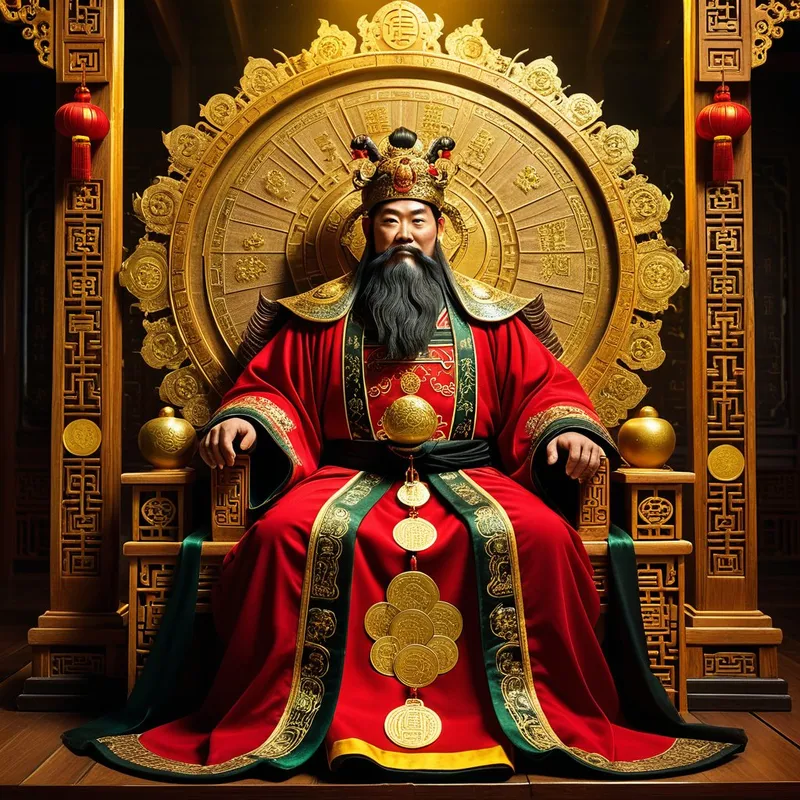
Caishen Myth Meaning & Symbolism
The celestial deity of wealth, whose myth reveals that true fortune is not merely gold, but a sacred alignment of virtue, fate, and inner worth.
The Tale of Caishen
Listen, and hear the tale that echoes in the clink of coin and the rustle of banknotes, a story not born of mortal mint but forged in the celestial fires of the Mandate of Heaven. In the time when dragons still traced the riverbeds and phoenixes nested in the peaks of Kunlun, the Heavenly Court decreed that the fortunes of the mortal realm required a steward. Not a careless distributor of random luck, but a magistrate, a divine accountant of destiny.
From the union of stellar essence and earthly virtue was formed a being of immense gravity and golden light. Some say he was once a loyal minister, Bi Gan, whose righteous heart was cut out by a tyrant, and thus, seeing all, could judge without bias. Others whisper he was Zhao Gongming, a formidable general who commanded the winds and rains, and upon his ascension, was given dominion over the world’s treasures. He resides not in a palace of mere opulence, but in the Celestial Treasury, a realm where gold flows like water yet is bound by ledgers of iron-clad law.
His visage is one of formidable authority. He wears robes the color of blood and night, embroidered with the Bagua. In one hand, he holds the Ru Yi, a scepter that bends reality to grant righteous desires. In the other, a golden ingot, the primal seed of all prosperity. At his feet often rests or strides the Black Tiger, a creature of mountain and shadow, guardian of the hidden hoards. His attendants, Li Jiaxing and He He Xian’er, carry baskets spilling with coins and scrolls that record every act of generosity and greed.
The conflict he oversees is eternal and internal: the discord between human desire and heavenly worth. He does not simply shower gold. He descends, sometimes in disguise—a weary traveler, a ragged merchant—to walk the dusty earth. He listens to the prayers not of words, but of actions. He witnesses the shopkeeper who shares his last bowl of rice, the farmer who returns a lost purse. He sees the heart swollen with envy and the hand clenched in avarice. His judgment is not punishment, but alignment. To the virtuous, his touch might be a dream of a hidden spring, the sudden fair price for a heirloom, the unexpected patronage. To the corrupt, fortune becomes a leaking jar, a sudden storm ruining a dishonest harvest, a wealth that brings only isolation and fear. His myth is the resolution of a cosmic equation: your inner currency must match your outer ledger. True wealth, he proclaims without words, is the resonance between your soul’s virtue and your material world.

Cultural Origins & Context
The veneration of Caishen is not the product of a single author or dynasty, but a deep, cultural sedimentation. Its roots intertwine with Taoist pantheon-building, folk hero deification, and the pragmatic spiritual needs of an agrarian and mercantile society. As commerce flourished along the Silk Road and later within imperial China, the abstract concept of “fortune” required a face, a bureaucracy mirroring the earthly one. Caishen emerged as the divine counterpart to the Minister of Revenue.
His stories were passed down not in one sacred text, but in a thousand ways: through oral tales told in teahouses and market squares, through the vibrant prints nailed to shop doors and home altars during the Lunar New Year, and through operatic performances where his imposing figure would descend on stage to bless the virtuous. This was a populist mythology. While the imperial court had its elaborate rites to ensure the wealth of the nation, every family, from the merchant prince to the humble farmer, had a personal relationship with Caishen. His societal function was dual: he was a source of hope and a mechanism of moral enforcement. He validated the struggle for material security while sanctifying the principles of hard work, fairness, and communal responsibility. To worship Caishen was to engage in a spiritual economics, acknowledging that prosperity was a divine collaboration, not a solitary theft.
Symbolic Architecture
At its core, the myth of Caishen is a profound symbolic system addressing humanity’s most potent shadow: its relationship with the material world. He is not a god of money, but the archetypal principle of Tian Li (Heavenly Order) as it applies to earthly resources.
Wealth, in this cosmology, is not a passive object to be possessed, but an active, relational energy—a measure of one’s harmony with the cosmic flow.
The Golden Ingot he holds is more than bullion. It is the prima materia, the unformed potential of value. The Celestial Ledger symbolizes the inescapable law of psychic cause and effect—what we might call karma or the unconscious accounting of the Self. The Black Tiger represents the raw, instinctual, and often feared power of the libido and life force, which must be mastered and integrated, not denied, for true prosperity. His disguises signify that the divine test is always immanent, woven into the fabric of the ordinary. The moment of “luck” or “loss” is thus recast as a moment of profound psychological revelation, a feedback loop from the Self.
The Dreamer's Resonance
When the pattern of Caishen stirs in the modern dreamer, it signals a critical engagement with one’s inner economy. To dream of finding or losing great sums of money, of being judged by a stern authority figure over finances, or of encountering a mysterious benefactor or thief, is to dream of Caishen’s court.
Somatically, this may manifest as tension in the solar plexus—the seat of personal power and self-worth—or a clutching in the hands. Psychologically, the dreamer is undergoing an audit of the soul. Are they living in alignment with their deepest values? Are they “spending” their life energy (time, creativity, attention) on what they truly cherish, or are they in deficit, pursuing hollow symbols of success? The dream may highlight a feeling of “poverty consciousness”—a sense of scarcity and fear—or its shadow, an inflated “grandiosity” that is spiritually bankrupt. The figure of Caishen in a dream does not bring a lottery ticket; he brings a mirror, forcing the dreamer to confront the true balance sheet of their existence.

Alchemical Translation
The individuation process modeled by Caishen is the alchemical transmutation of “lead” into “gold” at the level of the psyche. The “lead” is our base, unconscious relationship with matter: greed, envy, hoarding, fear of scarcity, or identification with status. The “gold” is the realization of authentic value, where external resources become a true reflection of inner wholeness and purpose.
The myth teaches that the treasure is not at the end of the quest, but is uncovered in the very manner of the seeking.
The first stage is the Nigredo, the descent. This is Caishen’s disguise, the feeling of lack, the financial or creative “dry spell.” It is a necessary darkening that forces introspection. The second is Albedo, the washing. This is the audit, the honest appraisal of one’s deeds and motivations (the Celestial Ledger). It requires purifying intention, separating the ego’s desire for aggrandizement from the soul’s need for meaningful expression. The third is Rubedo, the reddening. This is the integration of the Black Tiger—the passionate, disciplined application of one’s unique skills and life force into the world, in service of something greater than the self. The final stage is the production of the Gold, the Lapis Philosophorum. This is not infinite money, but a state of being where one’s work in the world is both prosperous and profoundly aligned with one’s essence. One becomes, in a sense, a steward of their own celestial treasury, where fortune is the natural offspring of integrity, and wealth is the capacity to generate life, beauty, and value for the whole community. The devotee does not beg Caishen for riches; they strive to become a worthy vessel through which the principle of Caishen can responsibly flow.
Associated Symbols
Explore related symbols from the CaleaDream lexicon: