Cahokia Mounds Myth Meaning & Symbolism
A myth of a great city built in alignment with the cosmos, whose survival demanded a sacred sacrifice, leaving behind silent, monumental earthworks.
The Tale of Cahokia Mounds
Listen. Before the rivers wore these deep channels, when the land breathed a different air, there was a place where the earth itself reached for the sky. It was a city of the sun, the People of the Great River. They did not build with stone, but with the very flesh of the world—basket upon basket of dark, living soil, carried in a sacred labor that spanned generations.
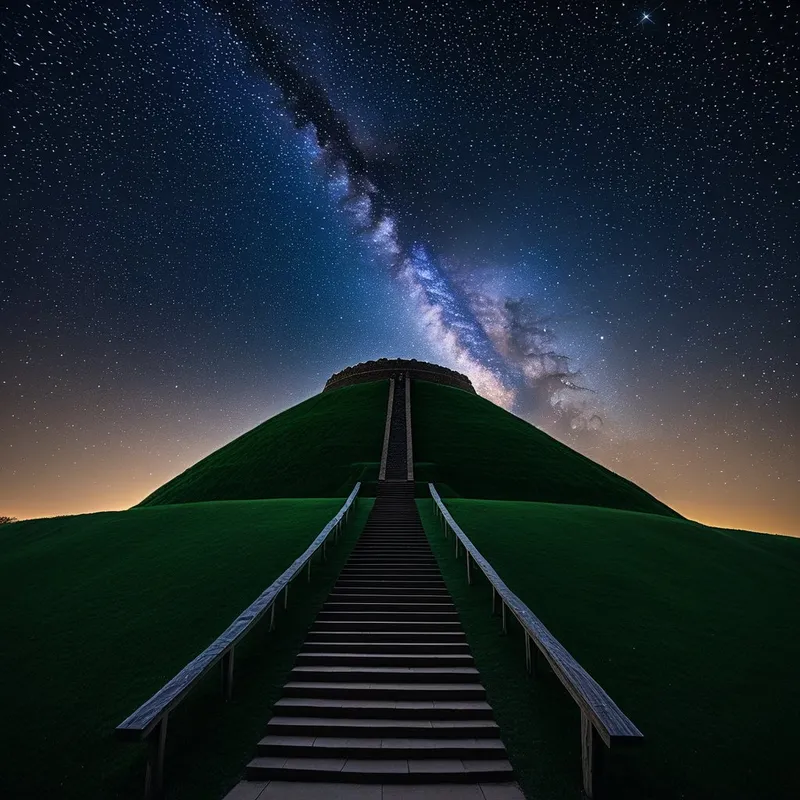
The heart of this place was the Great Mound, a sleeping giant of earth. Its slopes were gentle, but its summit touched the realm of Wakȟáŋ Tháŋka. There, the Míko would stand, a figure between worlds. To the west lay the plaza, a vast, flat mirror for the sky, where the people gathered like grains of pollen in the wind. And surrounding all, more mounds—hundreds of them—like the vertebrae of a great, resting serpent, or the stars of a constellation fallen to earth.
The city thrived. Corn grew tall, games were played on the plaza, and traders brought shells from southern seas and copper from northern lakes. The world was in balance. The people watched the sun. They saw it birth itself in the east from the Unčí Makhá, climb to its throne at midday over the Great Mound, and die in the west, only to be reborn again. They built their city to sing this song of death and rebirth. A great circle of red cedar posts, the Woodhenge, stood as a calendar of light, marking the solstices when the sun would kiss specific mounds on the horizon.
But the balance is a fragile thing. The seasons turned, and a silence began. The rains grew shy. The corn stalks whispered of thirst. The game moved farther away. The song of the world was slipping out of tune. The Míko fasted and sought visions. In his dreams, he walked the Wanáǧi Thacháŋku. There, the Star People spoke not in words, but in a terrible, necessary knowing. The city was a living being, they said. It had grown too large, its spirit too hungry. It fed on the harmony between earth and sky, and that harmony was fraying. To mend it, to make the rains return and the corn grow, the city itself must be fed. Not with grain, but with a perfect offering—a life that embodied the bridge between the worlds.
The choice was a darkness deeper than any night. It was not a sacrifice of an enemy, but of one of their own, a pure thread in the community's fabric. A young man, a dancer who had moved like sunlight on water, was chosen. His consent was not in words, but in the stillness of his acceptance. For three days and nights, the people sang the mourning songs of creation. On the fourth dawn, as the sun's first light struck the central post of the Woodhenge, they laid him upon a bed of finely woven mats atop a lesser mound facing the Great Mound. They surrounded him with gifts: mica from the mountains, shells from the gulf, a cup from a distant land. Then, with tender, ritual care, they began to cover him. Basket by basket, they buried him not in a grave, but in a new mound, a sacred tomb. His spirit did not travel the Path of Souls alone; it became the anchor, the new root, holding the city to the earth and pulling the sky's blessing down.
For a time, the balance returned. The rains fell. The city sang again. But the memory of that offering lived in the soil. Generations passed. The world shifted. The people, in ones and twos, then in streams, began to leave. They did not flee in panic, but departed with a slow, deliberate sorrow, as if following a quieter song only they could hear. They walked away from the great plazas and the towering mounds, letting the grasses reclaim the stairs, the winds silence the games. They left the city to the sun and the rain, to the sleeping giant and the anchored spirit. They became the whisper in the oak trees, the shadow in the river mist, leaving behind only the shape of their prayer in the earth—a question in soil, waiting for a future age to listen.

Cultural Origins & Context
The story woven above is not a single, preserved narrative, but a tapestry reconstructed from threads of archaeology, descendant oral traditions, and the broader mythological lexicon of the Mississippian Ideological Interaction Sphere. Cahokia itself (c. 1050-1350 CE) left no written records. Its myths are inscribed in the landscape: the alignment of mounds with solar and stellar events, the burial of high-status individuals with profound ritual care, and the evidence of large-scale, coordinated communal activity.
The "myth" of Cahokia is therefore a landscape myth. It was passed down not solely by storytellers, but by surveyors, priests, and farmers who lived the cosmology. The societal function was one of cosmic ordering. Building and maintaining the mounds was a continuous act of world-building and world-sustaining, aligning human society with the perceived order of the heavens. The potential for sacred sacrifice, evidenced by the "Beaded Burial" and other ritual interments, speaks to a profound theological concept: that the vitality of the cosmos and the community required the ultimate reciprocal gift. The eventual, peaceful abandonment of the site around 1350 CE may itself have become a powerful cultural narrative—a lesson in the cyclical nature of all things, even great cities, and the wisdom of knowing when a cycle is complete.
Symbolic Architecture
At its core, the Cahokia mythos is a profound meditation on the relationship between sacrifice and structure, between the individual and the collective psyche.
The mound is the solidified prayer, the permanent gesture of a community reaching for transcendence. Its stability is purchased not by stone, but by sustained, collective will and, at times, by ultimate individual consent.
The Great Mound symbolizes the axis mundi, the world center where communication between the earthly, celestial, and underworld realms is possible. It is the ego's aspiration to connect with the higher Self (the celestial order) and integrate the depths of the unconscious (the fertile, chaotic earth). The ritual sacrifice represents the unbearable but necessary price of consciousness. To establish a lasting order (the city), a piece of the instinctual, undifferentiated life force (the vibrant youth) must be consciously offered up and transformed. It is the killing of the purely natural state to feed a cultural and spiritual reality.
The eventual abandonment is perhaps the most sophisticated symbol. It is not a failure, but a completion. It signifies the understanding that no structure, no matter how grand, is eternal. The psychic energy that built Cahokia eventually had to be withdrawn, to be reinvested elsewhere, to allow for new growth. The mounds left behind are the psychic scars or monuments of a completed complex—still potent, still symbolic, but no longer actively inhabited by the conscious mind.
The Dreamer's Resonance
When this myth stirs in the modern dreamer, it often manifests as dreams of colossal, silent earthworks in unexpected places—a grassy pyramid at the end of one's street, or a vast, empty plaza discovered in a familiar forest. The somatic feeling is one of awe mixed with profound loneliness. The dreamer is often alone, a tiny figure facing an immense, silent architecture.
This dream signals a process of psychic infrastructure work. The dreaming culture.") ego is encountering the massive, often unconscious, structures of its own psyche: a long-held belief system (a mound), a foundational but now outdated identity (the city), or a deep, ancestral pattern (the solar alignment). The emptiness indicates a feeling that this inner structure, while monumental, is no longer "inhabited"—its old meanings and energies have departed. The dream may be asking the dreamer to acknowledge the scale of these inner constructs, to walk their contours, and to listen for what sacrificial offering (an old habit, a cherished pain) might have been made to build them. It is a dream of surveying one's own inner history, preparing not necessarily for demolition, but for a respectful, conscious relationship with the ruins of past selves.
Alchemical Translation
The alchemical journey modeled by Cahokia is the opus of coagulatio (solidification) followed by a sacred mortificatio (death), culminating in a voluntary sublimatio (ascent and dispersal).
First, the coagulatio: the chaotic, fluid potentials of the unconscious (the earth) are gathered, focused, and given form through sustained, conscious effort (the basket-by-basket labor). This is the building of the ego-complex and a stable persona—the "city" of the conscious personality, aligned with one's highest ideals (the cosmos).
The true sacrifice is not of life, but of identification. One must 'bury' the part of oneself that believes it can live forever in a single, perfect form to nourish the soul's ongoing journey.
Then, the critical mortificatio: the realization that this structure is not self-sustaining. To give it soul, to make it a living part of the psyche and not just a sterile monument, a sacrifice is required. In individuation, this is the sacrifice of the ego's total autonomy. The dreamer must willingly "bury" a piece of their youthful, uncomplicated identity (the dancer) into the foundation of their being. This is the painful integration of shadow, the acceptance of limitation, the offering of a personal desire to a transpersonal need for wholeness.
Finally, the sublimatio: the abandonment. This is the most advanced stage. After the structure is built and consecrated by sacrifice, the conscious mind must eventually learn to leave it. This is the transcendence of the very complex one has built. The ego, having used the "city" of its achievements and identities as a vessel for growth, now finds it too small. It must withdraw its primary identification, letting that former self become a monument in the landscape of memory—respected, but no longer home. The psychic energy is freed, like the people dispersing, to flow into new cycles of becoming. The mounds remain within us, not as prisons, but as testament: you built this, you offered for it, and you had the wisdom to walk away when its purpose was served, carrying only the wisdom forward into the next plain.
Associated Symbols
Explore related symbols from the CaleaDream lexicon: