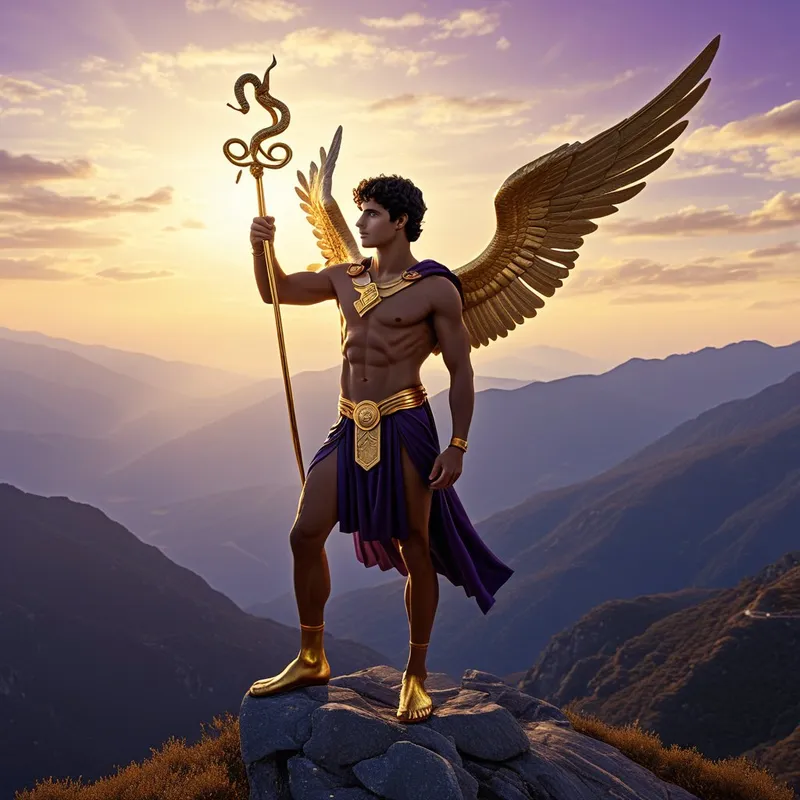
Caduceus of Hermes Myth Meaning & Symbolism
The story of how the messenger god Hermes received his magical staff, the Caduceus, by reconciling two warring serpents, becoming a symbol of mediation and transformation.
The Tale of Caduceus of Hermes
Hear now the tale of the first light on the path, of the whisper between worlds. Before the roads were stone, they were intention. And the one who walked them was not a man, but a presence—a laughter in the rustling leaves, a chill at the back of the neck when a secret is born. He is Hermes, son of Zeus and the star-cloaked nymph Maia. His feet are winged from the moment he leaves his cradle, his mind quicker than the hawk’s dive.
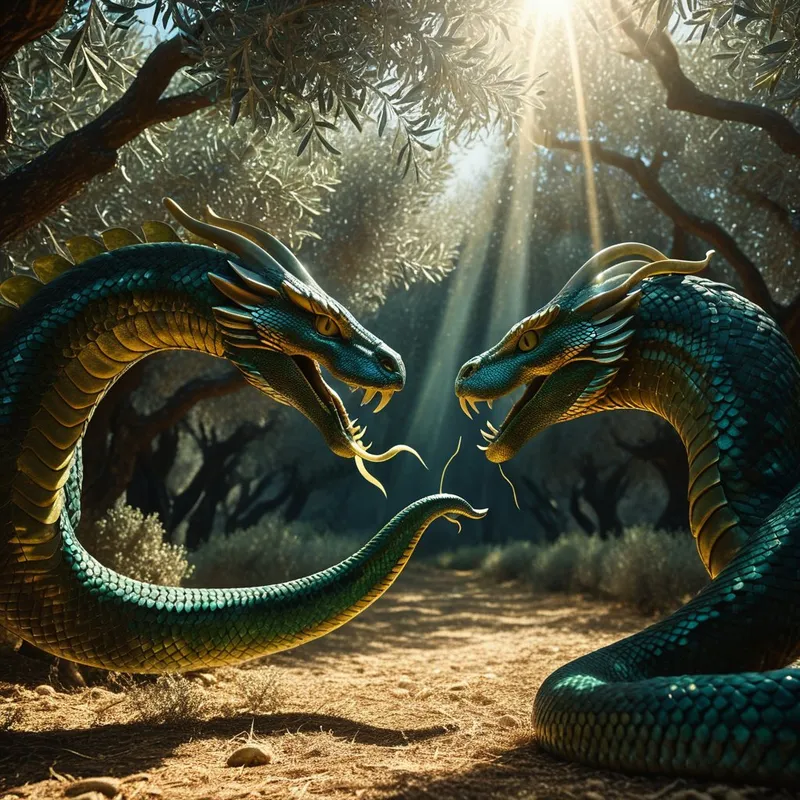
On a day when the sun hung heavy as ripe fruit, Hermes walked a dusty cleft between two great mountains. The air, usually humming with cicadas, was silent and thick with a different tension—a primal rage that vibrated through the very rocks. There, in a sacred grove of ancient, gnarled olives, he found the source. Two serpents, magnificent and terrible, were locked in a battle of absolute annihilation. One was the color of burnished copper and desert heat, its eyes coals of possessive fury. The other was the shade of deep river shadows and cool jade, its gaze a glacial wrath. They were not merely fighting; they were enacting a paradox, each embodying a force that denied the other’s very existence. Their hisses were the sound of worlds refusing to meet.
Hermes paused. A lesser god might have smote them, or passed by with a shudder. But Hermes, the connector, the translator, saw not a problem to be ended, but a conversation to be begun. He did not draw a sword. Instead, he reached for a simple staff of olive wood he carried, a wand of his travels. With a motion as fluid as the turning of a tide, he placed the staff directly into the seething space between the two raging heads.
The effect was not immediate. The serpents struck at the wood, their fangs scoring the grain. But Hermes held fast, his presence a calm, unwavering axis in the storm of their duality. He did not force. He mediated. He became the still point. Slowly, impossibly, the fury began to transmute. The coiling, striking bodies began to weave, not against each other, but around the central staff. The copper serpent softened its heat; the jade serpent warmed its cold. Their endless, horizontal conflict found a new, vertical axis. They spiraled upward in an intricate, living braid, a dance of reconciled opposition.
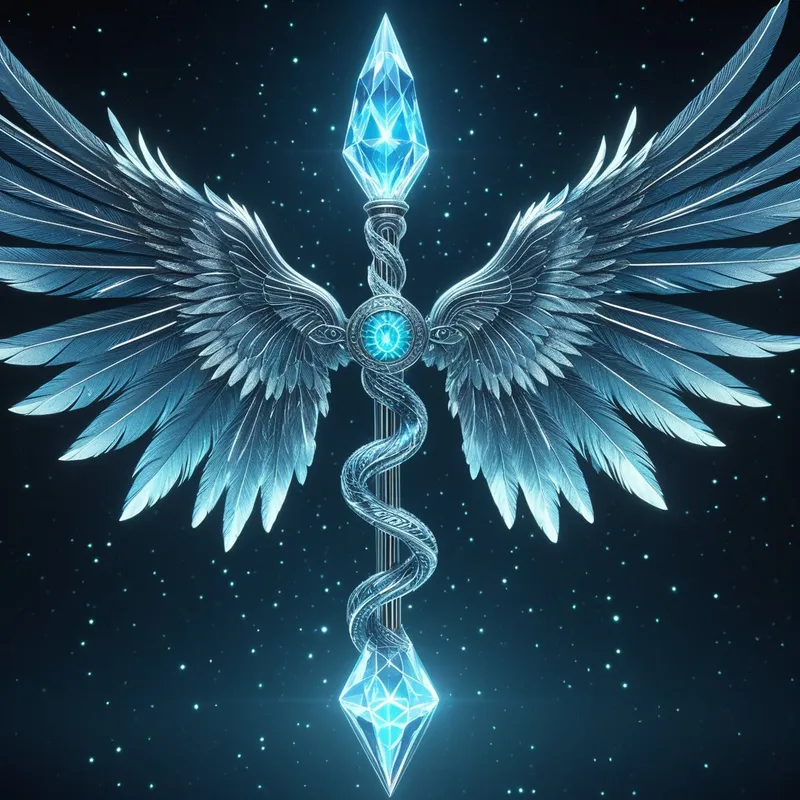
As they met at the apex of the staff, a miracle of integration occurred. From their reconciled being, two wings of pure light unfurled—not from the staff, but from the point of their union. The simple wand was now the Caduceus. Where there was chaos, there was now a sigil of dynamic peace. Hermes lifted the staff, and the serpents, now wise and calm, rested in their eternal embrace. He had not conquered them; he had introduced them to each other, and from that introduction, a higher power was born.
Cultural Origins & Context
The myth of the Caduceus is not a single, codified story from a text like Homeric Hymn, but a symbolic narrative that coalesced around the figure of Hermes over centuries. Its roots are likely pre-Greek, drawing from ancient Near Eastern motifs of entwined serpents as symbols of fertility, healing, and cosmic balance. In the fluid oral traditions of ancient Greece, storytellers and rhapsodes would have woven this tale to explain the origin of the god’s most iconic attribute.
The Caduceus was Hermes’ badge of office. As the divine herald, he moved freely between Olympus, the mortal world, and even the underworld. The staff was his passport and his tool of safe passage. The myth served a vital societal function: it modeled the divine sanction for diplomacy, negotiation, and commerce. In a world of often brutal conflict, the Caduceus represented the possibility—and the divine art—of resolving disputes through clever mediation rather than sheer force. It was a narrative anchor for the Greek values of metis (cunning intelligence) and xenia (the sacred guest-host relationship), both realms governed by Hermes.
Symbolic Architecture
At its core, the Caduceus is a map of consciousness. The two serpents represent the fundamental, often warring, dualities within the psyche and the cosmos: conscious and unconscious, spirit and matter, active and passive, solar and lunar, life drive and death drive. Their initial state is one of blind opposition, a civil war within the self that leads only to exhaustion.
The staff is the axis of the Self, the unwavering central principle that can hold the tension of opposites without identifying with either.
Hermes’ intervention symbolizes the emergence of the mediating function of the psyche—the transcendent function, in Jungian terms. He does not choose a side; he introduces a third, reconciling element. The act of the serpents entwining around the staff is the alchemical coniunctio oppositorum (the conjunction of opposites), the sacred marriage that gives birth to a new, more complex reality. The wings that sprout are the emergent property of this integration: elevated consciousness, spiritual insight, and the freedom that comes from inner resolution. The Caduceus, therefore, is not a symbol of simple peace, but of dynamic, creative tension harnessed into a generative force.
The Dreamer's Resonance
When the motif of the Caduceus or the two serpents appears in modern dreams, it signals a critical moment of intrapsychic negotiation. The dreamer is likely caught in an inner conflict so profound it feels irreconcilable: perhaps between a logical career path and a creative calling, between the need for security and the urge for freedom, or between a cherished identity and a emerging shadow aspect.
Somatically, this may manifest as a feeling of being "torn in two," tension headaches, or a knotted sensation in the gut. The dream image—whether it’s two animals fighting, two colors swirling, or an actual staff-like object—calls for the dreamer to embody the Hermes principle. It asks: Can you find a middle ground? Can you hold the space for these two parts of yourself to communicate, rather than annihilate each other? The dream is presenting the conflict not to torment, but to initiate a process of weaving. The resolution is not the victory of one side, but the creation of a new, more capacious inner structure that can contain both.
Alchemical Translation
The myth of the Caduceus provides a precise model for the Jungian process of individuation—the journey toward psychic wholeness. We all begin with our inner "serpents" at war. The conscious ego (one serpent) often denies or represses the demands of the unconscious shadow or anima/animus (the other serpent), leading to neurosis, projection, and a fragmented life.
The first step, embodied by Hermes’ journey, is to consciously encounter this conflict, to walk into the "olive grove" of our own depth and face the raging opposites. The second, and most crucial, step is to introduce the mediating staff—the observing Ego that can say, "I contain both these energies." This requires holding the tension without rushing to a premature, one-sided solution.
The alchemical work is in the patient, persistent holding. The transmutation occurs not by force of will, but by the gravity of conscious attention.
As we hold this space, the opposites begin to lose their absolute, antagonistic quality. They start to relate, to spiral around the central core of our developing Self. The "wings" that emerge are the gifts of this integration: a newfound sense of inner authority, creative inspiration that springs from reconciled depths, and the ability to move with agility (Hermes’ signature trait) through life’s contradictions. We become, like the Caduceus itself, a living symbol of connection—able to navigate between our own inner realms and mediate between the various opposites we encounter in the world, transforming conflict into a creative, ascending spiral.
Associated Symbols
Explore related symbols from the CaleaDream lexicon: