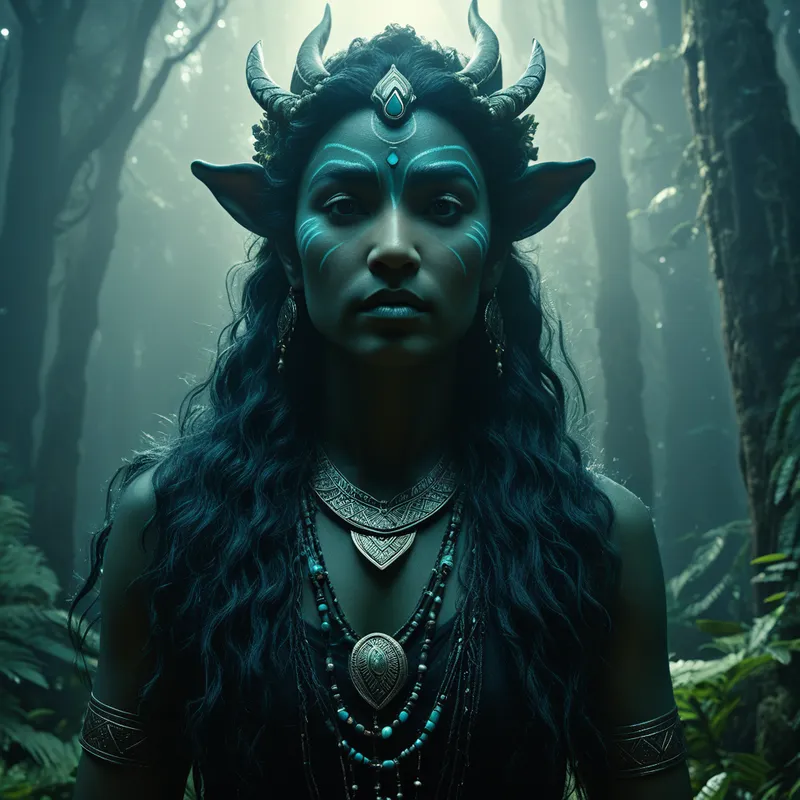
Cabrakan the Earthquake Demon
A fearsome Maya earthquake demon who shakes the earth and shatters mountains, embodying primal destructive forces in Mesoamerican mythology.
The Tale of Cabrakan the Earthquake Demon
In the deep, stone-boned heart of the world, where the roots of mountains drink from subterranean fires, there lived a being of pure, unthinking force. His name was Cabrakan, and he was the Earth-Shaker, the Mountain-Sunderer, son of the primordial creators Vucub Caquix and Chimalmat. He and his brother, Zipacna, the Maker of Mountains, were giants of the early, unfinished world, creatures of appetite and raw power who recognized no law but their own hunger.
Cabrakan’s existence was a simple, terrifying cycle. He would stride across the land, his footsteps a low, gathering thunder. When a peak pleased him—or displeased him—he would set his shoulders against its flanks and heave. With a sound like the sky tearing, the mountain would crack, its spine shattered, its summit crumbling into dust and boulders. He did this not from malice, but from a kind of monstrous play, the way a child might knock over a tower of blocks. The world was his to test, to break, to prove his strength against. He fed on the very ruins he created, consuming the fallen mountains as his meal.
This reign of terrestrial terror could not stand. The Hero Twins, Hunahpu and Ixbalanque, the destined orderers of the world, saw in Cabrakan a fundamental threat to the stability of creation. They knew they could not meet his brute strength with their own. Instead, they would trap him with his own nature. Disguising themselves, they sought out the giant, speaking not of challenge, but of a greater, more impossible feat.
They spoke of a mountain named Cahuan, so vast and so firmly rooted that it defied even Cabrakan’s might. His pride, a simpler, purer form of his destructive rage, was ignited. He demanded to be taken to it. On the journey, the cunning twins prepared a feast. They roasted a great bird, but the meat was not mere fowl; it was seasoned and coated with a plaster of white earth, tz’ite, a substance of magical weight and immobility. Ravenous, Cabrakan devoured it.
As they approached the appointed place, the twins pointed not to a mountain, but to the wide, empty sky. “There,” they said, “is the greatest peak of all.” Cabrakan, his senses already growing heavy and dull from the enchanted meal, strained to see it. His confusion was the final trigger. The magical plaster within him began to petrify his joints, to root him to the spot with the weight of the earth itself. His strength, which could level stone, turned inward. As he struggled, his own power broke him. The Earth-Shaker was brought down not by a greater force, but by the alchemy of his own gluttony and pride, transformed into a captive of the very substance he sought to dominate. In some tellings, he was buried there, his restless tremors forever after manifesting only as the faint, shaking sighs of the imprisoned earth—the earthquakes that remind the world of the giant sleeping in its depths.
Cultural Origins & Context
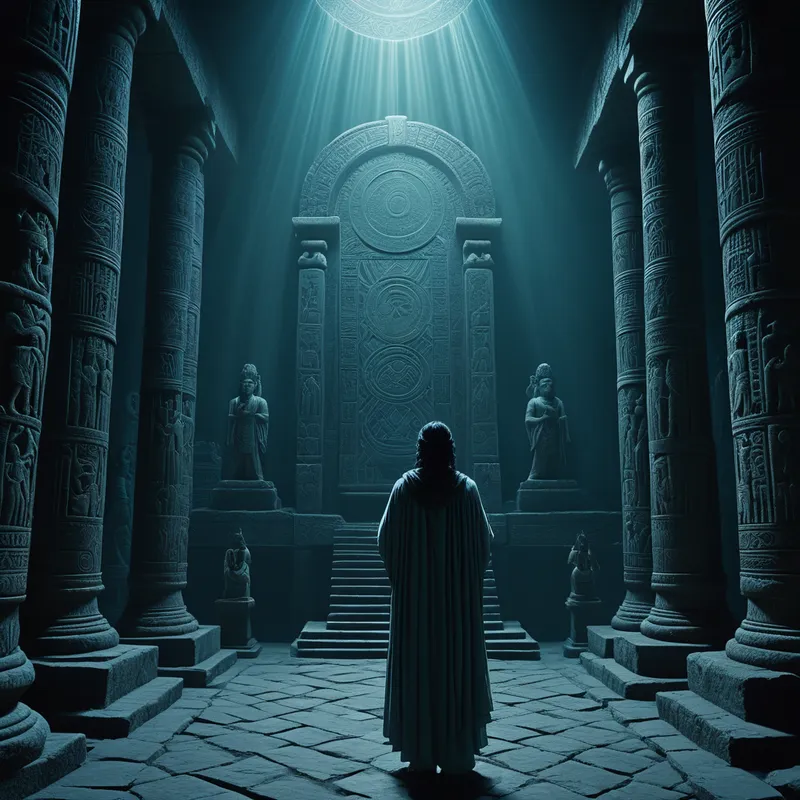
Cabrakan’s story is woven into the fabric of the Popol Vuh, the K’iche’ Maya book of creation. He belongs not to the age of humans, but to the previous, mythic era of the Hero Twins’ cleansings. This places him as a pre-human, elemental force that must be subdued for the current world-order to be established. He is not a god to be worshipped in temples, but a demonic force—a k’uh, or sacred power, gone wild—that embodies a specific and ever-present environmental threat.
In the seismically active landscape of Mesoamerica, earthquakes were not abstract concepts but visceral, house-collapsing, land-altering realities. The Maya, astute observers of natural phenomena, sought mythic explanations for these terrifying events. Cabrakan provided that explanation: the earth shakes because a buried, rebellious giant stirs in his bonds. His myth is a profound piece of geo-mythology, personifying geologic force into a narrative that could be understood, and whose subduing by culture-heroes offered a psychological reassurance. It speaks to the Maya understanding of the world as a living, sometimes violent entity, where balance is not a static peace but an ongoing achievement won against chaotic, primal powers.
Symbolic Architecture
Cabrakan represents the unintegrated shadow of the earth itself—its capacity for sudden, catastrophic rearrangement. He is the embodiment of the necessary destruction that precedes new foundations. While his brother Zipacna builds mountains, Cabrakan tests their integrity by destroying them. This is not mere chaos, but a form of cosmic pressure, a relentless questioning of all that appears solid and permanent.
He is the psyche’s own seismic event—the sudden upwelling of repressed material that shatters the carefully constructed landscapes of the ego. His rebellion is against stasis itself, against any mountain of belief or identity that claims to be eternal and unassailable.
His defeat is equally symbolic. He is not slain, but bound, his energy transformed and contained. The earthquake is not eliminated; it is integrated into the world’s functioning as a limited, occasional release. This reflects a sophisticated worldview that does not seek to eradicate chaotic natural forces, but to ritualize and mythologize their place within a larger, cyclical order. Cabrakan’s fate teaches that raw, destructive power cannot be met head-on by its opposite, but must be transmuted through cunning, patience, and a deep understanding of its own nature.
The Dreamer's Resonance
To encounter Cabrakan in the inner landscape is to experience a foundational tremor. He appears in dreams of collapsing buildings, of sudden cracks appearing in the ground beneath one’s feet, or in the overwhelming feeling that a long-held, seemingly solid structure of life—a career, a relationship, a self-image—is being shaken to its core. He is the personification of existential anxiety, the fear that everything one relies upon is inherently unstable.
Psychologically, Cabrakan’s energy corresponds to episodes of profound disruption that, while terrifying, are often precursors to necessary growth. The mountain that must be shattered may be a rigid complex, a towering pride, or an outdated way of being. His quaking force, though demonized, performs an essential function: it prevents psychic petrification. The individual who has metaphorically survived their own “Cabrakan event” knows that no inner mountain is truly permanent, and that resilience lies not in unshakable rigidity, but in the capacity to be reconfigured.
Alchemical Translation
The alchemical process here is not of purification, but of binding and redirection. The prima materia is the raw, blind force of Cabrakan—pure, disruptive potentia. The twins’ cunning represents the intellect and consciousness that must engage with this force. The plaster of white earth is the crucial agent of transformation; it is substance itself, the grounding reality principle, used to weigh down and internalize the chaotic energy.
The goal is not to destroy the demon, but to turn his shaking from a world-shattering event into a contained, resonant frequency—the heartbeat of the earth, rather than its death rattle. This is the translation of trauma into tremor, of catastrophic break into cyclical process.
In the soul’s work, this translates to the difficult task of taking a disruptive, potentially destructive emotion or memory—a rage, a grief, a shame—and, instead of expelling it, learning to bear its weight, to let it settle into the foundations of the self. The earthquake becomes a quiver; the scream becomes a vibration. The bound giant’s restless movement then becomes the source of a different kind of strength: a depth that has been shaken, tested, and has endured.
Associated Symbols
Explore related symbols from the CaleaDream lexicon:
- Earthquake — The manifest expression of Cabrakan’s bound power, a temporary release of the earth’s deep, structural tension into transformative violence.
- Mountain — The symbol of apparent permanence and stability that Cabraken exists to challenge and ultimately shatter, testing the limits of all solid forms.
- Demon — An embodiment of a primal, often destructive natural or psychic force that must be confronted and integrated rather than merely vanquished.
- Chaos — The primordial, unstructured state of potential from which all forms emerge and into which they can catastrophically return.
- Primal Chaos — The raw, undifferentiated energy of creation that precedes and underlies all order, symbolized by Cabrakan’s mindless, foundational power.
- Structured Chaos — The paradoxical state achieved by Cabrakan’s binding, where chaotic force is given a limited, rhythmic expression within a larger system.
- Tremors of Earthquake — The lingering, subtle vibrations of a major disruption; the psychic aftershocks that follow a period of profound inner change.
- Rebellion — The archetypal act of challenging established, towering structures, a necessary force for evolution that can manifest as pure destruction or creative overthrow.
- Pride — The towering, mountainous flaw that led to Cabrakan’s downfall, a rigidity of self that invites a shattering reconfiguration.
- Stone — The substance of both the mountain and the binding plaster, representing solidity, permanence, and the weight of reality that can either be broken or can immobilize force.