Cú Chulainn's Hound Myth Meaning & Symbolism
A boy kills a guardian hound, takes its name and geis, and becomes a legendary hero whose destiny is bound by his own sacred vow.
The Tale of Cú Chulainn's Hound
Hear now the tale of the Hound of Culann, and of the boy who became him. In the mist-wrapped province of Ulster, under the watch of the warrior-goddess Macha, there lived a boy named Sétanta. He was not like other boys of Emain Macha. The blood of the Tuatha Dé Danann sang in his veins, and a hero's light, a ríastrad, slept beneath his skin, waiting for the shout of war to wake it.
He was invited to a feast at the dun of the smith Culann. "Come when you are ready," they told him. But Sétanta was in the middle of a game of hurling, the clash of the camán and the flight of the sliotar his only world. He would finish the game and follow.
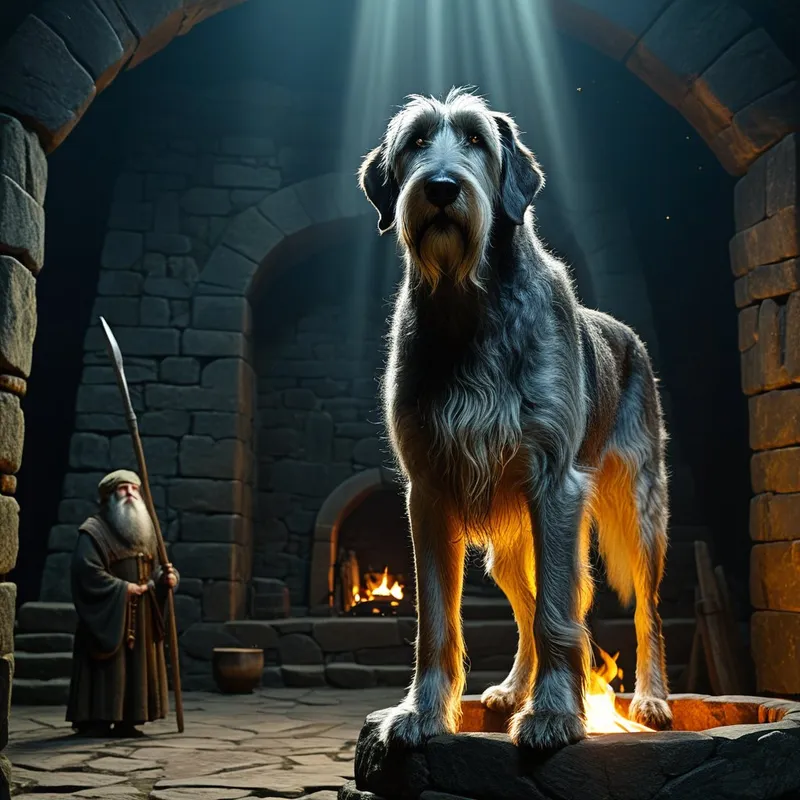
At Culann's fort, the gates were shut, the feast begun. To protect his people and his wealth, Culann had loosed his great hound—a beast more massive than a wolf, with jaws that could crush shield-rims and eyes that glowed like forge-coals. It was bound by a geis to guard and to kill.
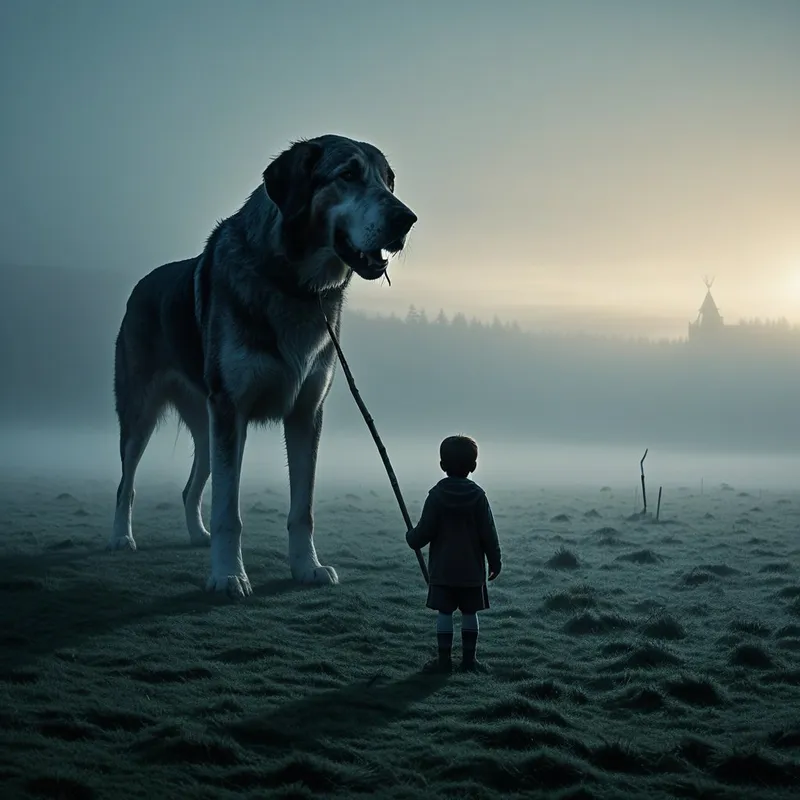
As twilight bled into dark, Sétanta approached the fort. The hound sensed him, a stranger in the night. With a roar that shook the earth, it charged, a storm of muscle and fury meant to tear the life from this intruder. Sétanta had no weapon but his hurley and his ball. There was no time for fear, only the instinct of the hero. He hurled the sliotar with all his might—it flew true as a spear, down the beast's throat. As the hound staggered, choking, the boy seized it and dashed its life out against the stone of the pillar-stone.
The feast-hall fell silent at the dying roar. Culann rushed out, and his grief was profound. "My guardian is slain," he mourned. "My home is now defenseless." Sétanta, standing over the great body, felt the weight of his deed. He had acted in defense, but he had broken a sacred trust. And so he spoke the words that would forge his destiny: "Until a pup of this hound is grown to take its place, I myself will guard your fort. I will be your hound."
The druid present, seeing the fate-thread spin, declared it so. "Henceforth," he intoned, "this boy shall be called Cú Chulainn." The name settled on his shoulders like a cloak and a chain. He had taken the life; now he took the identity, the duty, and the geis. The boy Sétanta was no more. The Hound of Ulster was born.
Cultural Origins & Context
This foundational myth of Ireland's premier hero comes from the Ulster Cycle, preserved in manuscripts like the Lebor na hUidre. It is not a mere adventure story but a macgnímartha—a "boyhood deed"—a narrative genre that establishes the essential nature and fatal trajectory of the hero. These tales were the province of the fili, the poet-seers who acted as custodians of history, law, and cosmic order.
Recited in chieftains' halls, the story of Cú Chulainn's naming served multiple societal functions. It rooted the hero in a specific, honor-bound relationship with the community (Culann the smith, a vital craftsman). It explained the origin of his famous name, a crucial aspect of identity in a culture where names held power. Most importantly, it established the core paradox of his existence: he is both the ultimate protector of Ulster and, by the nature of his binding geasa, doomed to a short, glorious, and tragic life. The myth thus served as a cultural container for exploring themes of obligation, the price of excellence, and the intimate link between a person's defining act and their fate.
Symbolic Architecture
At its heart, this is a myth of irrevocable choice and the assumption of a destined identity. The hound is not merely an animal; it is the embodiment of a specific function—guardianship, ferocity, loyalty unto death. In killing it, the boy does not destroy that function but is compelled to internalize it.
The true name is not given, but claimed in the moment of atonement. It is the sound the soul makes when it accepts the burden of its own power.
Sétanta’s act is one of unconscious brilliance meeting primal threat. He is not yet "the hero"; he is a boy playing a game. The confrontation with the hound is his first true encounter with the raw, amoral force of the world—the protective instinct turned mindlessly destructive. His victory is instinctual, but the consequence is conscious. By offering himself as replacement, he moves from simply acting to taking responsibility. The name Cú Chulainn becomes a psychic complex: a bundle of identity, duty, superhuman capability, and fatal limitation. The hound he killed externally becomes the internalized guardian of his own code, which will ultimately turn and demand his life in payment for its breach.
The Dreamer's Resonance
When this myth stirs in the modern psyche, it may manifest in dreams of confrontation with a loyal yet terrifying animal, often a dog or wolf. The dreamer might be forced to fight or kill it, followed by profound guilt and a sense of irreversible change. Alternatively, one might dream of being given a new name or title that feels both empowering and burdensome.
Somatically, this can correlate with a feeling of a "point of no return"—a career change, a commitment, a confrontation where one's latent capability is suddenly, violently called forth. The psychological process is the death of an old, more unformed self (Sétanta, the boy) and the often-traumatic birth of a new, more potent, but more constrained identity (the Hound). The dream signals that the psyche is negotiating a sacred contract: in claiming a new power or role, what innate, "wild" part of oneself must be sacrificed or subsumed to uphold it? The grief of Culann is also the dreamer's own grief for a simpler, less obligated state of being.
Alchemical Translation
The alchemical process mirrored here is the nigredo leading to the fixatio—the blackening and the fixing. The impulsive, leaden act (killing the hound) creates the black crisis of guilt and obligation. The conscious vow ("I will be your hound") is the fixing of the volatile spirit into a permanent, named form. Sétanta’s mercury (his quick, youthful potential) is fused with the sulfur of the hound’s fierce, guarding nature, resulting in the "salt" of Cú Chulainn—a stable, legendary identity.
Individuation often begins not with a quest, but with an accident that becomes an oath. The psyche transmutes trauma into destiny.
For the modern individual, this myth models the moment when a life pattern crystallizes around a defining choice or accident. Perhaps a crisis forces you to display courage, and you are thereafter seen as "the strong one." Or a mistake leads to a vow that shapes your path. The alchemical work lies in recognizing that the "hound" you internalized—the role, the burden, the strength—is now you. The task is not to resent it as an external imposition, but to integrate it with consciousness, to understand its geasa, and to ultimately wield that forged identity with the tragic wisdom that all profound power comes with a sacred price. We become who we are not in spite of our fateful acts, but because of the oaths we speak to mend the world after them.
Associated Symbols
Explore related symbols from the CaleaDream lexicon: