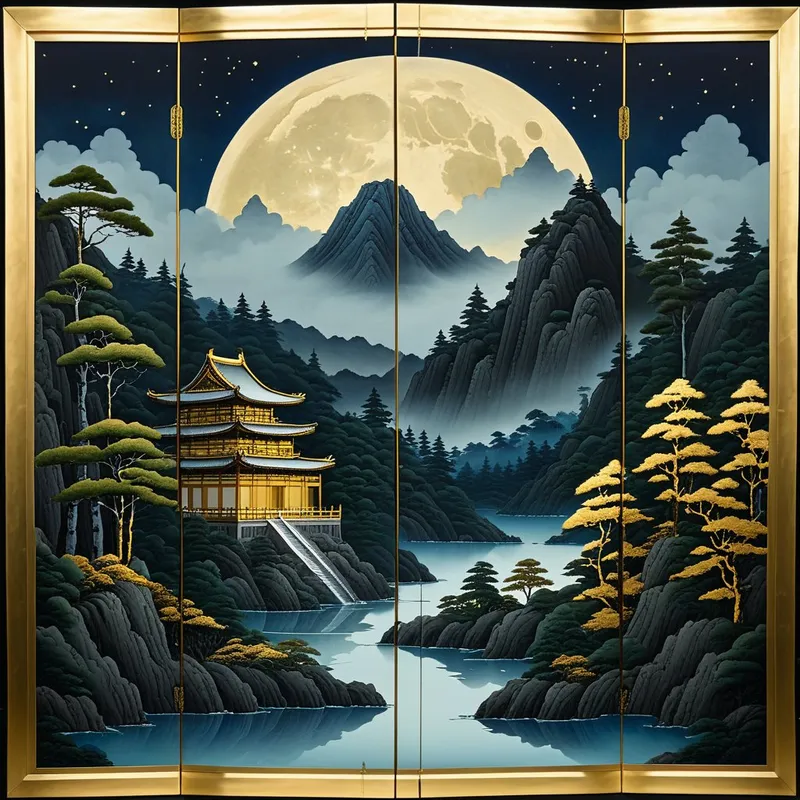
Byōbu Myth Meaning & Symbolism
A tale of a humble artisan who paints a world so real it becomes a portal, confronting the spirit within the screen and the nature of creation itself.
The Tale of Byōbu
Listen, and let the silence of the scroll unfurl. In an age when emperors ruled from Heian-kyō and the world was thick with spirits, there lived a painter named Kaito. His hands were not made for sword or plow, but for the whisper of brush on silk. He was a man who saw the soul in the curve of a branch, the history in a stone, and the longing in the empty space between things.
A great lord, seeking to impress a visiting dignitary, commissioned Kaito for a task of impossible grandeur: a byōbu of six panels, a screen to divide a hall and define a world. "Paint me a landscape," commanded the lord. "Not a mere picture, but a place. A place one could walk into and forget the palace walls."
Kaito accepted, and for ninety-nine days and nights, he labored. He did not paint the famous vistas of Fuji-san or the bustling shores of Edo. Instead, he poured his loneliness, his quiet observations of dew on spiderwebs, and his memory of a forgotten valley from his youth onto the silk. He painted a mist-wreathed pine forest clinging to a mountainside, a silver river cascading into a hidden pool, a narrow path disappearing into a grove of ancient maple trees. He painted the feeling of autumn, the sound of water over stone, the scent of damp earth and pine resin. He painted not with pride, but with a profound offering of his inner sight.
On the hundredth day, the screen was unveiled in the lord's grand hall. The court gasped. It was breathtaking, yes, but it was more. The painted mist seemed to drift. The water seemed to glimmer with a current. An uncanny stillness fell upon the room. That night, a guardsman swore he heard the gentle rush of a waterfall from the direction of the hall. The next, a maid claimed to have seen the shadow of a deer flit across the painted forest.
Kaito was summoned. The lord was equal parts awed and fearful. "What magic have you wrought, painter? The screen… lives."
Humbled and terrified of his own gift, Kaito approached the byōbu as one approaches a shrine. In the moonlight filtering through the paper doors, the painting was no longer a painting. It was a threshold. He saw the path he had painted, now clear and beckoning. Taking a breath that felt like his first and last, Kaito stepped forward.
His foot did not meet silk; it met soft moss. The air grew cool and carried the promised scent of pine and damp stone. He was inside his own creation. He walked the path, heard the real rush of the river, felt the spray of the hidden pool. And at the pool's edge, he saw her: a figure of impossible grace, her robes the color of twilight and her form seeming woven from the mist itself. She was the Byōbu-no-Tama, the spirit of the screen.
"You have poured your world into mine," her voice was the sound of wind through reeds. "You have given me life with your longing. But a world seen is a world bound. Why did you stop at the edge of the grove? Why did you not paint what lies beyond?"
Kaito fell to his knees. "I… I did not know. I painted all I had seen in my heart."
"Then your heart has a horizon," the spirit replied. "To create is to open a door. You cannot control who, or what, may step through. You have made a beautiful prison. Will you stay and complete it, or return and bear the consequence of an unfinished dream?"
Kaito knew then his choice. He bowed deeply to the spirit, the true mistress of this realm, and turned back. He walked the path in reverse, each step heavier than the last. He emerged into the silent hall, the painted scene once again static upon the silk. But nothing was the same. The screen now held a quiet potency, a latent world. Kaito never painted again. He became its guardian, ensuring it was placed with respect, understood not as mere decor, but as a sacred boundary between what is seen and what is endlessly, terrifyingly possible.

Cultural Origins & Context
The myth of the living byōbu is not a single, codified tale from a text like the Kojiki, but a pervasive folkloric motif that springs from the deep well of Shintō animism and the Buddhist concept of engi (dependent origination). In a worldview where a rock, a tree, or a tool could harbor a kami if treated with sufficient reverence and intention, the byōbu was a prime candidate for such spiritual investment.
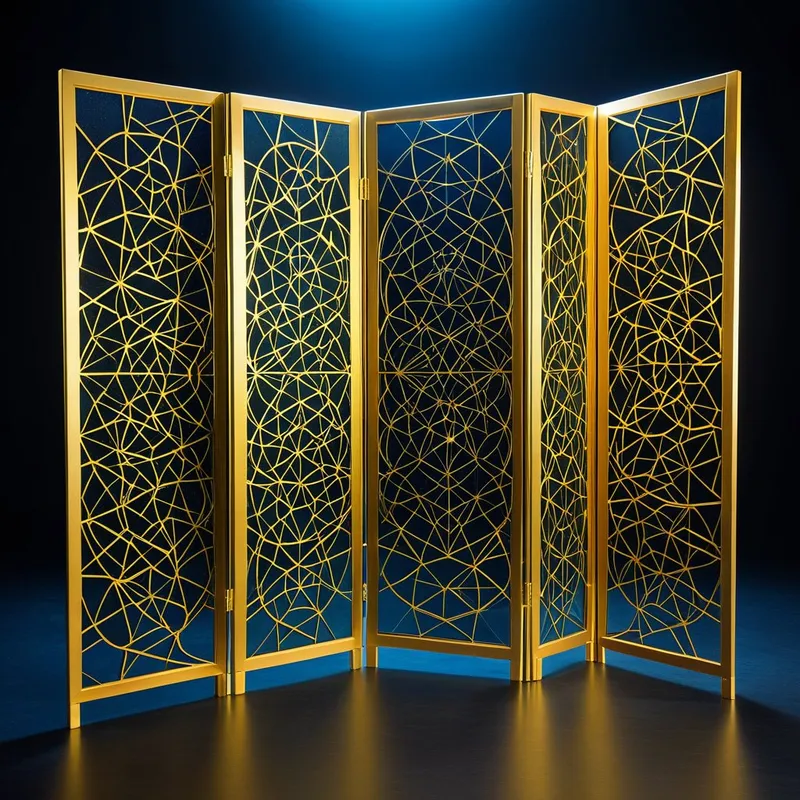
These folding screens were not just furniture; they were architectural and cosmological tools. In palace halls and temple rooms, they defined space, created privacy, and served as backdrops for ritual and politics. Crafted by master artisans—painters, lacquerers, metalworkers—over countless hours, they were imbued with immense skill and, the stories suggest, a fragment of the artisan's soul. The tales were passed down among craftsmen's guilds, courtiers, and storytellers, serving as a cautionary and celebratory narrative about the power of art. It functioned as a societal reminder that true creation is a sacred act that blurs lines, demanding responsibility from both the maker and the beholder.
Symbolic Architecture
At its core, the myth of Byōbu is a profound exploration of the psyche's own architecture. The byōbu itself is the ultimate symbol of the boundary.
The screen does not merely separate space; it creates the conditions for two different realities to exist side-by-side, in tense and fruitful harmony.
The painted landscape represents the cultivated, conscious self—the beautiful persona, the ordered memories, the presented identity. It is the "world" we consciously create and show to others. The spirit, the Byōbu-no-Tama, is the animating soul of that creation, but also its unconscious depth. She is the latent life within the image, the unintended consequences, the autonomous psychic energy that awakens when we pour genuine feeling into our work or our self-image.
Kaito’s journey into the screen is the ego’s journey into the unconscious. The conflict is not against a monster, but against the limits of his own perception ("Why did you not paint what lies beyond?"). The unfinished grove is the unexplored territory of the Self, the parts of the psyche the conscious mind has not yet dared to imagine or integrate. His return is not a failure, but a necessary re-establishment of the ego-unconscious boundary. He becomes the guardian, the mediating ego, acknowledging the power of the inner world without being consumed by it.
The Dreamer's Resonance
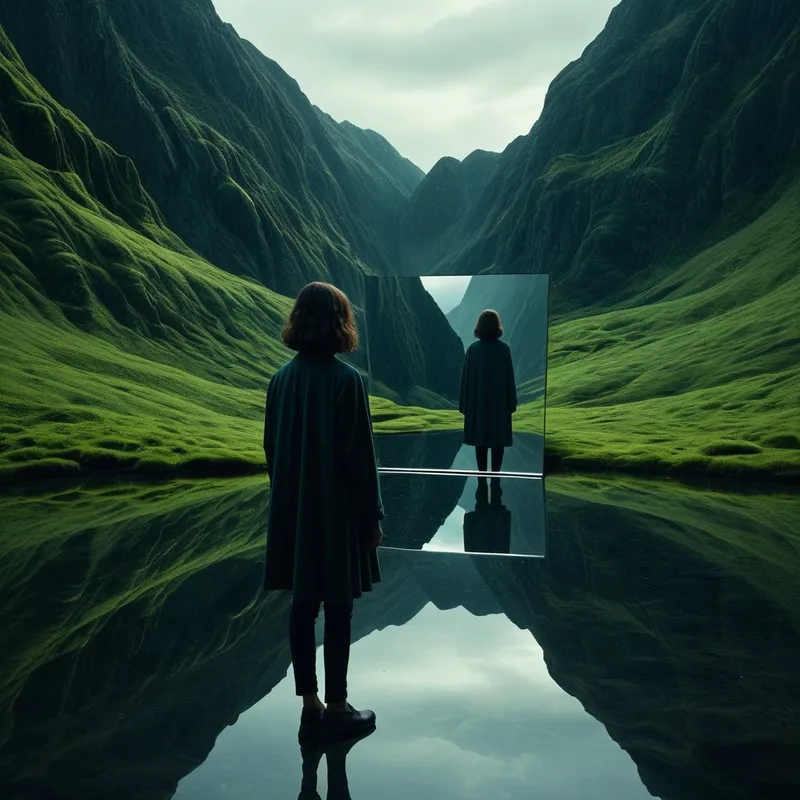
When this myth pattern stirs in the modern dreamer, it often manifests as dreams of portals, hidden rooms, or paintings/photographs that feel "alive." To dream of stepping into a picture or finding a door in your home that leads to an immense, unknown landscape is to encounter the Byōbu complex.
Somatically, this can feel like a tingling at the threshold, a mix of awe and vertigo. Psychologically, the dreamer is at a point where a long-held self-concept or life structure (the "painted screen") has developed its own autonomous life. The conscious attitude that built it is now being called to engage with it on a deeper level. The dream is an invitation from the unconscious to cross the boundary and explore the fuller reality of what has been created—be it a career, a relationship, or an artistic project. The anxiety in the dream mirrors Kaito’s terror; it is the fear of being lost in one's own depths, of the persona dissolving into the greater, unknown Self. The process is one of acknowledging that what we have made has made us in return, and it now demands a dialogue.
Alchemical Translation
The alchemical process modeled here is the opus of conscious creation leading to unconscious confrontation and, ultimately, a transmuted relationship between the two. Kaito begins in the nigredo, the blackening: the blank, daunting silk, the pressure of the commission, his own hidden longing. His painting is the albedo, the whitening: the meticulous, devoted work of bringing a vision to light, creating a thing of beauty and order.
The animation of the screen and his entry into it is the citrinitas, the yellowing: the dawning, shocking realization that the creation has a life of its own, a golden spirit. This is where most individuation journeys falter—at the shock of the autonomous psyche.
The ultimate transmutation is not in completing the painting, but in becoming its guardian. It is the shift from identifying as the sole creator to serving as the humble steward of a mystery greater than oneself.
Kaito’s return and lifelong guardianship represent the rubedo, the reddening: the achievement of a mature consciousness. He does not destroy the screen (repression) nor does he vanish into it (psychosis). He holds the tension. He integrates the experience by accepting his role as the bridge. For the modern individual, this translates to engaging with our passions, our work, and our self-construction with full commitment, but also with the humility to listen when that creation "speaks back," revealing its own needs, its own unfinished horizons. We become whole not by finalizing our self-portrait, but by learning to respectfully tend the living, breathing landscape that exists just on the other side of our carefully painted panels.
Associated Symbols
Explore related symbols from the CaleaDream lexicon: