Buffalo Woman Myth Meaning & Symbolism
A hunter breaks a sacred vow to Buffalo Woman, losing her and their son. He must journey to the Buffalo Nation to redeem his failure and restore life.
The Tale of Buffalo Woman
Listen. The wind on the high plains does not just blow; it carries stories from the time when the world was still soft, when animals and people spoke the same tongue. In that time, there was a hunter, a good man, but a lonely one. Day after day, he sought the buffalo, but the herds were like shadows, always just over the next rise, leaving him with an empty belly and a hollow heart.
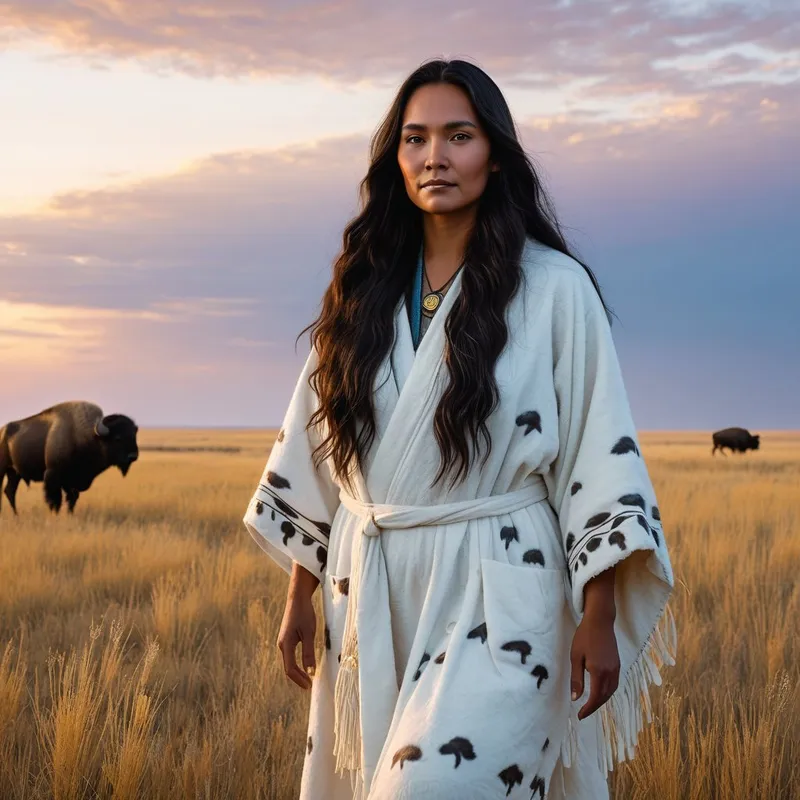
One evening, as the sun bled into the earth, he saw a figure approaching from the west. It was a woman, but like no woman he had ever seen. She walked with the steady, ground-shaking grace of the prairie itself. She wore a robe of pure white buffalo calfskin, and her eyes held the deep, patient darkness of a star-filled night. She was Buffalo Woman.
She came to his lonely lodge and spoke. Her voice was the low rumble of distant thunder, the whisper of grass in a breeze. She offered to be his wife, to bring abundance to his people, but her gift came with a sacred condition: a vow. He must never strike her. He must honor her as the source of life itself.
The hunter, his loneliness washed away in her presence, vowed. He brought her to his people. Where she walked, the very earth seemed to quicken. Where she breathed, the scent of sage and rich soil filled the air. Soon, she bore him a son, a strong boy who was both of their worlds. For a time, the lodge culture.") was full of warmth, and the people felt a promise of plenty they had almost forgotten.
But the human heart is a fragile vessel for the sacred. One day, in the cramped confines of the lodge, the hunter’s brother, a man of small spirit and sharp tongue, began to quarrel with the hunter. In the heat of anger, the brother raised his hand. The hunter, reflexively, moved to block the blow—and in doing so, his arm struck Buffalo Woman.
The world stopped. The air grew cold. No word was spoken, but the breaking of the vow echoed louder than any thunder. With a look of profound sorrow that held no anger, only the weight of a broken law, Buffalo Woman took her son, wrapped him in the white calf robe, and walked out of the lodge. She walked west, toward the setting sun, and as she walked, she began to change. Her form shifted, merged, and descended into the earth with the sound of a thousand hooves fading into silence. She was gone, and with her, all hope.
A terrible stillness fell upon the camp. Then, a hunger deeper than any they had known. The hunter was left with nothing but the ashes of his fire and the crushing weight of his failure. He had been given the heart of the world, and he had let it slip through his fingers. His choice was a stark one: to wither and die in his shame, or to follow her into the very belly of the earth, into the land of the Buffalo Nation, and beg for a second chance at life.
Cultural Origins & Context
The story of Buffalo Woman is a foundational narrative found among numerous Plains nations, including the Lakota, Dakota, Nakota, and others. It is not a mere folktale but a wicozani wicohan—a story about life and its proper order. These stories were the bedrock of spiritual and ethical instruction, told during the long winter nights or in ceremonial contexts by keepers of tradition, the wicasa wakan (holy men) and esteemed elders.
Its societal function was multifaceted. On one level, it taught the sacred protocols of the hunt, framing the buffalo not as mere prey but as a sovereign people who offered themselves in a covenant. To dishonor that covenant was to invite starvation. On a deeper level, it modeled the consequences of broken vows, especially those made to the sacred feminine principle that brings fertility and sustenance. The myth served as a constant reminder that survival was not a right, but a relationship—a relationship that demanded absolute respect, humility, and courage to repair when broken.
Symbolic Architecture
At its core, the myth maps the catastrophic and redemptive dynamics between the human ego and the instinctual, nourishing Self. Buffalo Woman is not a passive gift; she is the incarnate anima and the spirit of the land itself. She represents the totality of life-sustaining power: instinct, nourishment, fertility, and the raw, untamed divine.
The vow is the psychic container that allows the sacred to dwell in the mundane. To break it is not to commit a moral error, but to shatter the vessel of meaning itself.
The hunter represents the conscious mind—capable of recognizing the sacred and making promises, but also fragile, prone to distraction, and easily swayed by the petty conflicts (his brother) of the personal sphere. The strike is not necessarily one of malice, but of unconsciousness. It is the moment when daily preoccupations, fears, or arrogance violate the delicate connection to the deeper source of life and meaning.
The journey to the Buffalo Nation is the quintessential night sea journey. It is a descent into the collective unconscious, the underworld of the psyche where the archetypal powers reside. The council of Buffalo Chiefs represents the formidable, often terrifying, judgment of the Self. They do not offer cheap forgiveness; they demand proof of transformation—the ultimate sacrifice of the hunter's old, isolated identity.

The Dreamer's Resonance
When this myth stirs in the modern soul, it often manifests in dreams of profound loss followed by an impossible task. One might dream of a cherished partner or a source of deep inspiration turning away and walking into a landscape that changes around them. There is a somatic feeling of a door closing, a warmth leaving the body, replaced by a chilling emptiness.
The dreamer may then find themselves in a labyrinthine office building that becomes a cave, or at the edge of a cliff they must descend. This is the psyche initiating the reparative journey. The psychological process is one of confronting a foundational breach of trust—not necessarily with another person, but with one's own inner values, creativity, or instinctual life. The dream signals that a vital connection to the anima or animus, to one's own creative or nourishing core, has been severed through neglect, betrayal of one's true calling, or "striking" at what one most loves through cynicism or fear. The hunger that follows in the myth translates as depression, creative block, or a feeling of existential barrenness.
Alchemical Translation
The alchemy of Buffalo Woman is the transmutation of failure into sovereignty, of hunger into grateful reception. The myth models the complete cycle of individuation: the encounter with the Self (Buffalo Woman), the tragic inflation and fall (the broken vow), the necessary humiliation and descent (the journey), and the final integration (the return with the sacred herd).
Individuation is not about becoming perfect, but about becoming responsible for the sacred contract you have broken with your own soul.
The hunter’s willingness to be trampled is the ultimate ego-surrender. It is not self-annihilation, but the death of the old, isolated personality that believed it could control or take for granted the sources of life. His "death" is in fact a rebirth into the herd, into the collective body of the Self. He is no longer a lone hunter taking from the buffalo; he becomes a part of the buffalo, an agent of their return. His transformation allows the Buffalo People—the boundless energy and abundance of the unconscious—to flow back into the world of the tribe, the community, the conscious life.
For the modern individual, this translates to the painful but necessary process of following our deepest failures, our most shameful broken promises to ourselves, back to their source. It requires going into the "underworld" of our pain, facing the formidable judgments of our own inner council (our deepest fears and criticisms), and offering up our old identity. The reward is not just the return of what was lost, but its return multiplied, transformed. We do not get back the same "Buffalo Woman"; we gain the capacity to host the entire "herd"—a sustained, resilient connection to the instinctual, creative, and nourishing powers of the psyche, now respected as the sovereign reality they are.
Associated Symbols
Explore related symbols from the CaleaDream lexicon: