
Buffalo Hunter's Apron Myth Meaning & Symbolism
A hunter's desperate sacrifice to a spirit buffalo leads to a sacred covenant, transforming a tool of death into a vessel of life and reciprocity.
The Tale of Buffalo Hunter's Apron
Listen. The wind on the high plains does not whisper; it carries the memory of thunder. In a time when the grass was a green ocean and the sky a bowl of endless blue, there lived a hunter. He was known for his skill, his arm strong, his eye true. His name is lost, but his story is not. He wore a simple apron of buffalo hide, stiff with the blood and grease of a hundred successful hunts. It was his badge, his second skin, a testament to taking.
But the great herds, those living mountains of flesh and spirit, grew thin. The thunder of their passing became a distant rumor. The people grew hungry. The hunter, once proud, now walked with a hollow step. His arrows flew and found only dust. His apron, once a symbol of plenty, became a weight of shame.
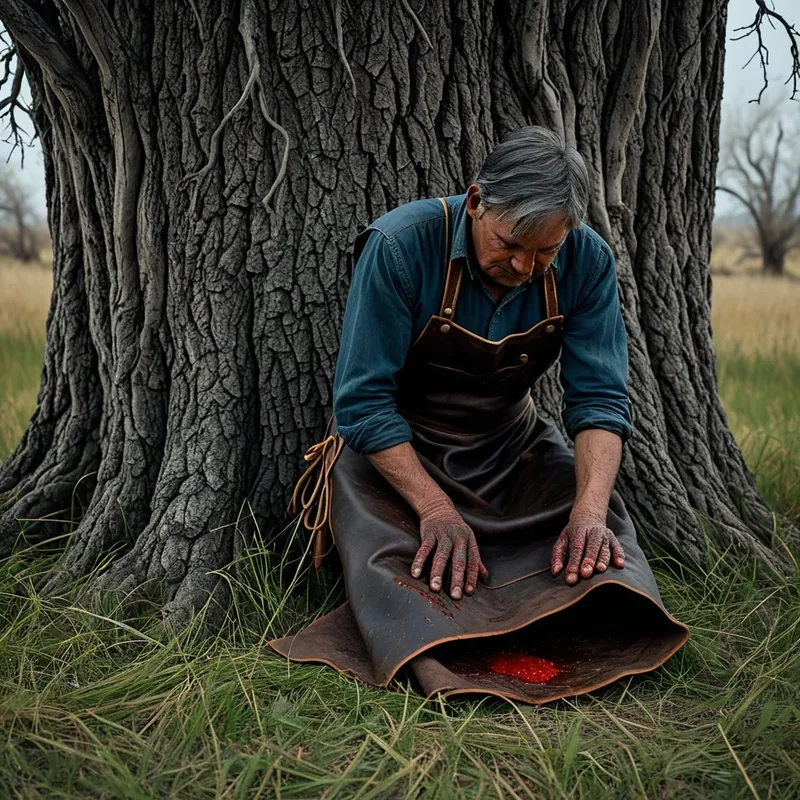
In his despair, he climbed to a high place where the bones of the ancient earth broke through the sod. There, beneath a gnarled cottonwood that clawed at the sky, he made a fire of sage and sweetgrass. The smoke curled, a gray prayer. He took off his apron, this skin of his failure, and held it in the smoke. He did not pray for skill. He did not pray for a lucky shot. He wept and prayed for forgiveness. He offered not a promise to take, but a plea to understand.
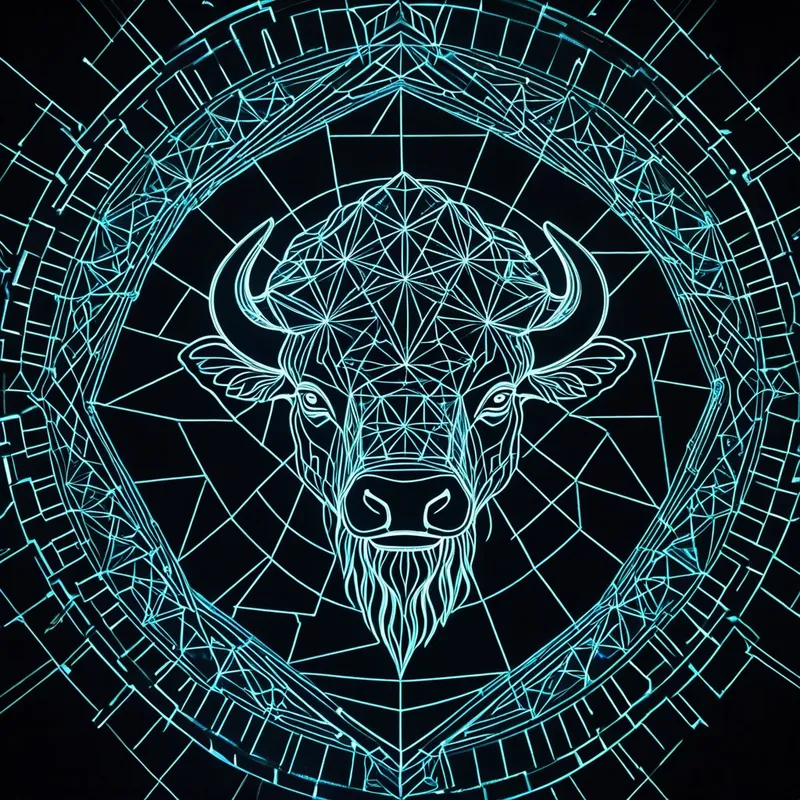
The wind died. The fire snapped. And from the gathering twilight, a form emerged. It was a buffalo, but unlike any that walked the earth. Its hide was the color of moonlight on snow, and in its depths swam the patterns of the night sky—constellations unknown to man. Its eyes were deep pools of silent knowing. This was Pte Oyate, the Spirit Buffalo, the first of all buffalo.
The hunter fell to his knees, his offering—the blood-stained apron—held out in trembling hands. The Spirit Buffalo did not speak with a human tongue. Its voice was the low rumble of distant thunder, the grinding of continents, the sigh of the grass. It showed the hunter a vision: the endless cycle. The grass fed the buffalo. The buffalo fed the people. The people, in their gratitude and their rituals, fed the spirit of the land, which in turn nourished the grass. The hunter saw his apron not as a trophy of death, but as a crucial link in this sacred circle. He saw that his taking was only one half of a vow; the other half was giving back.
The Spirit Buffalo breathed upon the apron. Where there was blood, patterns of sacred geometry appeared. Where there was grease, it became soft and supple as new hide. It was no longer just an apron. It was a map, a covenant, a living parchment of the agreement between the hunter and the hunted. The hunter understood. When he returned to his people, the herds returned. And from that day, the killing of a buffalo was preceded by prayer, and every part of the great being was used with reverence, its spirit honored so it would choose to return.
Cultural Origins & Context
This myth, in its many variations, belongs to the Plains tribes, including the Lakota, Cheyenne, Blackfoot, and others for whom the buffalo was not merely food, but the central pillar of existence—"the walking supermarket." It was told not as mere entertainment, but as foundational instruction. Elders would recount it during ceremonies, before great hunts, or in the tipi during the long winter nights.
Its function was deeply societal and ecological. It encoded the law of reciprocity, a non-negotiable spiritual and practical contract. The myth taught that survival was a gift, not a right. It established the protocols for the hunt, the prayers of apology to the animal's spirit, and the imperative of using every part of the body so nothing was wasted. The story of the apron was the story of the culture's covenant with its world, a narrative technology for maintaining balance. It was passed down to ensure that the people remembered they were partners in a sacred cycle, not masters over a resource.
Symbolic Architecture
At its heart, the myth is an alchemical drama of consciousness. The apron begins as a symbol of the persona—the hunter's identity as a successful taker. When this identity fails, it plunges him into a confrontation with the shadow of that identity: the guilt, the failure, the unsustainable nature of mere taking.
The offering of the blood-stained apron is the critical act of ego surrender. It is the moment the conscious personality, bankrupt and desperate, willingly presents its flawed identity to the transcendent wisdom of the Self.
The Spirit Buffalo represents the archetypal anima/animus as a guide, but also the objective psyche of Nature itself—the Self of the world. Its gift is not more buffalo, but a transformed understanding. The apron, transmuted, becomes a symbol of the coniunctio, the sacred marriage of opposites: hunter and hunted, human and spirit, taking and giving, death and renewal. It is no longer a tool for extraction, but a talisman of connection, a constant somatic reminder worn on the body of the covenant one must uphold.
The Dreamer's Resonance
When this myth stirs in the modern dreamer, it often manifests as a profound sense of unsustainable taking. One might dream of a job, a relationship, or a creative pursuit that has become barren, yielding only exhaustion where there was once passion. The "apron" in the dream could be a business suit, a diploma, a tool of one's trade, or even one's own body, feeling stiff, stained, and heavy with the residue of endless output without renewal.
The somatic experience is one of depletion and hollow pride. The dreamer is the hunter on the barren plain. The psychological process initiated is a necessary crisis of meaning, forcing a confrontation with the shadow side of one's achievements. The dream may present a numinous, awe-inspiring animal or a vast, indifferent natural landscape—the Spirit Buffalo in modern guise. The call is not to try harder with the old methods, but to make the sacred offering: to surrender the worn-out identity, the "blood-stained" persona of the perpetual achiever, and wait in the vulnerable space of not-knowing for a new pattern of being to be revealed.

Alchemical Translation
For the individual on the path of individuation, the myth of the Buffalo Hunter's Apron models the transformation of the ego's relationship to the Self. Our modern lives are often built on the paradigm of the hunter: we set goals, we pursue, we acquire, we consume. Our "aprons" are our CVs, our social media profiles, our portfolios of success. But this one-sidedness inevitably leads to a psychic drought, a feeling of being disconnected from the source of life.
The alchemical operation here is solutio (dissolution) and coagulatio (coagulation). The hunter's despair and his offering at the sacred tree is the solutio—the dissolving of the hardened, rigid identity in the waters of tears and humility. The breath of the Spirit Buffalo is the coagulatio—the formation of a new, living structure from the dissolved material, now impregnated with spiritual meaning.
The transmuted apron is the symbol of the integrated personality. It carries the scars and stains of the old life (the blood), but they are now organized into a sacred pattern (the covenant) that serves a higher, connecting function.
The modern individual's task is to identify what their "apron" is—what identity or tool has become a burden of mere taking?—and to have the courage to offer it up. This is not quitting, but engaging in a ritual of psychic reciprocity. It means stopping the endless extraction from one's own soul or from one's world, and instead entering a prayerful dialogue with the deeper, guiding spirit within (the inner Pte Oyate). The outcome is not merely more success, but success redefined: a life where action is in sacred alignment with a greater cycle, where giving and receiving are seen as one breath, and where one's work in the world becomes a form of worship, worn not as a badge of pride, but as a humble garment of service to the whole.
Associated Symbols
Explore related symbols from the CaleaDream lexicon: