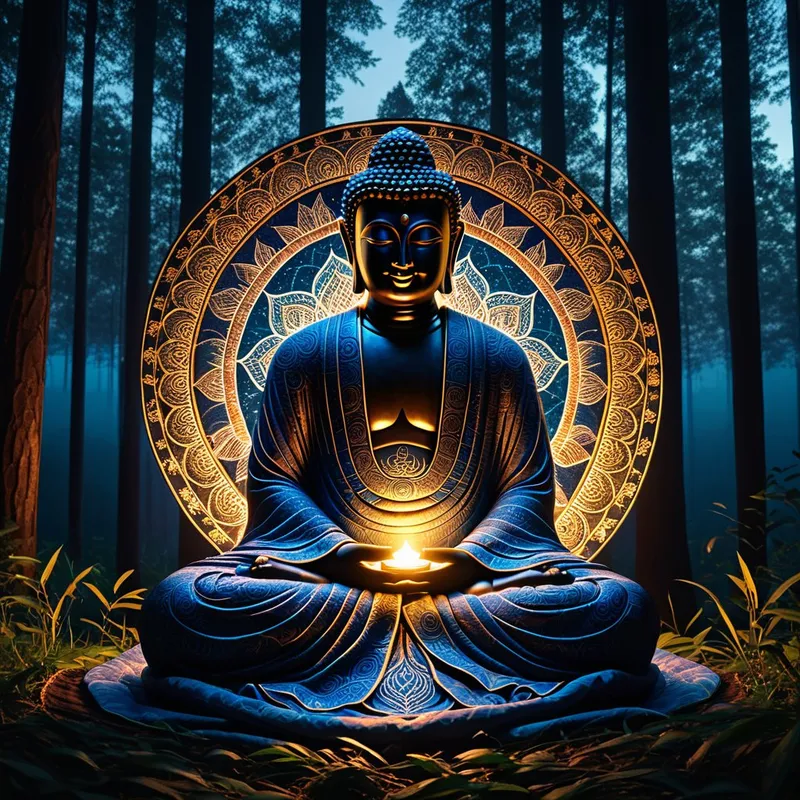
Buddha's Robe Myth Meaning & Symbolism
A mythic tale of a simple offering becoming a sacred garment, weaving threads of renunciation, compassion, and enlightened protection into a single cloth.
The Tale of Buddha's Robe
Listen. Before the great Sangha was a vast forest, and before the forest was a road of dust. Upon that road walked Shakyamuni, his feet bare, his form austere. The rains had come, a cold deluge that turned the earth to mud and the sky to a sheet of grey iron. The wind, a hungry ghost, sought the spaces between his bones. He wore only the thin remnants of the fine garments he had cast aside years before, now little more than rags clinging to his frame, offering no warmth, no dignity against the season’s bite.
In a village at the forest’s edge lived a woman named Sujata. Not a queen, not a merchant’s wife, but a woman of the earth, her hands etched with the memory of soil and loom. She had heard tales of the sage who wandered, who spoke of a peace beyond suffering. That night, as the storm howled, she saw not a prince-turned-ascetic, but a man—cold, exposed, human. A deep, wordless knowing stirred within her, a compassion that bypassed doctrine and went straight to the act.
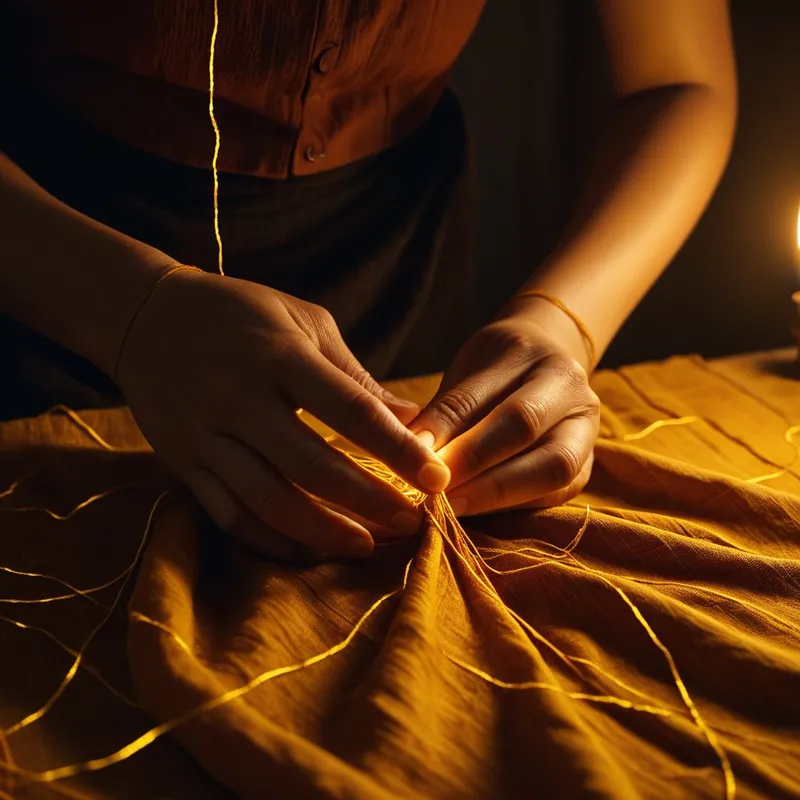
By the light of a single, guttering lamp, she went to her chest. There lay no bolt of silk, no embroidered brocade fit for a king. Instead, she gathered discarded cloths: a piece from a worn-out work sari, strips from an old canopy, fragments that had once swaddled her child. Each piece carried the memory of a life lived. With hands that knew the rhythm of creation, she began to wash them, to stitch them together. Her needle did not weave gold thread, but intention. Each pull of the thread was a silent prayer, a wish for warmth, for protection. She did not craft a robe; she crafted an offering, a field of merit made tangible.
At dawn, the rain ceased, leaving a world washed clean and shivering. Sujata walked to the roadside where the Buddha sat in meditation, his stillness a stark contrast to the night’s chaos. Without a word, her head bowed not in subservience but in profound respect, she laid the folded cloth before him. It was humble, a patchwork of earthy colors, yet it held the weight of her entire heart.
The Buddha opened his eyes. He did not see a mere garment. He saw the storm endured. He saw the hands that labored in the dark. He saw the compassion that had moved a universe to provide exactly what was needed. He accepted the robe. As he draped it over his shoulders, a transformation occurred, visible not to the physical eye but to the soul. The patchwork cloth seemed to settle not just on his body, but around his being. It became a boundary, not of possession, but of purpose. It was no longer a collection of rags, but a mandala of community, a shield woven from selfless giving. The cold retreated, not from the body, but from the very space around him. In that simple act, the robe ceased to be an object. It became the Robe, a testament that the highest protection is forged not in isolation, but in the humble, connective thread of human kindness.
Cultural Origins & Context
The story of the Buddha’s robe is not a single, codified myth from a canonical scripture, but a living narrative thread woven through the Pali Canon, commentaries, and oral tradition. Its most poignant telling is often associated with the Buddha’s encounter with the outcaste woman, Sujata, and his subsequent laying down of the ascetic’s rags. Historically, the robe, or civara, was one of the few permissible possessions for a bhikkhu, governed by strict Vinaya rules regarding its material (discarded cloth), color (often dyed with vegetable matter, yielding saffron or earth tones), and construction (a patchwork of panels).
Societally, the myth functioned on multiple levels. For the monastic community, it sanctified the humble robe, transforming it from a symbol of renunciation of worldly wealth into a badge of spiritual sovereignty and protection. It modeled the ideal relationship between the Sangha and the laity: the monks depended on material support, while the laity earned “merit” through selfless giving (dana). The robe became the primary artifact of this sacred exchange. The story was told to inspire generosity, to dignify the simplest offering, and to remind all that the fabric of the spiritual community is literally and figuratively stitched together by mutual dependence and compassion.
Symbolic Architecture
The Robe is a master symbol of alchemical transformation. It begins as pamsukula—discarded, funeral, or soiled cloth, representing the rejected aspects of life, our mortality, and the “rags” of our egoic identities. Through the ritual of washing, dyeing, and sewing, it is transmuted into a vessel of the sacred.
The robe is the skin of the world, offered back to the awakened one as a container for his peace.
It symbolizes the Middle Way itself: neither the opulent silks of the prince nor the degrading nakedness of the extreme ascetic, but a garment of simple adequacy. Psychologically, it represents the constructed Self—not an innate, solid identity, but a patchwork of experiences, memories, and influences (the skandhas) that, when understood and worn with mindful intention, can serve a higher purpose rather than enslave us.
The act of offering by Sujata is equally symbolic. She represents the fertile, nurturing aspect of the unconscious that responds to the ego’s (the Buddha-as-seeker) moment of utmost vulnerability and exposure. Her gift is the psyche’s innate capacity to provide the exact “container” needed for the next stage of integration. The Robe, therefore, is not just protection from the world, but protection for the world—a boundary that allows the boundless compassion of awakening to engage without being dissipated.
The Dreamer's Resonance
When this mythic pattern stirs in the modern dreamer, it often surfaces during a period of profound exposure or “spiritual poverty.” One may feel stripped of old identities, professional roles, or emotional defenses, left feeling raw and vulnerable to psychic elements. To dream of a torn, inadequate cloak, or of shivering in the cold, echoes the Buddha on the rainswept road.
Conversely, to dream of finding or being given a simple, surprisingly warm garment—especially one that is patched or handmade—signals the activation of this deep archetypal process. The somatic sensation is often one of sudden, enveloping warmth and profound relief, a feeling of being “held” by something both humble and immensely powerful. Psychologically, this marks the unconscious providing a new structure of meaning. The dream-robe is the nascent form of a healthier ego-container, being woven from the very fragments of one’s past sufferings and insights. It is the psyche’s assurance that one is being re-clothed in a purpose born of integration, not inflation.

Alchemical Translation
The journey of the Robe models the individuation process with elegant precision. We begin identified with our “fine garments”—our persona, achievements, and social status. The first alchemical step is nigredo, the darkening: we renounce these, often through crisis, and are left with the “rags” of our shadow—our brokenness, vulnerabilities, and rejected parts (the pamsukula). This is a cold, exposed, and necessary state.
The transmutation occurs not in discarding the rags, but in consenting to have them sewn into a new pattern by a force beyond the ego.
Sujata represents the nurturing, synthesizing function of the Self. Her labor is the unconscious work of gathering our disparate life-threads—failures, joys, traumas, loves—washing them of fixed, toxic narratives, and stitching them into a new whole. The dreamer’s task is to accept this gift, to consciously “wear” this newly integrated identity. The Robe that results is the authentic personality, strong not because it is thick or ornate, but because it is honest, flexible, and purposefully constructed. It protects not by being a wall, but by being a permeable membrane, allowing experience in while grounding the core being. To don this alchemical Robe is to move through the world with the dignity of one who owns nothing, yet is clothed in the wisdom of everything experienced and transformed. It is the ultimate triumph: turning the cloth of suffering into the garment of awakening.
Associated Symbols
Explore related symbols from the CaleaDream lexicon: