Buddha's Relics Myth Meaning & Symbolism
After the Buddha's final nirvana, his physical remains become sacred relics, sparking a quest for unity and division that transforms memory into a living, distributed presence.
The Tale of Buddha's Relics
The great teacher, the Buddha, had entered Parinirvana. His physical form lay still in the sala grove at Kushinagar, but the air itself trembled with the weight of his absence. For seven days, his closest disciples, the Sangha, sat in silent vigil, the world holding its breath. Then came the time for the funeral rites.
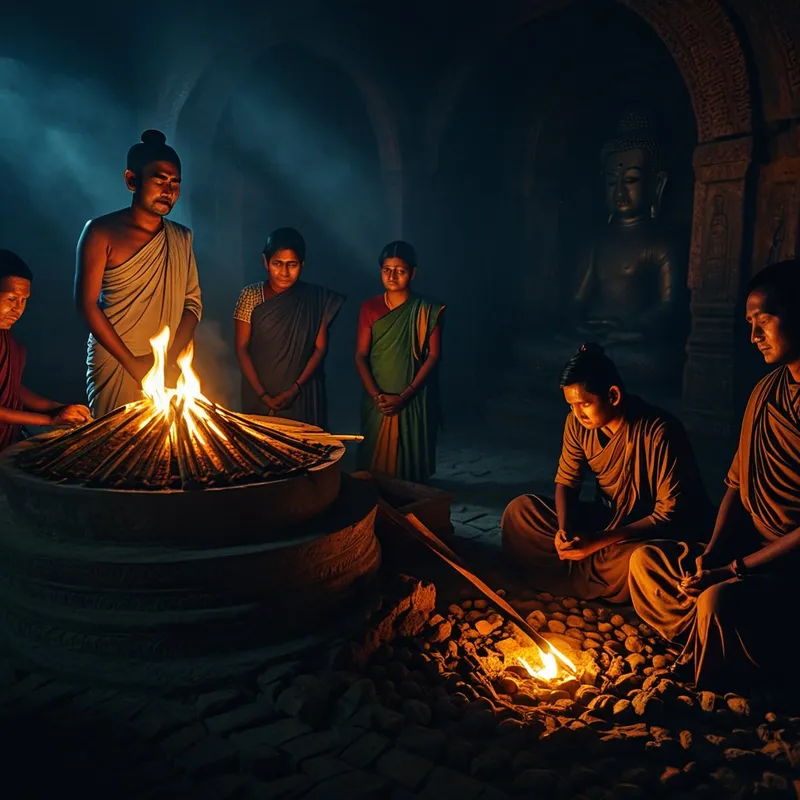
The body was anointed with perfumes and wrapped in fine cloths, a thousand layers deep. The pyre, built of fragrant sandalwood, refused to ignite. It waited. It waited for the arrival of the venerable Mahakasyapa, who was journeying from afar. When he finally arrived, bowed in grief, and paid his final respects, the pyre burst into flame of its own accord, consuming the mortal coil in a pure, smokeless fire.
When the flames subsided, what remained was not ash, but wonder. Amid the embers lay relics—sarira. They were like pearls, like crystals, indestructible and radiant. Bones that would not burn, teeth that shone like mother-of-pearl. The kings of the earth heard of this marvel. Seven mighty rulers, led by the fierce Ajatashatru, marched with their armies to Kushinagar, each demanding the sacred remains. The air, once thick with grief, now crackled with the threat of war. "The relics belong to us, the Kshatriyas!" they declared, their hands on their swords.
A wise brahmin named Drona stepped into the center of the tension. He raised his hands, not in surrender, but in wisdom. "Honored lords," he said, his voice calm over the din of armored men, "the Blessed One taught peace. Is it fitting to wage war over his remains? Let us divide the relics honorably, into eight equal portions. Let them be enshrined far and wide, so that all people, in all lands, may have a place to gather, to remember, to find peace."
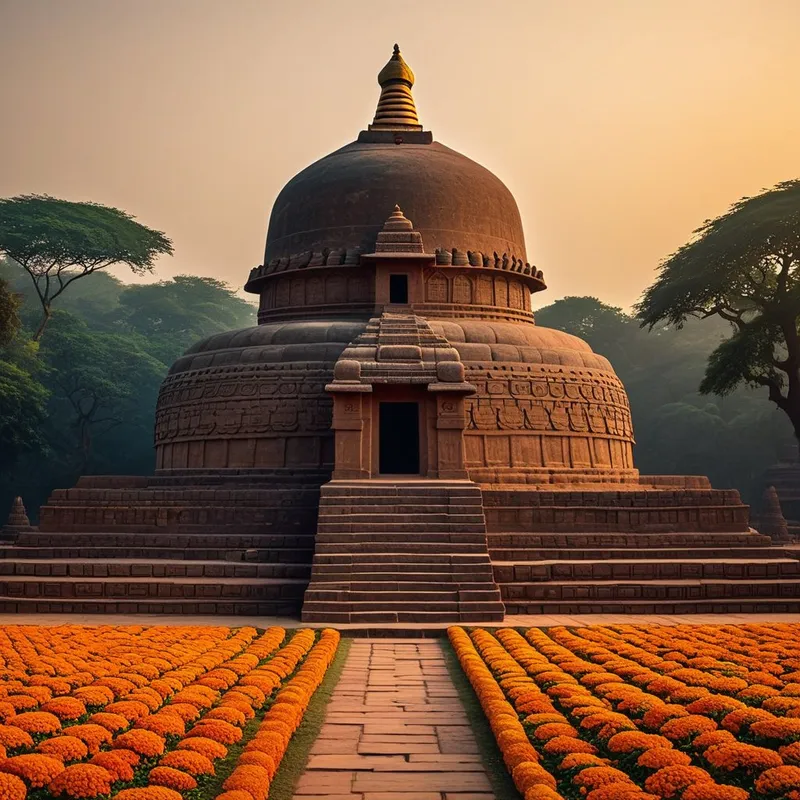
His words were like cool water on a fevered brow. The kings assented. With utmost reverence, the relics were divided. Drona himself received the urn that had held them, and another venerable elder received the ashes from the pyre. These too would be venerated. The kings returned to their kingdoms, each bearing a portion of the light. They built great mounds, stupas, over the relics. And there, the physical presence of the teacher was transformed. It was no longer in one body, in one place. It was in the land itself, in the hearts of millions, a distributed awakening waiting at countless crossroads.
Cultural Origins & Context
This narrative, primarily drawn from the Mahaparinibbana Sutta and later commentarial traditions, served a profound sociological function in early Buddhist communities. Emerging after the Buddha's death (circa 5th-4th century BCE), the story provided a foundational charter for the cult of relics, which became central to Buddhist practice, politics, and geography. It was a story told by monks to laypeople, by kings to subjects, explaining why sacred sites dotted the landscape from India to Sri Lanka and beyond.
The myth legitimized the distribution of spiritual authority. It moved the locus of the sacred from a single, inaccessible person to accessible, localized monuments (stupas). This allowed the Sangha to secure patronage from rulers (like the kings in the tale) and fostered a unifying religious identity across disparate kingdoms. The story transformed a potential crisis—the violent fragmentation of the community after the founder's death—into a doctrine of benevolent, purposeful dissemination. The relics became anchors for pilgrimage, meditation, and communal unity, making the Dharma physically present in the world.
Symbolic Architecture
At its heart, the myth is a profound alchemy of presence and absence, unity and multiplicity. The Buddha's body, the vessel of enlightenment, undergoes a final transformation. It is not merely destroyed but transmuted into indestructible, jewel-like relics.
The ultimate teaching is that form is emptiness; here, emptiness takes a new, distributed form. The body dissolves to become architecture, geography, and community.
The relics symbolize the enduring essence of wisdom beyond the perishable self. They are not the man, but the teaching made concrete; the Dharma crystallized. The division among kings is not a tragedy of loss, but a necessary scattering of seeds. It represents the adaptation of a universal truth to local contexts, cultures, and minds. The stupa that enshrines the relic is a cosmic diagram—its hemispheric dome representing the world mountain or the Buddha's meditative posture, its central axis a link between earth and heaven, the human and the transcendent.
Psychologically, the story maps the journey of integrating a transformative insight. The initial, overwhelming presence of the "teacher" (an insight, a Self-realization) must eventually "die" to its initial, raw form. It is then internalized, broken down, and distributed throughout the landscape of the psyche. What remains are not overwhelming epiphanies, but stable, integrated "relics"—core truths that become touchstones in different "kingdoms" of our inner life: our work, relationships, and personal ethics.
The Dreamer's Resonance
When this mythic pattern stirs in the modern dreamer, it often surfaces during periods of profound transition or loss, particularly the loss of a guiding figure, a cherished ideal, or a phase of life. To dream of searching for fragmented, precious objects (jewels, bones, crystals) in ashes or ruins speaks to this process. The dream-ego is the disciple or the king, seeking to reclaim and secure what is essential from a perceived dissolution.
Somatically, this may accompany feelings of fragmentation, anxiety about legacy ("What remains of me? Of what I learned?"), or a deep yearning for connection to something sacred that feels dispersed. The dream is not a sign of failure, but of the psyche's innate work of relic-making—the process of identifying what is truly indestructible from an experience. It is the mind's way of building its own inner stupas, creating sites for contemplation and return. The conflict in the dream (the warring factions) may mirror an internal conflict between different parts of the self (e.g., the inner warrior, the inner diplomat) vying for control of this nascent, precious truth.

Alchemical Translation
The alchemical journey modeled here is the transmutation of a unified, externalized ideal into a diversified, internalized infrastructure. The modern individual often encounters a "Buddha" figure—a mentor, a profound book, a transformative experience—that seems to hold all the answers. This is the initial, unified relic. Individuation, however, requires the Parinirvana of that projection. The teacher must "die," or be seen as separate, for the disciple to awaken.
The psychic fire of analysis and lived experience consumes the idealized form, leaving only the essential, indestructible principles—your personal sarira.
The "kings" are the various complexes and commitments of the adult personality—the ruler, the caregiver, the artist, the thinker. They each demand exclusive ownership of the truth. The alchemical work is the mediation of Drona, the wise, impartial consciousness that facilitates a fair division. It allocates the core insight to each inner kingdom: how it applies to your career, your compassion, your creativity. You build a stupa in each domain.
Thus, enlightenment is not concentrated in a single, peak experience, but is enshrined in the daily round. The pilgrimage is no longer to a distant land, but to these multiple inner sanctuaries. The struggle for the relics becomes the ongoing, creative tension of holding a unified truth in a multifaceted life, ensuring the wisdom is not lost to inner conflict, but shared peacefully throughout the entirety of one's being. The body of the Buddha becomes the body of your world, and your life becomes the reliquary.
Associated Symbols
Explore related symbols from the CaleaDream lexicon: