Brokkr and Sindri Myth Meaning & Symbolism
A tale of dwarven smiths who, through immense sacrifice and perfect craft, forge divine treasures for the gods, embodying the alchemical fire of creation.
The Tale of Brokkr and Sindri
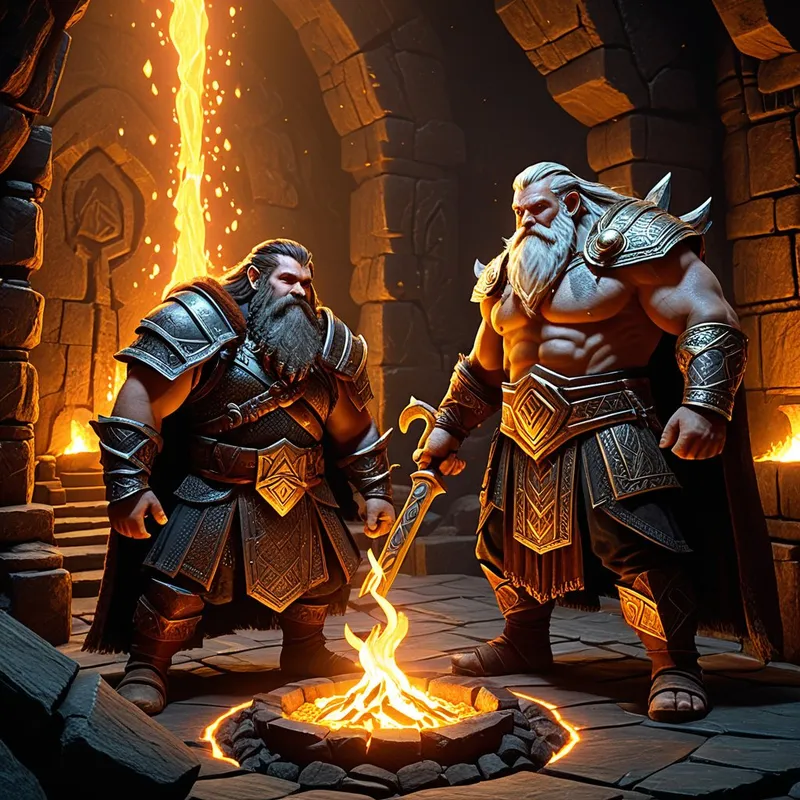
Listen, and hear the tale of the fire beneath the mountain, the breath that stirs the embers of fate. It begins not in the golden halls of Asgard, but in the deep, resonant dark of Svartálfheimr, where the earth’s bones hold heat like a secret.
The gods were in celebration, boasting of their new-gained treasures. Loki, the shape-shifter, the bringer of trouble, had gifted Odin with Gungnir, and Thor with his mighty hair. But in his arrogance, Loki wagered his own head that no smiths in all the worlds—not even the famed sons of Ivaldi—could craft gifts so fine. He sought out the brothers, Brokkr and Sindri, and with a silver tongue, he provoked them. “They say your fire has grown cold, that your hammers have forgotten their song. The sons of Ivaldi have already surpassed you.”
A silence fell in the forge, broken only by the drip of condensed stone. Sindri, the master craftsman, looked not at Loki, but into the heart of his furnace. His eyes held the blue-white heat of a star’s core. “We will take your wager, trickster. And we will take your head.” Brokkr, his brother, a mountain of muscle and steadfastness, merely nodded, his hands already gripping the great bellows.
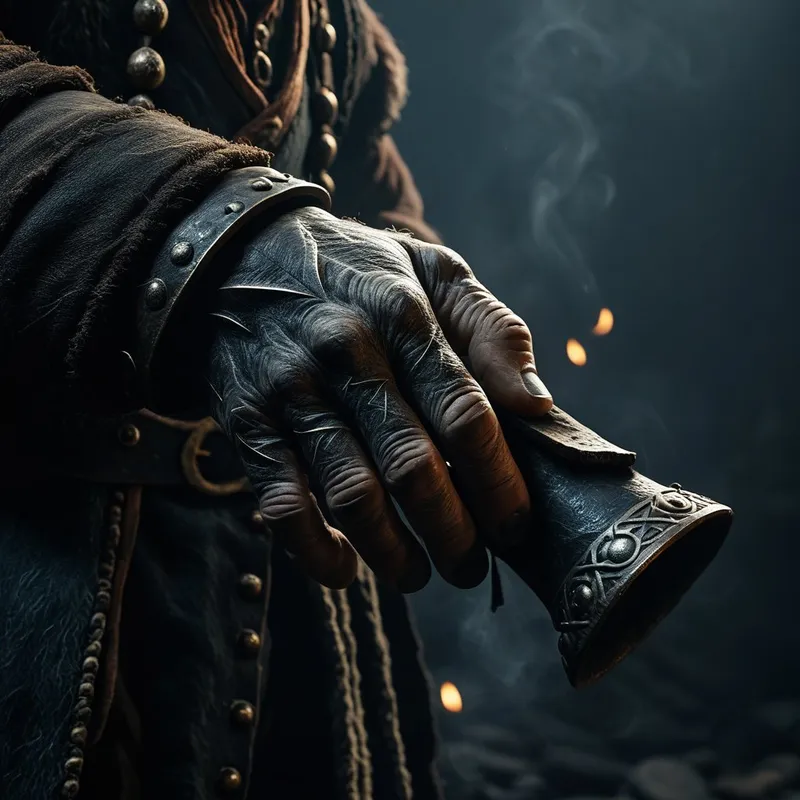
So began the work. Sindri laid a pig’s skin upon the anvil. “Brother,” he said, his voice like grinding stone, “you must work the bellows. Do not stop for a single breath. The fate of our craft hangs on this fire.” Brokkr took his place, and as Sindri placed the skin into the forge, Brokkr began. His arms pumped with a rhythm older than the gods, a heartbeat of the earth itself. The fire roared, white and furious. But then, a fly—a biting, stinging thing—landed on Brokkr’s hand. It buried its sting in his leathery flesh. Brokkr did not flinch. The bellows did not falter.
From the fire, Sindri drew forth Gullinbursti, a living boar of gleaming gold, whose bristles shone like the dawn and who could run across sky and sea.
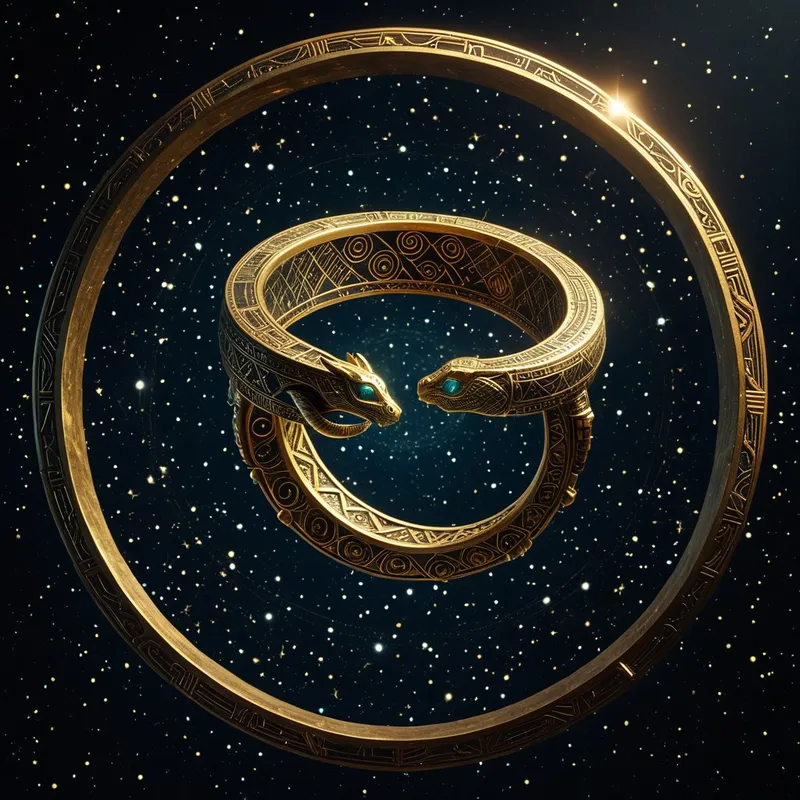
Next, Sindri took a circle of gold. Into the maw of the furnace it went. Again, Brokkr worked, the sweat and soot mixing on his brow. Again, the fly returned, this time attacking the bare skin of his neck, biting with a venomous pain. Brokkr grunted, a sound of deep agony, but his arms did not cease. The bellows breathed. And from the flames, Sindri drew Draupnir, a ring of such perfection that every ninth night, eight new rings of equal weight would drip from its band.
For the final treasure, Sindri brought forth a block of iron. “Now, brother,” he whispered, “now we make our masterpiece. Do not stop. No matter what comes.” Into the inferno went the iron. Brokkr heaved, the muscles in his back screaming. The fly, now grown bold and monstrous in its malice, landed between Brokkr’s eyes and drove its sting into his eyelid. Blood and sweat blinded him. The pain was a fire in his skull. For one terrible instant, his hand slipped, and the bellows’ breath hitched—just once.
Sindri cried out, but it was too late. He drew the form from the fire. It was a hammer of immense power, its head blocky and formidable. But the handle was short. Sindri’s face fell. “The work is flawless… yet flawed. The breath was interrupted.” He named it Mjölnir.
They brought their gifts to Asgard. The gods judged. Gullinbursti, for its radiant might. Draupnir, for its endless generosity. And Mjölnir, for despite its short handle, its power to protect the realms was unmatched. The treasures were deemed the greatest. Loki had lost.
As Brokkr advanced to claim his prize—Loki’s head—the trickster squirmed. “The head is yours,” Loki said, “but the neck was not part of the bargain. You may not touch it.” Cheated of his full due, Brokkr’s rage was cold and practical. He took a thong and Loki’s own knife, and sewed the trickster’s lips shut. A silence, for a time, was won. The treasures took their places in the fate of the worlds, forged in pain, perfected in flaw, and paid for in blood and cunning.
Cultural Origins & Context
This myth reaches us from the rich tapestry of Old Norse literature, primarily preserved in the Prose Edda by Snorri Sturluson. Snorri, writing in Christianized 13th-century Iceland, was both a scholar and a poet, collecting and systematizing the myths of his ancestors. The tale of Brokkr and Sindri is found in the section known as the Skáldskaparmál, the “language of poetry,” which served as a guide for skalds (poets) to understand the complex kennings—metaphorical references—for gods, people, and things.
The societal function of this myth was multifaceted. On one level, it is an etiological story, explaining the origins of the gods’ most iconic possessions: Thor’s hammer, Odin’s ring, Freyr’s boar. On a deeper level, it reinforced core Norse values: the supreme importance of craft (smíð), the sacredness of an oath or wager, and the very real, tangible power that arises from hardship, focus, and sacrifice. The dwarves, beings of the earth, were seen as the master artisans of the cosmos, whose creations literally shaped the destiny of gods and men. The myth also served as a cautionary tale about the dangers of arrogance (Loki’s) and the inevitability of cosmic consequence.
Symbolic Architecture
At its heart, this is a myth of the creative act in its most primal and demanding form. Brokkr and Sindri are not just craftsmen; they are the personification of the alchemical process itself. Sindri is the opus, the guiding intelligence and precise formula. Brokkr is the labor, the relentless, physical endurance required to sustain the transformative fire.
The forge is the crucible of the self. The bellows is the disciplined breath of consciousness that must be maintained against all distraction and pain.
The three treasures represent a profound triad of creation. Gullinbursti, the living gold, symbolizes generative, fertile power—creation that takes on a life of its own. Draupnir symbolizes self-replenishing value and cyclical return—the principle that true creation generates more creation. Mjölnir, the flawed masterpiece, is perhaps the most potent symbol. It represents the protective, defining power that emerges from the creative process, a power that is both ultimate and imperfect. Its short handle means it must be wielded with immense skill and effort; it cannot be used lightly. The flaw is not a failure, but a condition of its power.
Loki, as the fly, is the inevitable shadow of creation: distraction, doubt, sabotage, and the chaotic unconscious that seeks to disrupt focused effort. His stings are the pains, insecurities, and fears that arise whenever one commits to a great work.
The Dreamer’s Resonance
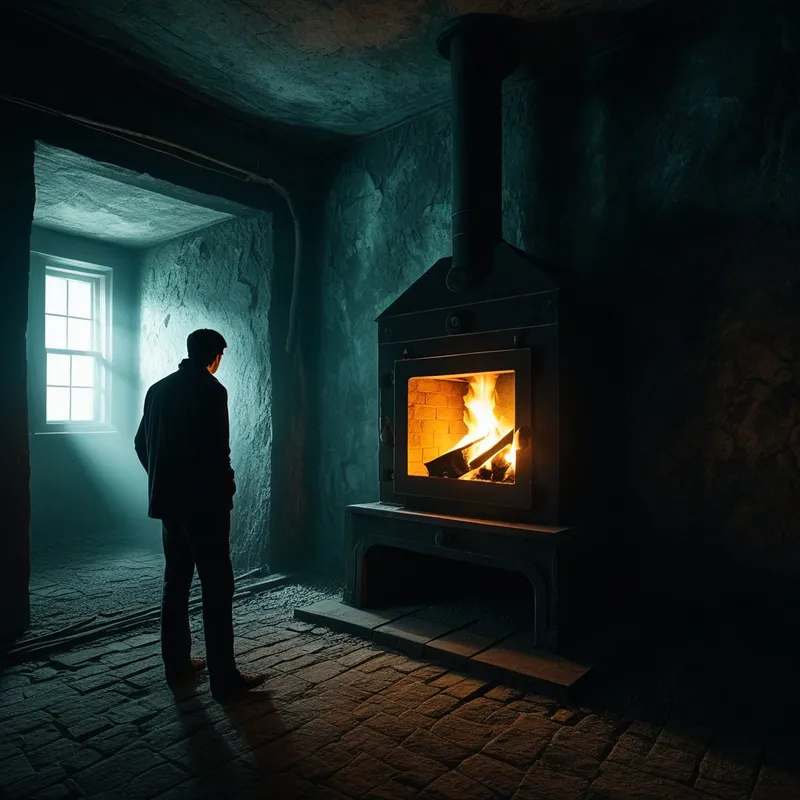
When this myth stirs in the modern psyche, it often manifests in dreams of intense, focused labor against interference. One may dream of tending a crucial fire that must not go out, while being swarmed by insects or harassed by a mocking figure. The dreamer might be in a workshop, trying to assemble something of vital importance, but their tools are clumsy or the instructions blur.
Somatically, this can correlate with a feeling of intense pressure in the head or chest—the “bellows” of one’s own breath and heartbeat under strain. Psychologically, this dream pattern signals that the dreamer is in a profound phase of psychic creation or re-forging. They are in their own Svartálfheimr, the deep unconscious, attempting to bring something new and powerful into being. The “fly” represents the specific internal or external resistance they are facing: a critical inner voice, a draining responsibility, a fear of failure. The dream is a map of the endurance test required to complete the inner work.
Alchemical Translation
For the individual on the path of individuation—the process of becoming psychologically whole—the myth of Brokkr and Sindri is a master guide to the stage of coagulatio: the hardening and forming of the new self from the prima materia of the unconscious.
The first step is to enter the forge: to consciously commit to a transformative process, whether it is therapy, artistic endeavor, spiritual practice, or the integration of a major life change. Here, one must play both roles. You must be Sindri, choosing the raw material (a memory, a talent, a wound) with intentionality and placing it in the heat of focused attention. And you must be Brokkr, maintaining the consistent, often monotonous, daily practice (the bellows) that keeps the process alive.
The treasures you forge are not for the gods of Asgard, but for the sovereignty of your own soul. Gullinbursti is your revitalized instinct and vitality. Draupnir is your capacity for self-renewal and abundance. Mjölnir is your empowered will, your ability to set boundaries and shape your reality—imperfect, demanding skill, but uniquely yours.
The interruptions—the flies—are not failures, but essential parts of the opus. Each sting that Brokkr endures without ceasing his work represents the integration of a piece of the shadow. The pain of the sting is the pain of acknowledging a fear, a jealousy, a laziness, and choosing to continue the work anyway. The final, flawed masterpiece, Mjölnir, is the ultimate goal: not a state of perfect, sterile completion, but a functional, powerful wholeness that includes one’s limitations. The short handle means you must get close to your power, grip it firmly, and understand its weight. You have earned it through sacrifice, and only you can wield it rightly. In the end, like Loki, the chaotic, sabotaging elements of the psyche are not destroyed, but their lips are sewn shut—their disruptive chatter is silenced, integrated into the quiet authority of the crafted self.
Associated Symbols
Explore related symbols from the CaleaDream lexicon: