Brokkr and Eitri Myth Meaning & Symbolism
A dwarf smith and his brother forge impossible treasures for the gods, their success hinging on a test of endurance and a brother's sacrifice.
The Tale of Brokkr and Eitri
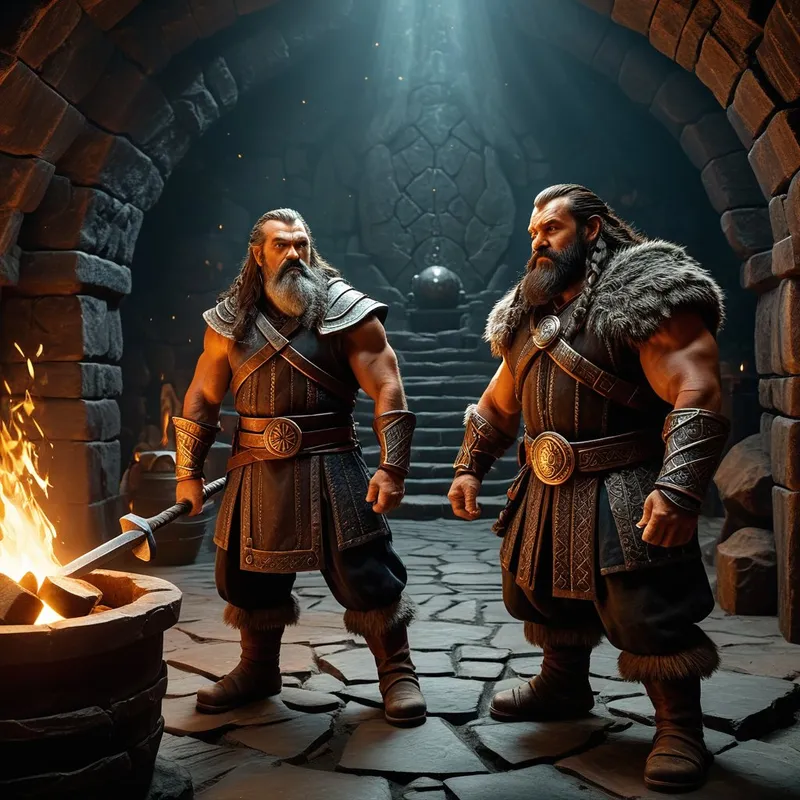
Listen, and hear the tale of the forge-fire’s price. It begins not in the golden halls of Asgard, but in the deep, resonant dark beneath the roots of the world. Here, in the realm of Svartálfheimr, the air is thick with the scent of stone and hot metal. Two brothers dwell here: Eitri, the master-smith, whose mind holds the shapes of wonders not yet born, and Brokkr, whose strength is as steady as the bedrock.
Their peace was shattered by the boasting of a trickster. Loki, silver-tongued and ever-mischievous, had wagered his own head with the gods that no smiths in all the worlds could craft gifts finer than those he had procured. Desperate to win, he descended to the brothers’ forge, his smile sharp. He spoke of a greater wager: craft three masterworks for the gods—Odin, Thor, and Freyr—and if the gods deem them the finest, he would give the brothers his own head. But he set a cruel condition: the work must be completed in a single, unbroken session at the forge.
Eitri looked into the fire, seeing the impossible forms within. He agreed. “Then you, Brokkr,” he commanded, “shall work the bellows. Do not cease, not for an instant, no matter what you see or hear. Our fate, and Loki’s head, depends on the constancy of your breath.”
The first wonder was for Freyr. Eitri laid gold in the hearth. “Pump, brother! Pump until the heart of the mountain beats in this metal!” As Brokkr drove the bellows, a great, buzzing fly—Loki in disguise—landed on his hand and bit fiercely. Brokkr did not flinch. From the fire, Eitri drew forth Gullinbursti, a boar of living gold that shone in the dark and ran across sky and sea faster than any horse.
Next, for Odin. Eitri threw more gold onto the coals. “Again! Do not let the fire’s spirit wane!” The fly returned, this time biting Brokkr’s neck twice as hard. Blood trickled into his beard, but his arms were pistons of will. From the anvil, Eitri lifted Draupnir, a ring of such pure craft that every ninth night, eight new rings of equal weight and beauty would drip from its golden band.
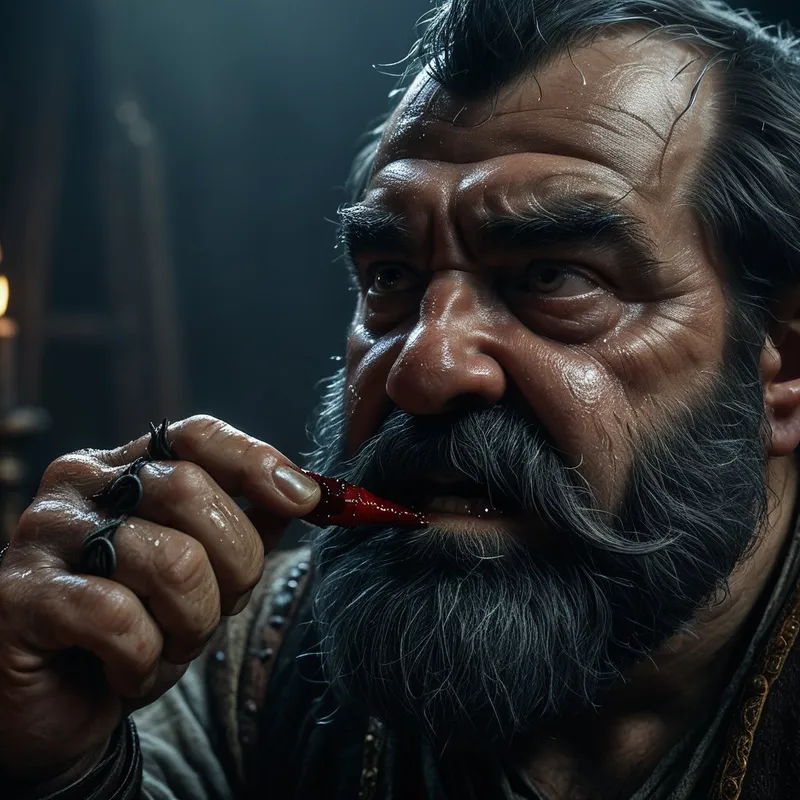
Finally, the greatest work. Eitri placed iron in the forge. “Now, brother! Now pour all your being into the wind! If the breath falters now, all is lost!” The fly came a third time, landing directly on Brokkr’s eyelid, biting so deep the blood blinded him. For one agonizing moment, Brokkr’s hand slipped from the bellows handle to swipe at the torment. Just a heartbeat. Then his hand slammed back, and the forge roared anew.
Eitri pulled the hammer from the fire. It was magnificent, its head massive and rune-carved, its handle oddly short. He named it Mjölnir. A weapon to guard both gods and mortals, it would never miss its mark and would always return to the hand that threw it. But because of that single faltering breath, the handle was imperfect.
When presented to the gods, the treasures were declared the finest ever seen. Yet Loki, ever slippery, argued the hammer’s flaw voided the win. Brokkr, holding his bleeding face, demanded his prize: Loki’s head. The trickster agreed, then quipped they could take the head but not the neck, which was not part of the bargain. Cheated of his full due, Brokkr took an awl and a thong and sewed the trickster’s lying lips shut—a temporary, painful silence. The treasures were taken by the gods, and the brothers returned to their deep forge, their triumph bitter, their craftsmanship now woven into the fate of the world.
Cultural Origins & Context
This myth survives primarily in the Skáldskaparmál of the Prose Edda, a 13th-century Icelandic text by Snorri Sturluson. While Snorri wrote in a Christian era, his work systematized older oral traditions. The tale of Brokkr and Eitri would have been told in skalds’ poetry and around fires, serving multiple functions in the Norse worldview.
It is a myth of origins, explaining the divine tools—Mjölnir, Draupnir, Gullinbursti—that are central to other stories. It reinforces the Norse value of craftsmanship (smíð), a sacred act that brings order from chaos. The dwarves are not mere laborers; they are beings of immense, primal skill, whose art is essential to the cosmic order. The myth also serves as a cautionary tale about the nature of bargains, oaths, and the cunning required to navigate them, with Loki embodying the chaotic element that tests and defines all contracts. It was a story that validated the idea that the greatest creations are born from ordeal and that even the gods rely on the skilled “other” from the underworld.
Symbolic Architecture
At its core, this is a myth of the creative act in its most raw and demanding form. Eitri represents the vision, the archetypal pattern held in the mind’s eye. Brokkr represents the endurance, the relentless, physical, and often unconscious force required to bring that vision into being. They are two halves of a single creative psyche.
The masterpiece is born not from inspiration alone, but from the sustained breath that feeds the fire—a breath that must continue even when the creative self is being devoured.
The three stages of forging map onto a universal creative process: the initial burst of energy (the golden boar), the complex, self-replicating systems of a project (the ring), and the final, formidable product that carries a flaw due to exhaustion (the hammer). Loki, as the shape-shifting fly, is the personification of distraction, doubt, and the inevitable psychic interference that arises during any profound act of making. His bites are the pains of creative labor: the doubts, the criticisms (internal and external), the mundane intrusions that threaten to break concentration.
The flawed handle of Mjölnir is the myth’s most profound symbol. It signifies that nothing born into the world of form is perfect. The masterpiece always bears the mark of the struggle that created it. This “flaw” is not a failure but a signature of its authentic, costly origin. It is what makes the hammer uniquely wieldable and real.
The Dreamer’s Resonance
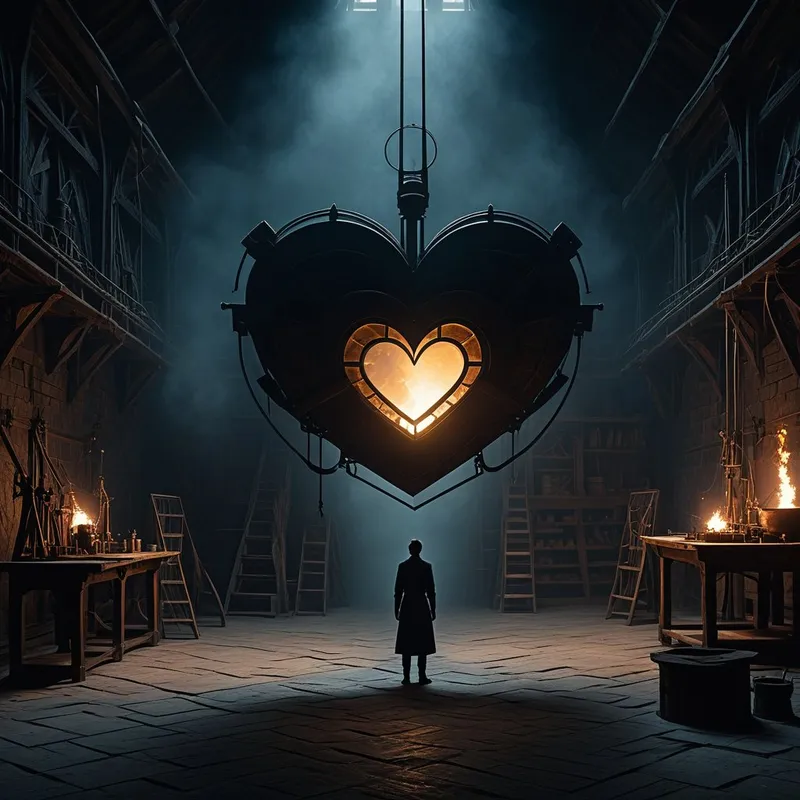
When this myth stirs in the modern unconscious, it often manifests in dreams of intense, pressured work. The dreamer may find themselves in a workshop, laboratory, or studio, tasked with an impossible project on a strict deadline. They are simultaneously the smith and the bellows-worker, feeling the exhaustion in their bones while trying to hold a vision in their mind.
The Loki-fly may appear as a buzzing anxiety, a critical voice, a persistent physical discomfort, or a literal insect in the dream that cannot be swatted away. The somatic sensation is one of being bled by the process—of giving a literal pound of flesh to one’s work. To dream of forging the hammer but being unable to lift it, or of the bellows failing, speaks to a fear that one’s endurance is insufficient for the creative task at hand. This dream pattern signals that the psyche is in the crucible of a major creation or transformation, and the ego is being tested to maintain focus amidst psychic torment.
Alchemical Translation
Psychologically, the myth of Brokkr and Eitri models the alchemical opus, the work of individuation. The dark, subterranean forge is the unconscious. The raw materials (gold, iron) are the unrefined contents of the psyche—talents, complexes, primal energies. Eitri is the guiding, conscious intention of the Self. Brokkr is the vital, instinctual energy of the body and the libido that must be harnessed.
The process of becoming whole requires one to be both the artisan and the instrument, to suffer the bites of one’s own shadow (Loki) in order to produce the tools necessary for one’s own destiny.
The three treasures are the fruits of this inner work: Gullinbursti is the radiant, guiding energy that illuminates the inner darkness and carries us forward (a developed attitude or function). Draupnir is the symbol of the Self’s generative, abundant nature, the ability to create value from a centered core. Finally, Mjölnir is the forged ego, the conscious will and capability that can act decisively in the world. Its short handle is crucial—it represents the humbling recognition that our power is never absolute, that it operates within human limits. We must grip it closely, with effort, not with casual ease.
The modern individual in this alchemical process is both brothers. We must find the vision (Eitri) and then submit to the grueling, often blind work of realizing it (Brokkr), enduring the self-sabotage and distractions (Loki) that arise. The reward is not perfection, but potent, real tools: a focused will, a generative center, and the capacity to defend one’s own psychological territory. The myth teaches that what is forged in darkness, under pressure, and at great personal cost becomes the very implement that shapes our reality.
Associated Symbols
Explore related symbols from the CaleaDream lexicon: