Brokkr Myth Meaning & Symbolism
A master dwarf smith forges three legendary treasures for the gods, paying a terrible price in a wager that tests the limits of craft and endurance.
The Tale of Brokkr
In the deep places of the world, where the roots of the Yggdrasil drink from forgotten wells, the air hums with the memory of the hammer’s song. It was here, in a cavern lit by the heart of the earth itself, that the tale of Brokkr was forged.
The gods of Ásgarðr were in a boasting mood. The trickster Loki, ever the provocateur, had sheared the golden hair of Sif, wife of the mighty Þórr. To avert a thunderous wrath, Loki swore to replace it. He journeyed to the world of the dvergar, the dwarves, and commissioned not only hair of living gold for Sif, but a ship that could fold into a pocket for Freyr, and a spear that never missed its mark for Óðinn. The sons of Ivaldi crafted these wonders, and Loki, swollen with pride, declared that no smith in all the Nine Worlds could craft their equal.
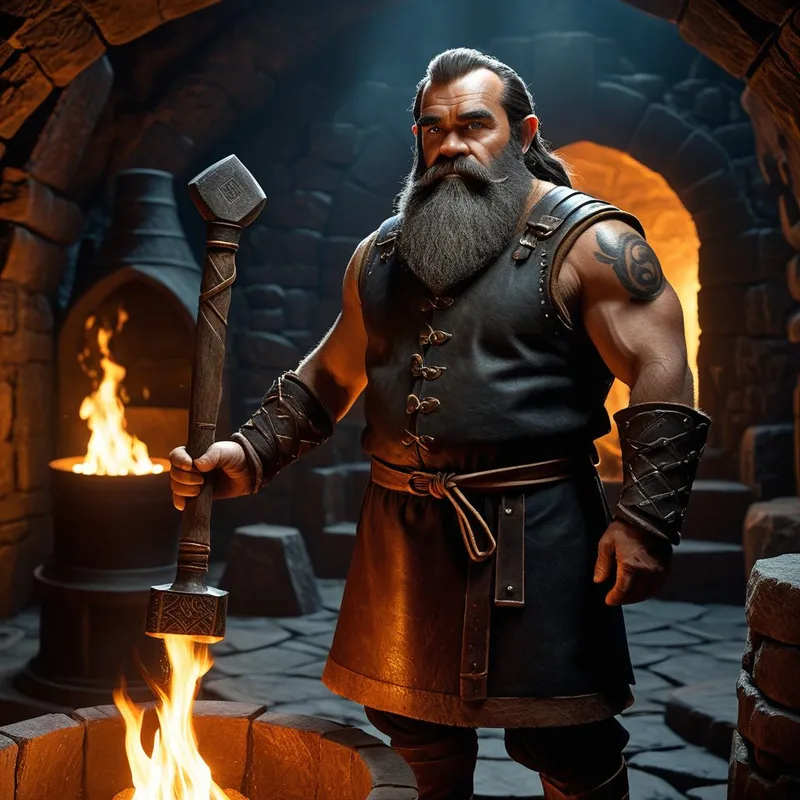
His boast echoed down into the deepest forge, where Brokkr and his brother Sindri (or Eitri) labored. The air there was thick with the smell of hot metal and stone. Brokkr, broad and strong, with a beard matted by soot and sparks, heard the challenge. “We shall see,” he growled, the words like grinding stone. He sought out Loki and laid a wager: his head against Loki’s own. If he and his brother could make three treasures greater than those of the sons of Ivaldi, Loki would lose his clever head.
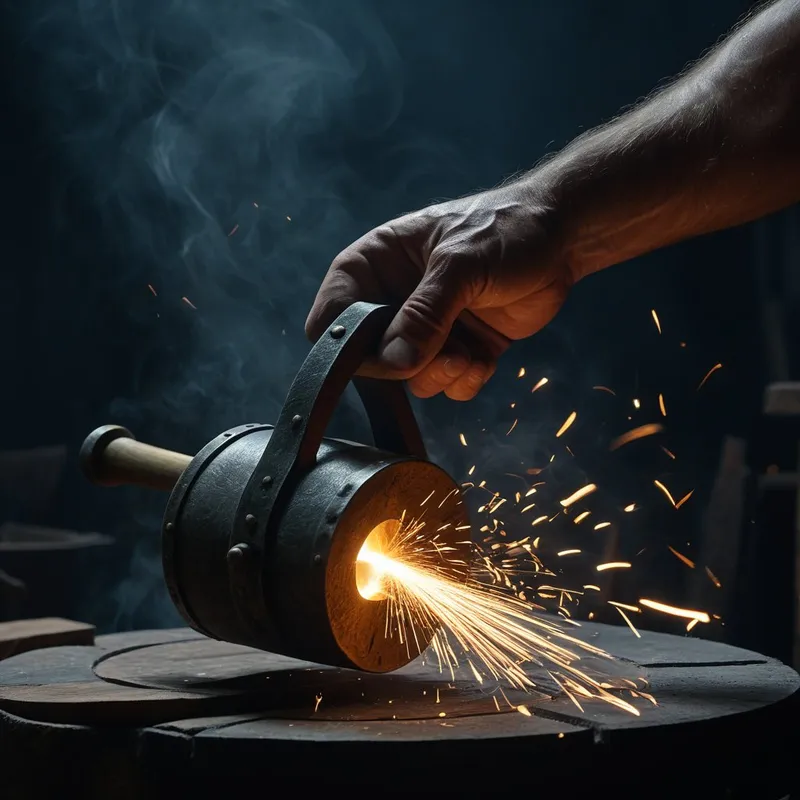
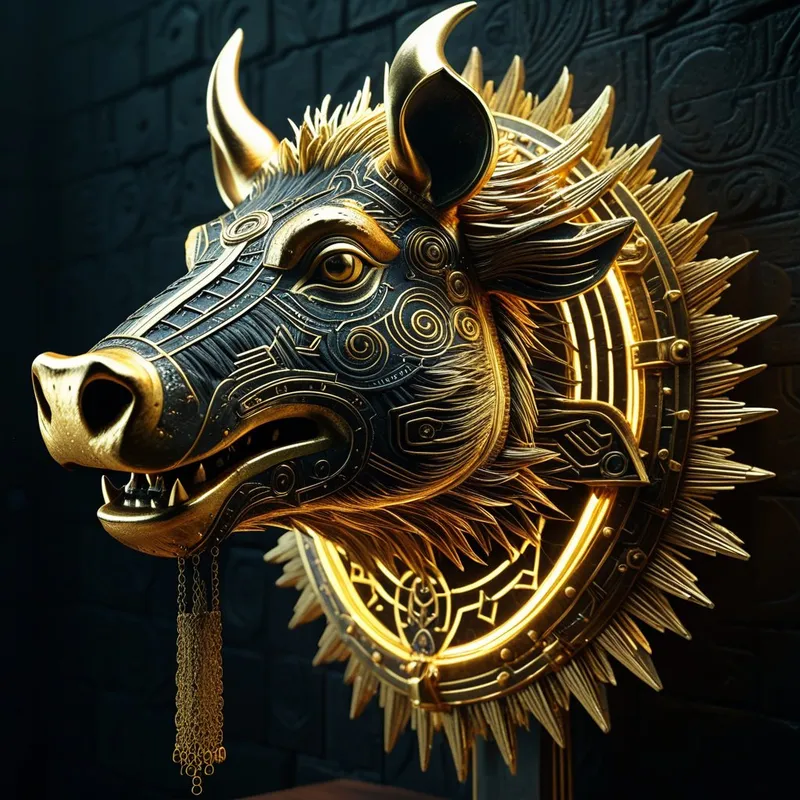
The brothers set to work. Sindri placed gold in the forge and gave Brokkr one command: “Pump the bellows without cease, no matter what emerges, until I take the work from the fire.” Brokkr took the great bellows, its leather lungs sighing, and began. The fire roared to a blinding white heart. As he worked, a monstrous fly—Loki in disguise—landed on his hand and bit deep. Brokkr did not flinch. The bellows wheezed on. From the fire, Sindri drew Gullinbursti, the golden boar, whose bristles lit the darkest path.
Next, Sindri threw a lump of gold onto the coals. Again, he gave the command, and again Brokkr pumped. The fly returned, biting Brokkr’s neck, drawing blood that mingled with his sweat. The pain was a fire of its own, but Brokkr’s arms were like pistons of stone. From the flames came Draupnir, the ring that dripped wealth.
For the final treasure, Sindri placed iron in the forge. “Do not stop,” he warned, his eyes grave. “This is the greatest work.” Brokkr bent to his task. The fly, desperate now, landed between Brokkr’s eyes and bit his eyelid. Blood poured down, blinding him. Yet through the red haze, Brokkr heard the rhythm—the breath of the bellows, the heartbeat of the forge. He did not stop. Not for the pain, not for the blindness, not for the trickster’s sting. And from that ultimate trial of endurance, Sindri drew forth Mjölnir, the hammer of the gods, short in the handle but terrible in its power.
The treasures were presented. The gods judged: the boar, the ring, and the hammer were indeed the greatest works ever seen. Loki had lost. In the end, the trickster weaseled out of the literal forfeit of his head, but Brokkr’s vengeance was still precise: he sewed Loki’s lips shut with a leather thong. The smith had won. The silence that followed was the silence of the deep forge, where creation is born not from words, but from unwavering will.
Cultural Origins & Context
This myth is preserved primarily in the Skáldskaparmál section of the Prose Edda, compiled by the Icelandic scholar Snorri Sturluson in the 13th century. It is a classic example of a “craftsman’s myth,” a narrative that would have resonated deeply in a pre-industrial society where the blacksmith held a near-magical status. The smith transformed raw, chaotic earth (ore) into purposeful, cultural objects (tools, weapons, treasure), a literal act of alchemy central to survival and power.
The story functions on multiple levels. On one hand, it is an etiological myth explaining the origins of the gods’ most iconic attributes: Óðinn’s ring, Freyr’s boar, and most importantly, Þórr’s hammer, the primary defensive weapon of the gods against the giants. On another, it is a cautionary tale about the dangers of pride (Loki’s boast) and a celebration of the virtues of the artisan: focus, endurance, and silent dedication. Told in halls and around fires, it reinforced a cultural ethos where the value of a thing was inextricably linked to the sacrifice and skill required to make it. The smith, like Brokkr, was a liminal figure, bridging the mundane and the divine through the transformative power of craft.
Symbolic Architecture
Brokkr is the archetype of the Conscious Craftsman. His myth is not one of questing heroism, but of profound, stationary endurance. The forge is the vas Hermeticum, the sealed container where base matter is subjected to extreme pressure and heat to be transmuted. Brokkr himself becomes an aspect of the forge—his unwavering labor is the necessary, consistent heat.
The true magic is not in the spell, but in the unbroken rhythm of the breath that feeds the fire.
The three trials, each interrupted by Loki (the Trickster Shadow), represent the inevitable psychic disturbances that arise during any act of deep creation: distraction, doubt, and ultimately, the blinding pain of total commitment. Loki’s bites are not just physical attacks; they are the insidious whispers of “Is this worth it?” or “You could stop now.” Brokkr’s victory is his non-reaction. He does not fight the fly; he endures it, integrating the irritation into the work itself. The flawed handle of Mjölnir is a powerful symbol—perfection is not the goal of the deep creative process; potency is. The flaw is the seal of the real, the mark of the struggle that birthed it.
The Dreamer's Resonance
To dream of Brokkr’s forge is to dream of a somatic process of psychic gestation. The dreamer may find themselves in a basement, a workshop, or a cavern, engaged in a repetitive, urgent task. There is often a sense of being “on the clock,” with a high stakes outcome. A modern Brokkr dream is one of creative incubation under pressure.
The somatic sensations are key: the heat, the weight of the tool (the bellows), the strain in the muscles, the sting of the “fly” (which may manifest as a buzzing anxiety, a critical voice, or a physical itch). The dreamer is not passively analyzing a problem; they are in the body of the problem, working it out through physical metaphor. This dream pattern emerges when an individual is in the midst of a life-creation—be it a project, a relationship, a career shift, or an inner transformation—that requires sustained, focused energy despite constant internal and external distractions. The dream is a testament from the unconscious: the process is painful and all-consuming, but you must not stop pumping the bellows. The treasure is in the final pull.
Alchemical Translation
For the modern psyche, the myth of Brokkr models the opus contra naturam—the work against one’s own lazy or distracted nature—required for individuation. We are all both Sindri and Brokkr: Sindri is the intuitive, guiding spark of genius or purpose that knows what is to be made; Brokkr is the ego-consciousness that must execute the labor, minute by minute, despite the pain.
The alchemical stages are clear. Nigredo: the raw material (gold, iron) is the unformed potential of the Self, plunged into the darkness of the forge (the unconscious). Albedo: the intense, purifying fire, fed by the unwavering breath (Brokkr’s focus), begins the whitening, the separation of spirit from gross matter. Here, Loki’s attacks represent the caput corvi, the head of the crow—the putrefaction and despair that threaten to abort the process.
Individuation is not a revelation granted; it is a hammer forged, blow by blow, in the sweat-blinded dark.
Finally, Rubedo: the reddening, the achievement. The three treasures are the triune fruits of this inner work: Gullinbursti is the radiant, guiding energy of the renewed personality (the lumen naturae); Draupnir is the self-sustaining, generative power of the integrated psyche; and Mjölnir is the focused, conscious will—the “hammer” of discernment and action—that can defend the nascent Self and hallow its space. The myth teaches that the sovereign, creative Self is not found, but forged. And the price of its creation is the total, unwavering application of our attention, even when—especially when—every instinct screams to let the fire go out.
Associated Symbols
Explore related symbols from the CaleaDream lexicon: