
Brigid's Mantle Myth Meaning & Symbolism
A myth where the goddess Brigid's cloak magically expands to cover a kingdom, securing sanctuary through boundless generosity and sacred presence.
The Tale of Brigid's Mantle
Hear now a tale from the mist-wrapped hills, when the world was younger and the veil between the realms was thin as morning dew. It is a story of Brigid, she of the triple flame, whose breath kindles inspiration in the bard, healing in the wise woman, and strength in the smith’s forge.
In those days, Brigid walked the land of Éire not as a distant star, but as a presence. She sought a place for her sisters, a sanctuary for the sacred fires of learning, craft, and compassion. Her gaze fell upon the plains of Cill Dara, a place of good earth and clear water. But the land was held by a king, a man of practical mind and measured generosity.
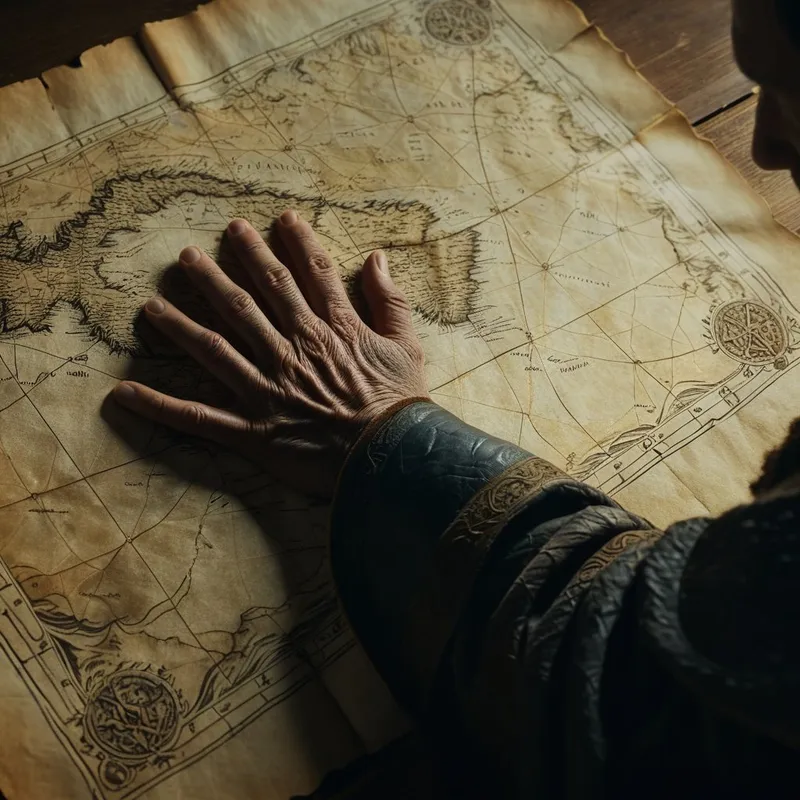
Brigid, accompanied by her followers, approached the king’s ringfort. She asked not for gold or tribute, but for land. “Only what my mantle can cover,” she said, her voice like the whisper of a forge-bellows. The king, perhaps amused by the modesty of the request from this woman of palpable power, granted it with a wave of his hand. A cloak’s span of earth was a small price.
Brigid nodded, a faint smile touching her lips. She unfastened her mantle—a simple, woven thing of undyed wool. Four of her sisters took a corner each. They began to walk.
East, towards the rising sun. West, towards the setting light. North, to the cold mountains. South, to the warm sea. And as they walked, the mantle began to grow. It did not tear; it expanded. The weave loosened and re-knit itself, the threads singing a silent hymn. It spread over a field, then a hill, then a forest. It flowed like liquid shadow and light, covering meadow and stream, sacred grove and pasture.
Within the fort, the king watched. His amusement turned to unease, then to awe. The fabric, humble as it was, became a living map of his own kingdom, stretching further with every heartbeat. It was not an invasion, but an embrace. There was no violence in its expansion, only an inevitable, gentle unfolding. Finally, as the sisters reached the far horizons, the mantle settled, covering a vast and fertile tract. The king, humbled and recognizing a sovereignty greater than his own, knelt. He granted the land, forever, to Brigid and her fire-keepers.
And so, the sanctuary was won not by sword or treaty, but by a cloak that held the impossible within its humble weave.
Cultural Origins & Context
This myth is rooted in the rich, oral tradition of early medieval Ireland, a culture where land, sovereignty, and hospitality (oíged) were sacred contracts. The figure of Brigid is complex, likely a Christianized synthesis of a powerful pre-Christian goddess and the historical Saint Brigid of Kildare. This story served as a foundational dindshenchas (place-lore) for the monastic settlement at Kildare, which became one of the most important centers of learning and spirituality in early Christian Ireland.
Told by bards and monks alike, the function of the myth was multifaceted. It established the divine right and legitimacy of Brigid’s community to the land. It also encoded a core Celtic virtue: the law of hospitality was absolute, and a promise, once given, was binding, even—or especially—when it revealed a divine truth. The king, by honoring his word, participates in the sacred order. The story bridges the pagan past with the Christian present, presenting a model of spiritual authority based on nurturing, protection, and boundless generosity rather than conquest.
Symbolic Architecture
The mantle is the central symbol, a profound image of the feminine archetype as a vessel of infinite potential. It is not a weapon or a wall, but a covering—a protector and a nurturer.
The mantle does not conquer territory; it reveals relationship. Its expansion is the unfolding of an inherent, connected wholeness that was always present, simply waiting to be recognized.
Brigid herself embodies the triple goddess in unity: the poet (vision), the healer (integration), and the smith (manifestation). Her request is an act of poetic craft, the mantle’s growth is a healing of fragmented space into sanctuary, and the secured land is her forged reality. The king represents the egoic consciousness and worldly authority. His initial grant from a place of limited perception is transformed into a conscious submission to a greater, life-giving principle. The conflict is not of wills, but of scales of being.

The Dreamer's Resonance
When this myth stirs in the modern unconscious, it often surfaces in dreams of expansion and sanctuary. One might dream of a small, personal item—a scarf, a blanket, a piece of paper—beginning to grow, gently filling a room, a house, or a landscape. There is typically no fear, but a sense of awe and rightness.
Somatically, this can correlate with a feeling of the chest or heart center expanding, a deep breath that seems to have no end. Psychologically, the dreamer is likely navigating a process where a seemingly small, inner truth or capacity is revealing its true, boundless nature. It may signal the need to claim psychological or emotional "land"—to establish a sacred, protected space for one’s creativity, spirituality, or healing. The dream asserts that what feels like a modest request of the self or the world contains the seed of vast provision.

Alchemical Translation
For the individual on the path of individuation, Brigid’s Mantle models the alchemy of turning a latent, inner quality into a lived, outer reality. The "king" is our own conscious mind, which often believes it is in control and doles out resources in meager, measured amounts. The "mantle" is a nascent aspect of the collective unconscious—perhaps one’s capacity for compassion, creative vision, or inner resilience.
The process begins with the humble request: acknowledging this quality. The conscious ego must grant it space ("only what this can cover"). The transformative work—the walking of the four directions—is the application of this quality to all aspects of life (thought, feeling, sensation, intuition). As it is applied, it miraculously expands, revealing that this inner resource was never scarce, but infinite.
The goal is not to possess more, but to realize that your essential nature is already a sanctuary, capable of holding and transforming all that falls within its compass.
The triumph is the establishment of the temenos, the sacred inner precinct, where the fires of spirit, art, and soul-work are perpetually tended. We become both the goddess who requests the space and the king who, in awe, grants it, thereby unifying the divine aspiration and the earthly authority within one psyche. The mantle becomes the symbol of our own boundless, protective, and generative consciousness, woven from the threads of our deepest, most essential self.
Associated Symbols
Explore related symbols from the CaleaDream lexicon: