Brigid's Hearth Myth Meaning & Symbolism
A myth of the goddess Brigid, whose sacred hearth fire is the source of all healing, poetry, and the transformative warmth of the human spirit.
The Tale of Brigid's Hearth
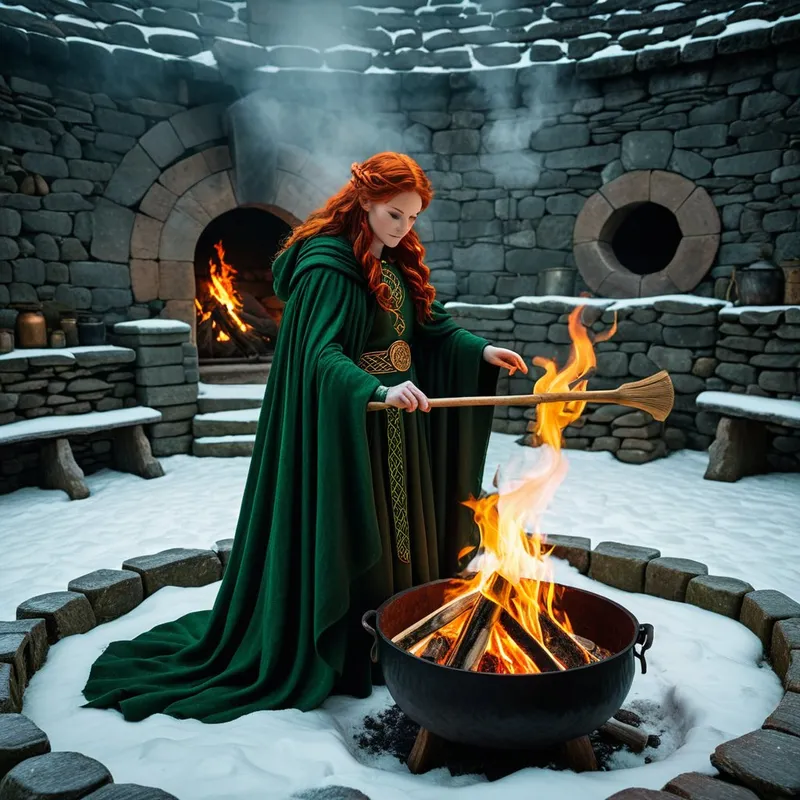
Listen, and feel the chill of a world in the grip of winter. The land is a sleeping giant, breath held beneath a blanket of frost. The days are short, the nights long and hungry. In this time of brittle silence, the people gather in their roundhouses, huddled close, their own hearth-fires burning low, a desperate mimicry of the sun’s lost warmth. They whisper of a time when the fire might not just warm bones, but souls.
And in that whisper is a name: Brigid. She is not a distant figure in a starry court, but a presence as close as the next breath. Her sanctuary is at Kildare, a place of the sacred oak. Here, there is no ordinary hearth. Here, a fire burns that was never lit by mortal hand. It is the First Fire, the spark struck from the anvil of creation itself when the world was forged.
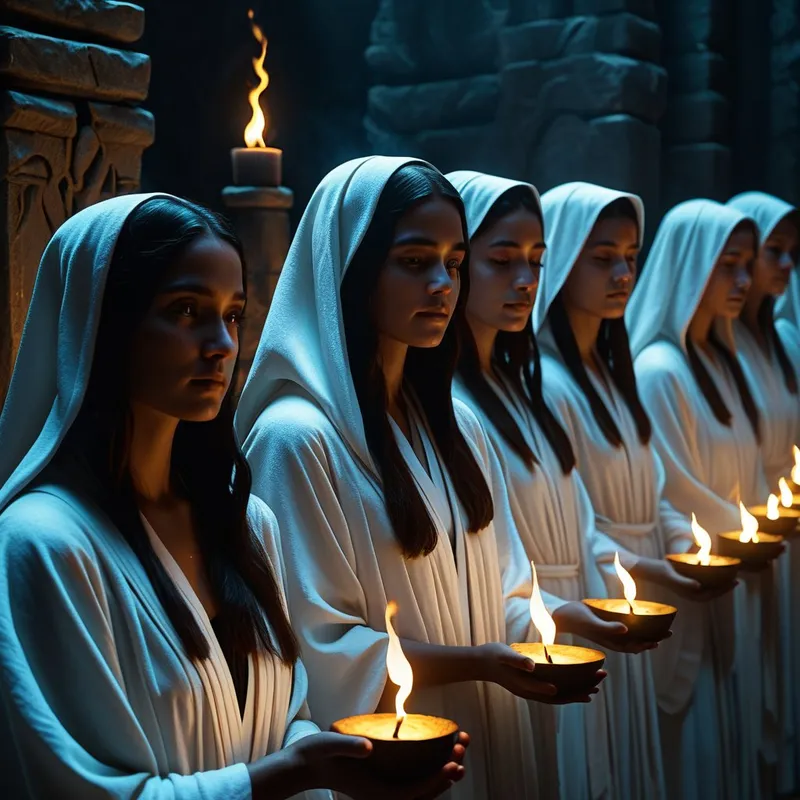
This is no roaring bonfire of conquest, but a steady, unwavering flame. It is tended not by one, but by a sisterhood of nineteen. Each night, as the world slips into darkness, one among them—the twentieth—takes her turn. She approaches the stone hearth, her breath a cloud in the sacred air. She does not add wood, for this fire consumes no common fuel. She tends it with prayer, with a song so old the words are felt in the pulse, not spoken. She feeds it with the essence of care itself. And the fire answers, holding its golden vigil through the longest night.
For nineteen nights, the cycle holds. The flame is the heartbeat of the land. It is the promise that the cold will not last, that the sap will rise again in the sleeping trees. But the twentieth night… that is the Night of the Goddess. On that night, the twentieth attendant steps back. The hearth is left to its keeper. The fire is left to Brigid herself. And in that profound solitude, something miraculous occurs. The fire does not dwindle or die. It burns, self-sustained, a testament to a covenant between the divine and the earthly. It is the invisible hand of the goddess, tending the world’s inner flame, ensuring that when dawn breaks on Imbolc, the spark of life will be undimmed.
This is the hearth that heals the sick who are brought near its radiance. This is the flame over which poets breathe to catch the spark of Awen. This is the forge-fire that tempers not just iron, but spirit. It is a sanctuary that does not exclude the cold, but transforms it; a warmth that does not merely comfort, but creates.
Cultural Origins & Context
The figure of Brigid stands at a powerful crossroads in Celtic tradition, straddling the pre-Christian pagan world and its integration into early Irish Christianity as Saint Brigid. This duality is not a contradiction but a testament to her profound and enduring cultural resonance. The myth of her eternal hearth originates in the pagan veneration of Brigid as a triple goddess of fire: the fire of the forge (smithcraft), the fire of the healing cauldron (physicianship), and the fire of inspired speech (poetry).
The ritual at Kildare, historically attested by Gerald of Wales in the 12th century, describes a perpetual fire tended by nuns, a direct continuation of the earlier pagan priestesshood. This was not mere folklore; it was a living, somatic practice. The fire’s maintenance was a sacred duty, a communal act that mirrored the cycles of the moon and the sun. Its societal function was multifaceted: it was a calendrical marker for Imbolc, a spiritual center for pilgrimage and healing, and a tangible symbol of sovereignty and protection. The hearth was the omphalos, the navel of the world, for her community. The myth was passed down not just in story, but in the very ritual of tending—a knowledge held in the hands and the rhythmic prayers of the keepers of the flame.
Symbolic Architecture
At its core, Brigid’s Hearth is an archetypal symbol of the Self as a generative, sustaining center. The hearth is not the bustling, chaotic fireplace of a great hall; it is the focused, sacred center of a roundhouse—a model of the psyche itself, with the ego-structures (the walls) arranged around a central, nourishing truth (the fire).
The sacred fire is not lit; it is remembered. It is the primordial spark of consciousness that must be tended, not possessed.
The threefold nature of Brigid’s domains—poetry, healing, smithcraft—maps perfectly onto the alchemical process of transformation. Poetry (Awen) represents the inspiration, the raw, unconscious material (the prima materia). Healing represents the integration, the application of wisdom to mend what is broken. Smithcraft represents the discipline, the forceful, shaping will that tempers raw inspiration into usable, enduring form (the artifact, the healed body, the coherent poem). The hearth is the vessel where these three fires unite.
The nineteen priestesses and the solitary twentieth night are a profound symbol of the relationship between the conscious ego and the autonomous, nurturing power of the unconscious. For nineteen cycles (the realm of time, effort, and human diligence), we tend the flame through our practices, our therapy, our art. But there comes a necessary moment—the “twentieth night”—where we must step back and let the psyche itself, the Brigid-within, take over. It is the moment of grace, of incubation, where healing and inspiration arise not from effort, but from a deeper, self-sustaining source.
The Dreamer's Resonance
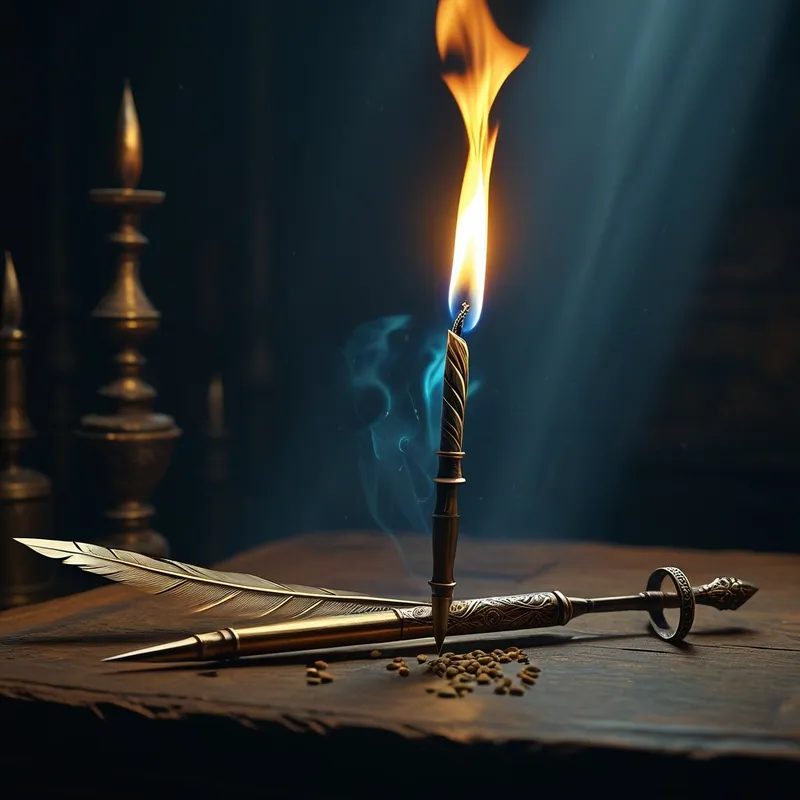
When this myth stirs in the modern unconscious, it often manifests in dreams of fire, warmth, and sacred domestic spaces in states of neglect or miraculous preservation. A dreamer may find a forgotten fireplace in their childhood home, its embers still glowing. They may dream of desperately trying to light a stove that won’t catch, or conversely, of a simple candle flame that grows to illuminate an entire cavern.
Somatically, this points to a process of returning to one’s core vitality—the “inner thermostat” of the soul. The conflict in the dream mirrors the psychological conflict: the fear that one’s creative spark, one’s capacity for self-care, or one’s sense of spiritual warmth has gone out or is unsustainable. The hearth in the dream is the dreamer’s own psychic center. To tend to it is to engage in the fundamental act of soul-care. The dream is an invitation to become one of the priestesses—to take up the rhythmic, daily responsibility of attending to one’s own inner flame through practice, ritual, and respect, while also learning to trust the cycles of withdrawal where the deeper Self does its work.

Alchemical Translation
The individuation journey modeled by Brigid’s Hearth is not one of heroic questing outward, but of profound, committed tending inward. The alchemical vessel is the roundhouse of the psyche; the fire is the living process of the Self.
The first operation is kindling: identifying the faint, often ignored spark of one’s authentic passion, curiosity, or joy—the “poet’s fire.” This is the raw, inspired material. The second is feeding: the disciplined, often mundane work of the “smith’s fire”—showing up, practicing, honing, enduring the heat of frustration. The third is applying: the “healer’s fire” of integrating these energies to mend psychic splits, to bring warmth to frozen traumas, and to foster growth.
Individuation is the art of becoming the keeper of your own sacred flame, and having the wisdom to sometimes let it keep you.
The ultimate transmutation occurs in the recognition of the “twentieth night.” It is the surrender of the ego’s frantic control, acknowledging that the core of our being is sustained by a source greater than our conscious will. We are both the tender and the tended. The triumph is not in creating fire from nothing, but in discovering that the essential fire was always there, eternal and self-renewing, waiting for our attention and trust. To build one’s life around this hearth is to achieve the alchemical gold: a personality centered, warmed, and creatively fueled by its own sacred, inner sun.
Associated Symbols
Explore related symbols from the CaleaDream lexicon: