Brigid's Flame Myth Meaning & Symbolism
The myth of the goddess Brigid, who tends an eternal flame, embodying the sacred trinity of poetry, healing, and smithcraft in Celtic tradition.
The Tale of Brigid's Flame
Listen. In the time before memory, when the world was a cloak of green and grey draped over the bones of the land, there was a silence. It was the silence of the deep earth in winter, a sleep so profound it felt like an ending. The rivers were locked in ice, the trees stood as bare sentinels, and in the hearts of the people, the fire of life burned low, a mere ember beneath the ash.
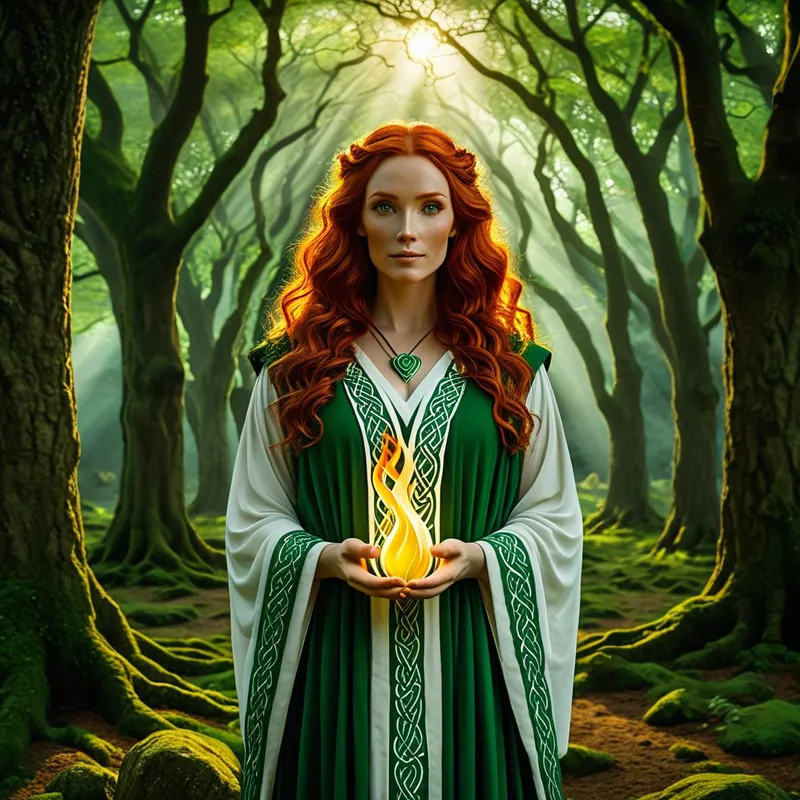
Then, she came. Not with thunder, but with the first, hesitant drip of snowmelt from a branch. Her name was Brigid. She was not one thing, but three: the Poet, whose words could shape reality; the Healer, whose touch could mend broken flesh and spirit; and the Smith, whose hammer could forge destiny from raw ore. And at the center of her threefold being burned a single, inextinguishable flame.
It was said she was born at the exact moment of dawn, with a pillar of fire reaching from her dwelling to the heavens. This was no ordinary fire. It did not consume wood, but fed on inspiration, on compassion, on the sheer will to create. She established a sanctuary at Cill Dara, a sacred grove of oak. There, in a simple stone cell, she lit her flame upon a hearth of ancient rock.
For nineteen days, she alone tended it. On the twentieth day, the flame would become its own keeper, burning without fuel, a miracle of pure essence. It became a beacon. The sick came, and by its light, she compounded herbs and sang healing chants. The lost came, and by its warmth, she offered visions and crafted poems that gave their lives new meaning. The broken came, and at her forge, she showed them how to take their shattered pieces and reforge them into something stronger, more beautiful.
But the old order, the deep winter of the spirit, feared this flame. It was a power that could not be controlled, a truth that could not be silenced. Shadows gathered—not creatures, but the cold weight of dogma, the fear of the new, the desire to extinguish what one does not understand. They sought to smother the light, to return the world to a single, simple, frozen truth.
The conflict rose not in a battle, but in a creeping frost that sought the sanctuary’s heart. The flame flickered. The people’s hope wavered. Brigid did not raise a sword. Instead, she raised her voice in a poem so potent it defied the cold. She laid her hands upon the hearthstone, and her healing will flowed into the very land. She took up her hammer and struck the anvil not to shape iron, but to ring a note of pure, resonant defiance that shattered the stillness.
And the flame blazed brighter. It did not just survive; it multiplied. From that one central hearth, torches were lit and carried out across the darkened land—to humble homes, to lonely hilltops, to the hearts of those who had forgotten their own inner light. The flame was never meant to be hoarded. It was meant to be shared, to be carried into the darkest corners of the year, a promise that beneath the frost, the seeds of spring and the fires of creation forever stir.
Cultural Origins & Context
The figure of Brigid is a profound example of the living, adaptive nature of Celtic tradition. She originates as a pan-Celtic goddess, revered across Ireland, Britain, and beyond, likely connected to the Celtic high deity of poetry and wisdom. Her myth was not preserved in a single, canonical text like those of Greece or Rome, but was woven into the oral tapestry of the filid, the poet-seers.
Her story was intrinsically tied to the festival of Imbolc, one of the four great seasonal hinges of the Celtic year. Imbolc, meaning "in the belly," celebrated the first stirrings of life in the womb of the earth. Brigid’s flame was the symbolic heart of this festival. In ritual and practice, the communal hearth fire was doused and rekindled from her sacred flame, a literal and spiritual act of renewal that purified the home and community for the new cycle.
The societal function was multifaceted. As a goddess of poetry (imbas), she governed the power of language to shape law, history, and identity. As a healer, she presided over the practical and spiritual medicine of the people. As a smith, she represented the transformative power of technology and craft. Her enduring flame symbolized the continuity of culture itself—the knowledge, skills, and spiritual vitality that must be consciously tended and passed from one generation to the next, lest they go out forever.
Symbolic Architecture
Brigid’s Flame is not merely a plot device; it is a complete symbolic universe. The flame itself is the core symbol of consciousness—not the flickering, ego-driven awareness, but the steady, eternal light of the Self. It is the inner spark of creativity, the vital force of healing, and the catalytic energy of transformation.
The sacred flame is the psyche's first principle: it creates, it heals, and it forges the raw material of experience into meaning.
The threefold nature of Brigid—Poet, Healer, Smith—represents a trinity of essential human faculties often fragmented in modern life: the creative imagination that envisions new possibilities, the compassionate empathy that mends wounds, and the disciplined will that manifests vision into tangible reality. The myth insists these are not separate paths, but interdependent aspects of a whole being. The poet’s vision guides the healer’s hand; the healer’s compassion tempers the smith’s force; the smith’s discipline gives form to the poet’s dream.
The sanctuary at Cill Dara symbolizes the temenos, the sacred, protected inner space of the psyche where this integrative work can occur. The "shadows" that seek to extinguish the flame are the forces of psychic entropy: literalism that kills metaphor, cynicism that denies healing, and inertia that refuses the hard work of forging a new self.
The Dreamer's Resonance
When this myth stirs in the modern unconscious, it often manifests in dreams of fire in liminal states. One might dream of a single, beautiful flame burning in a rainstorm, untouched. Or of desperately trying to light a damp kindling in a cold, dark place. Perhaps the dreamer is tasked with guarding a hearth, or searching for a lost source of light in a labyrinth.
Somatically, this can correlate with a feeling of creative constipation, a numbness to joy, or a chronic, low-grade fatigue—the "winter of the soul." The dream is pointing to a need to tend. The psychological process underway is the re-ignition of a dormant life force. The dreamer is being called to become their own Brigidine, to take up the vigil for their own inner flame. The conflict in the dream mirrors the internal resistance—the fears, distractions, and old wounds that threaten to snuff out one’s unique creative spark and vital energy.
Alchemical Translation
The myth of Brigid’s Flame is a precise map of the individuation process. The journey begins in the nigredo, the blackening: the wintered soul, the fragmented self where poetry, healing, and will are disconnected. The call is the first glimpse of the flame—a moment of inspiration, a surge of compassion, a flash of determination.
The central work, the albedo or whitening, is the tending. This is the daily, often mundane practice of the vigil: writing the poem, attending to the wound, laboring at the forge of one’s craft. It requires discipline (the 19-day cycle) to reach the point where the process becomes self-sustaining, where creativity flows from an inner source, not external validation.
Individuation is the art of kindling a fire that feeds on its own essence, becoming independent of the dry tinder of circumstance.
The confrontation with the "shadows" is the citrinitas, the yellowing or testing, where the emerging Self faces the full weight of the personal and collective unconscious that prefers the safety of the frozen status quo. Victory is not annihilation of the shadow, but integration—using the poet’s insight to understand it, the healer’s art to accept it, and the smith’s strength to incorporate its energy.
The final stage, the rubedo or reddening, is the multiplication and sharing of the flame. The individuated Self does not hoard its wholeness. It becomes a source of light for others, carrying the torch of consciousness into the world. The eternal flame at Kildare, historically tended for centuries, symbolizes this ultimate goal: the creation of a continuous, unbroken lineage of conscious life, a Self that outlives the ego and contributes its unique fire to the great, enduring hearth of humanity.
Associated Symbols
Explore related symbols from the CaleaDream lexicon: