Brigid's Butter Myth Meaning & Symbolism
A myth where the goddess Brigid, disguised as a beggar, tests a woman's hospitality and transforms water into rich butter, revealing hidden generosity.
The Tale of Brigid's Butter
Listen now, and let the peat-smoke carry you back. It was a time when the veil between the worlds was thin as morning mist, and the footsteps of the Tuatha Dé Danann still echoed in the hollow hills. The land was gripped in the iron fist of winter, a season of want, where every crust of bread was counted and every drop of milk was precious.
In a small, humble dwelling of stone and sod, a woman toiled. Her name is lost to us, but her story is not. Her larder was near bare, her heart heavy with the burden of scarcity. The only wealth she possessed was a single churn of precious cream, saved and saved, the hope for a pat of butter to see her through the bleak days.
A knock came at her door, not a bold rap, but a soft, insistent scratching, like the wind in the thatch. She opened it to find a woman of great age, her cloak ragged and thin, her face etched with the map of countless roads. The cold clung to her like a second skin. She asked not for coin, but for a simple act of mercy: a place by the fire to churn her own meager portion, for she had nothing but a vessel of water.
The woman of the house hesitated. Her own cream was scant. To share her fire, her warmth, her precious time with a stranger who offered nothing in return? It was a risk. Yet, something in the beggar’s weary eyes, a glimmer that belied her frailty, stirred a deep, ancestral chord of féile. She stepped back, bidding the stranger enter.
The old woman settled by the hearth, her knotted hands placing a simple pitcher beside the house’s own churn. As the woman of the house began her rhythmic, hopeful work, the beggar did the same. But her churn held only clear, cold water. The hostess watched from the corner of her eye, a pang of pity and disbelief in her heart. To churn water! It was the action of a fool or one touched by the otherworld.
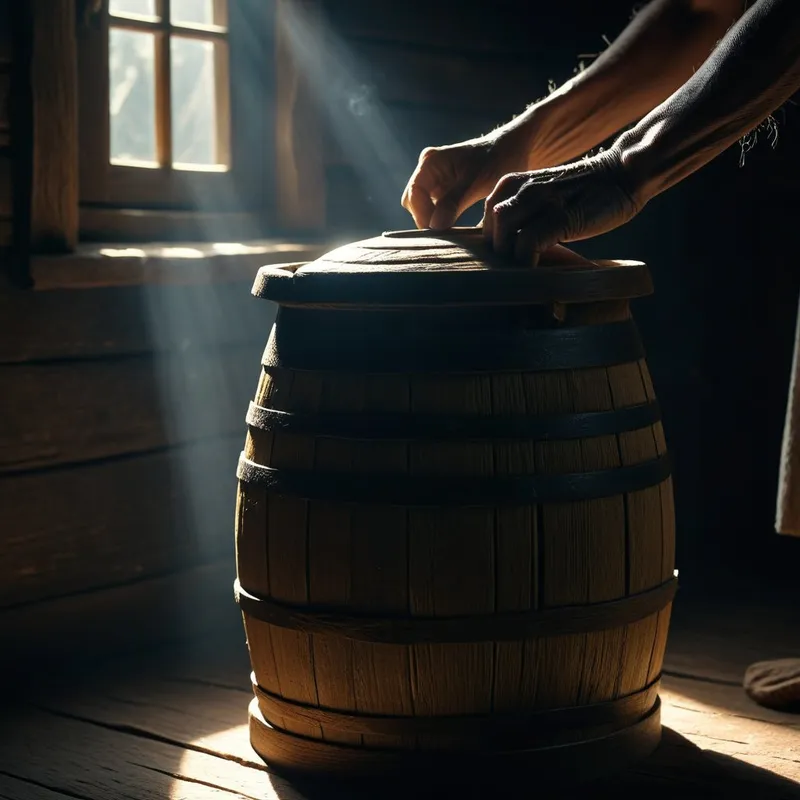
For a long time, the only sounds were the crackle of the fire, the sigh of the wind, and the steady thump-thump-thump of two dashers. The woman’s own churn yielded its treasure: a small, pale gathering of butter. Her heart sank at its meagerness. Then, the beggar woman ceased her motion. She lifted the lid of her churn.
A fragrance filled the cottage, rich and golden as a summer meadow—the unmistakable, profound scent of fresh, sweet butter. But it was a scent multiplied a hundredfold. The woman peered inside. Where there had been water, there now swirled a bounty of the richest, most golden butter she had ever seen, overflowing the vessel, a miracle of abundance.
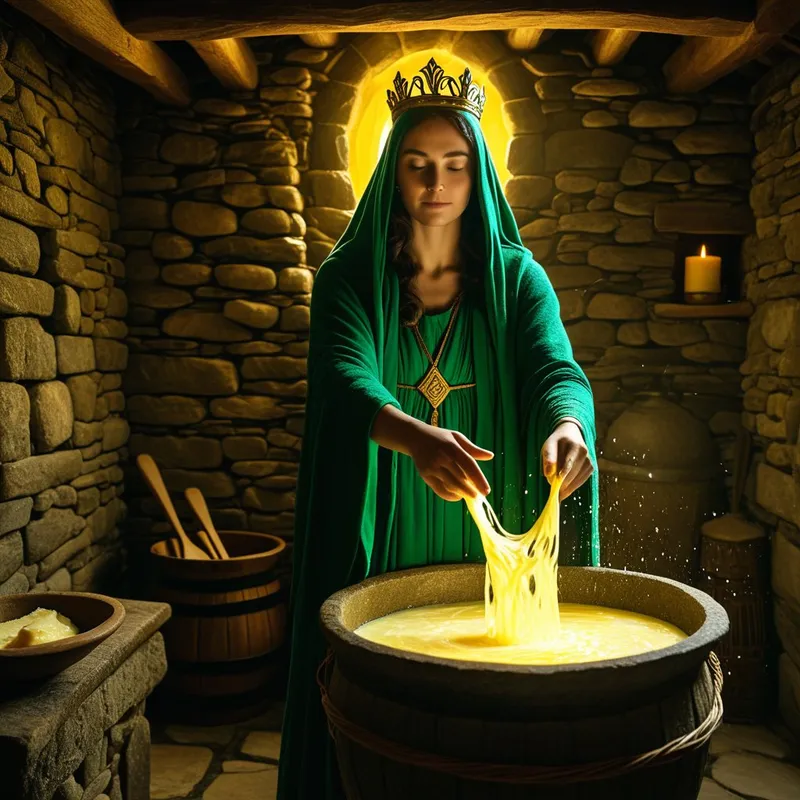
The beggar woman stood, and as she rose, her ragged cloak fell away. No longer was she aged and bent, but radiant, crowned with a light that was neither fire nor sun. She was Brigid, the exalted one, the flame in the head, the keeper of the sacred hearth. She smiled upon the stunned woman. “For your generosity when you believed you had nothing to give,” her voice was like the hum of a bee in clover, “your own need is met.” She gestured to the hostess’s churn. Looking inside, the woman found her own modest portion transformed, now as plentiful and rich as the goddess’s own.
Then, as softly as she came, Brigid was gone. The woman was left alone with two churns of miraculous butter, the warmth of a sacred touch lingering in the air, and a lesson etched forever in her soul: that the vessel of hospitality, even when filled with the water of poverty, could be transmuted into the gold of divine abundance.
Cultural Origins & Context
This story belongs not to the grand epic cycles of Irish mythology, but to the folk tradition—the fireside tales told by the seanchaí, the storytellers, in the Gaelic world of Ireland and Scotland. These narratives, often called Brigid's miracles, served as exempla, teaching profound social and spiritual laws through simple, relatable parables. While the figure of Brigid seamlessly transitioned from a pan-Celtic goddess to a beloved Christian saint, this myth carries the unmistakable signature of the older, pagan understanding of her nature.
Its societal function was multifaceted. Primarily, it was a powerful enforcement of the sacred law of hospitality, a cornerstone of Celtic society. In a world of thin margins and potential isolation, the stranger at the door could be anyone—even a deity in disguise. The myth taught that true féile was not conditional upon the host’s wealth or the guest’s status, but was a sacred duty that, when fulfilled, could unlock unforeseen blessings. Furthermore, it positioned Brigid as a goddess of the hearth and home, a protector of women’s domains and domestic arts, who directly intervened in the daily struggle for sustenance, transforming scarcity into security through the alchemy of right action.
Symbolic Architecture
At its heart, the myth is a map of psychic economy. The water in the beggar’s churn symbolizes the apparent emptiness, the potential that is not yet formed, the unactivated resource. It is the guest who appears to bring nothing, the part of ourselves we deem worthless or barren. The butter is the concentrated essence, the nourishing gold, the tangible fruit of labor and transformation. It represents psychic substance, soul-food, and realized value.
The true miracle is not that water becomes butter, but that the perception of lack becomes the recognition of latent wealth through an act of unconditional giving.
The churn itself is the crucible of transformation—the heart, the home, the focused effort of consciousness. The rhythmic act of churning is the discipline of attention, the often-tedious work of bringing disparate elements (cream, or experience) into a cohesive, valuable whole. Brigid, in her dual disguise as beggar and goddess, represents the Self—the ultimate, often hidden, guiding principle of the psyche. She tests the ego’s (the housewife’s) capacity for compassion beyond logic. The moment of hesitation is the ego’s calculation, its fear of depletion. The act of opening the door is the surrender to a deeper, archetypal law of the soul.
The Dreamer's Resonance
When this myth stirs in the modern unconscious, it often surfaces in dreams of paradoxical abundance or tests of character. You may dream of being asked to give away your last coin, only to find your pocket full of gold. You might dream of cooking a meal with empty pots that somehow become lavishly filled, or of tending a barren garden that overnight blooms with impossible fruit.
Somatically, this can correlate with a feeling of constriction in the chest (the hesitation, the fear of scarcity) releasing into a warm, expansive feeling in the heart or gut (the flow of generosity and the surprise of reciprocation). Psychologically, the dreamer is navigating a core conflict between the ego’s accounting—its ledger of what it owns, deserves, and can afford to lose—and the soul’s knowledge of a different kind of economy. The dream is an invitation to churn the “water” of one’s current life: the seemingly meaningless job, the stalled creative project, the relationship that feels draining. The myth-dream suggests that the act of engaging with it faithfully, of offering it hospitality instead of rejection, may initiate a hidden process of transmutation.

Alchemical Translation
The process modeled here is the alchemy of shadow integration through the principle of generosity. The beggar at the door is the ultimate shadow figure: she represents our own perceived poverty, our need, our vulnerability. Our instinct is to shut the door, to deny this aspect in ourselves and others. The myth instructs us to invite her in, to give her a place by our inner fire.
The alchemical operation is solutio (dissolution) followed by coagulatio (coagulation). The rigid boundaries of “mine” and “not mine,” “enough” and “not enough,” are dissolved (solutio) in the waters of shared humanity and compassion. From this dissolved state, a new, richer substance coalesces (coagulatio)—not just more butter, but butter of a miraculous, golden quality. This is the individuation process: by consciously engaging with and offering value to the neglected, “watery” parts of the psyche (the beggar), we are not depleted. Instead, the entire psychic system is enriched and unified under the auspices of the Self (Brigid).
The ultimate yield of Brigid’s churn is not a commodity, but a revelation: that our deepest security springs not from hoarding, but from the courageous, rhythmic act of turning our attention and care toward that which seems empty, thereby activating the hidden gold within ourselves and our world.
For the modern individual, the myth is a call to practice a radical hospitality of the spirit. Churn the water of your doubts. Offer warmth to the impoverished parts of your soul. In that faithful, often illogical action, you may find the goddess has been working alongside you all along, waiting to reveal that what you perceived as lack was the raw material of divinity itself.
Associated Symbols
Explore related symbols from the CaleaDream lexicon: