
Brigid Myth Meaning & Symbolism
The story of Brigid, the Celtic goddess of sacred fire, who embodies the triple flame of poetry, healing, and smithcraft, illuminating the soul's forge.
The Tale of Brigid
Listen. In the time before time was counted, in the land of Éire, where the veil between worlds was thin as morning mist, there was a silence that yearned for a sound. It was a silence of cold earth, of unlit hearths, of wounds without song. From this deep longing, she emerged—not with a crash of thunder, but with the first, sure spark in the darkness.
Her name was Brigid. They say she was born at the exact moment of dawn, her first cry the sound of flame catching dry tinder. Where her feet touched the frozen ground, green shoots pushed through the iron-hard soil. Her breath was the west wind that carries the scent of rain. But her essence was fire—not the fire that consumes, but the fire that reveals, that transforms, that makes.
She walked the land, and where she paused, three sacred wells sprang forth. At the first, she sang. The notes were not mere sound; they were living things that shaped the air into stories, into laws, into laments of such beauty that the stones wept. This was the Well of Poetry, and from it, the first bard drew his breath.
At the second well, she knelt. She placed her hands upon the waters, and they grew warm and bright. She whispered to the herbs that clustered at its rim—comfrey, yarrow, moss—and they learned the secrets of bone and blood and spirit. This was the Well of Healing, and the first wise woman learned to listen.
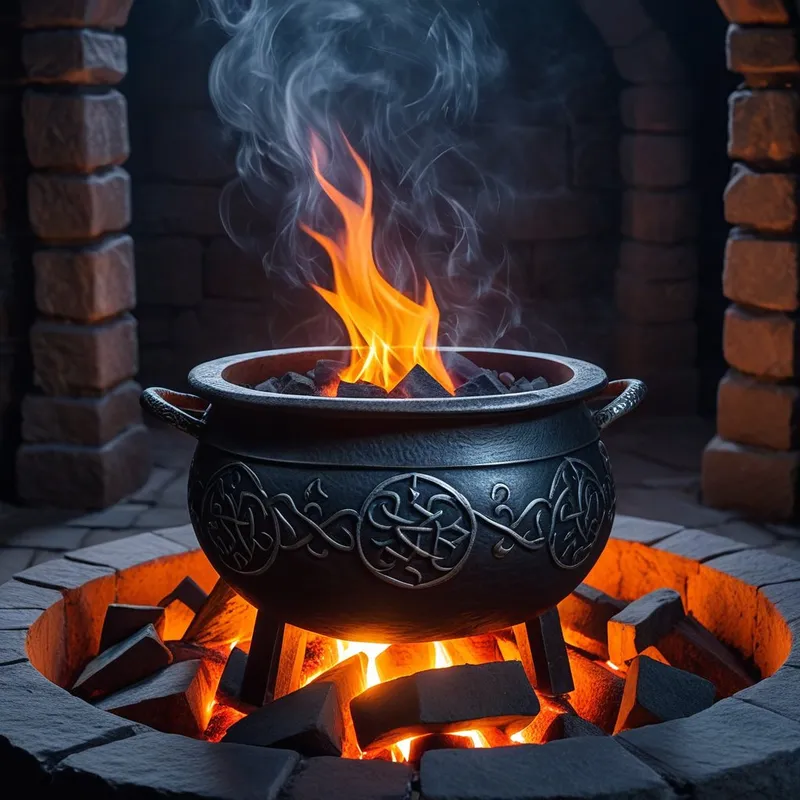
But it was at the third place she stopped that the greatest mystery unfolded. She did not find a well here, but a cold, dark forge. Within it lay raw ore, dull and sleeping in the earth. Brigid entered, and with a breath, she awakened the banked fire. She took the heavy hammer in her hands—hands that could cradle a newborn lamb or shape destiny. The first strike rang out, a clear, defining note that echoed in the hollow hills. With each blow, she did not force the metal; she conversed with it, persuading the stubborn iron to remember its potential. She forged not swords, but tools: the ploughshare to cut the earth, the cauldron to hold the feast, the bell whose voice would call communities together. This was the Forge of Smithcraft.
The people came. The poets, whose minds were dark, came to her first well and drank, and their thoughts caught fire. The sick and the heart-sore came to her second well and were washed in light. The makers and the builders came to her forge and saw that to create was a holy act. She became the heart of the tribe, the flame at its center. Her fire was in the bard’s tongue, in the healer’s touch, in the smith’s transforming art. She was the triple spark in the darkness, and while her flame burned, the people knew that life was not merely to be endured, but to be sung, mended, and magnificently made.
Cultural Origins & Context
The figure of Brigid is not a singular character from one tale but a pervasive, pan-Celtic presence whose worship stretched across Ireland, Britain, and the European continent. She is a goddess of the Tuatha Dé Danann, the mythical tribe who represented the sovereign spirit of the land itself. Unlike myths centered on a linear narrative of conquest or tragedy, Brigid’s “myth” is her pervasive function. Her stories were not a single epic but a constellation of attributes, passed down through the oral tradition of filid (poets) and seanchaí (storytellers), often at the very hearths and forge-fires she sanctified.
Her societal role was foundational. As a goddess of poetry, she presided over imbas, the fire of inspiration that governed law, history, and satire—the very fabric of cultural memory and social order. As a healer, she was integral to the Bean Feasa (wise woman) tradition. As a smith, she protected the vital, transformative technology of the Iron Age. She was, effectively, the archetype of civilized craft and communal sustenance. This deep-rooted veneration made her transition into the Christian era seamless; she was syncretized into Saint Brigid of Kildare, who kept a perpetual flame burning with her nuns, mirroring the pagan priestesses who had done the same for the goddess. Her feast day, Imbolc (February 1st), remains a potent cross-quarter day celebrating the returning light and the awakening earth.
Symbolic Architecture
Brigid embodies the sacred trinity of inner forces necessary for a soul—and a culture—to be whole. She is not three separate beings, but one consciousness expressing itself through three distinct, yet interwoven, modalities.
The Poet represents the Logos, the formative power of consciousness. This is the fire of mind that names, structures, and gives meaning to raw experience. It turns chaos into narrative, suffering into song, and memory into identity.
The poet’s forge is the mind, where the raw ore of experience is hammered into the meaningful shape of a life told.
The Healer represents Eros, the connective, mending power of compassion. This is the watery, receptive fire that soothes, integrates, and makes whole what is broken. It attends not just to the body, but to the fractures in relationship and spirit.
The Smith represents the Telos, the willful, transformative power of action. This is the most tangible fire—the heat of friction and effort required to alter the state of something. It is the application of pressure and vision to reshape the stubborn materials of reality (habits, circumstances, the self) into a functional, beautiful form.
Together, they form a complete cycle of creation: Inspiration (Poet) → Integration (Healer) → Manifestation (Smith). Brigid’s myth insists that true creation is never a sterile act of intellect alone; it must be tempered by compassion and realized through disciplined craft.

The Dreamer's Resonance
When Brigid’s pattern stirs in the modern psyche, it often manifests in dreams of potent, creative tension. One might dream of a neglected, cold forge that suddenly roars to life, or of a well of dark water that begins to glow from within. These are somatic signals of a dormant creative impulse seeking expression.
Dreams of trying to speak but producing only sparks or music, or of holding a painful, wounded object that requires mending with unexpected tools, point directly to the integration of her three flames. The dreamer may be at a life threshold where a raw, unprocessed experience (the ore) demands to be shaped. The psychological process is one of gathering: gathering the scattered threads of inspiration, the neglected wounds requiring attention, and the latent will to act. The conflict in such dreams is often the fear that these fires are separate or contradictory—that the artist cannot be the caregiver, or the maker cannot be tender. Brigid’s archetypal presence in the dream reassures that these are not competing energies, but different facets of the same sacred fire of becoming.

Alchemical Translation
For the individual on the path of individuation, Brigid models the alchemy of psychic transmutation. The modern soul often suffers from a painful fragmentation: the creative self is split from the compassionate self, which is in turn divorced from the capable, manifesting self. We are poets without a forge, healers without a song, smiths without a vision.
Brigid’s process begins at her forge—the vas of the inner life. The raw ore is the contents of the unconscious: primal emotions, inherited complexes, unlived potentials. The fire is the focused attention of the ego, the conscious will to engage. The hammer is the discipline of practice—whether in therapy, art, or relationship—that repeatedly strikes to shape this material.
Individuation is the smithcraft of the soul. One must be willing to hold the heat, endure the blows, and shape the self with the same reverence a master smith shapes a sacred tool.
The poet’s well teaches that we must find the narrative that makes our suffering meaningful. The healer’s well demands we tend to the wounds uncovered in the process with compassion, not judgment. The final product is not a perfected, static being, but a functional vessel—a cauldron of the self that can contain contradiction, generate nourishment, and serve a purpose in the world. To invoke Brigid is to commit to this triple labor: to have the vision (poet), to hold the process with kindness (healer), and to do the hard, hot, repetitive work of self-creation (smith). In her myth, we learn that our most profound creations are always forged in the union of inspiration, integration, and unwavering effort.
Associated Symbols
Explore related symbols from the CaleaDream lexicon: