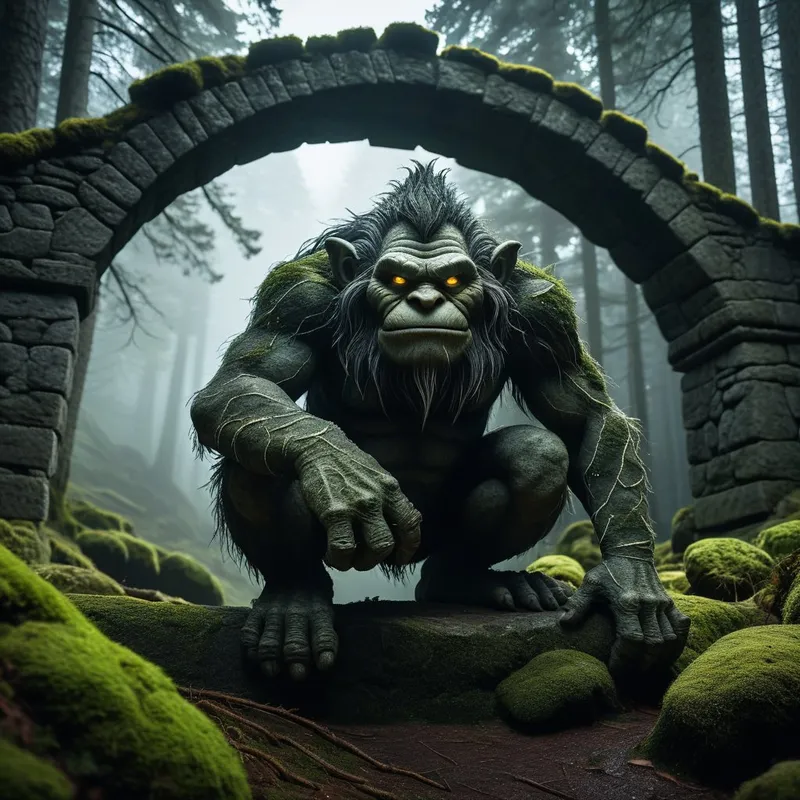
Bridge Trolls Myth Meaning & Symbolism
An ancient guardian of thresholds demands a toll, challenging the traveler to a riddle contest for passage, embodying the psyche's confrontation with the shadow.
The Tale of Bridge Trolls
Listen, and let the firelight carve the shapes from the dark. In the time when the forest was a deeper, older creature, and the mountains held their breath, the roads were not safe. They were threads through a tapestry of shadow, and where they crossed the cold, swift rivers—those veins of the land—the bridges were built. Stone upon stone, arching over the whispering water. And under every such arch, in the perpetual damp and gloom where the sun never warmed the stone, they waited.
They were the trolls. Not the petty creatures of later tales, but ancient ones, as old as the rock itself. Their skin was like lichen-covered granite, their hair like tangled roots, and their eyes held the slow, patient glow of banked coals. A troll did not own the bridge, you understand. It was the bridge, and the bridge was it. Its purpose was the toll.
So it was for the traveler, wrapped in a cloak smelling of woodsmoke and far places, who came to such a crossing at the failing of the light. The river roared below, a hungry sound. The bridge was a black maw against the twilight sky. And as the traveler’s foot touched the first worn stone, a voice rumbled from the darkness beneath, a sound of grinding stones and deep earth.
“Who seeks to cross my back?”
From the deepest shadow under the arch, a shape detached itself, vast and ponderous. The air grew cold. The troll unfolded to its full, terrifying height, blocking the way, its breath a fog in the chill air. “My toll,” it growled, the words vibrating in the traveler’s bones. “Pay my toll, or turn back to the forest.”
In some tellings, the toll was gold or silver. In the oldest, the truest, it was a life. The troll’s price was you. But the old laws of the world, older even than the trolls, offered a thread of hope. “Or,” the creature would say, a cunning glint in its stone-like eye, “answer me this. Answer my riddle, and pass freely. Fail, and you are mine.”
The night would hold its breath. The river’s voice seemed to hush. The traveler, heart a frantic bird against ribs, had no weapon but wit. The troll’s riddle would come, often a twisting thing about the sun and the moon, about what has one voice but walks on four legs, then two, then three. A puzzle of existence itself. To answer wrong was to be snatched up, to become a story swallowed by the dark. But to answer right…
To answer right was to witness a miracle. The great troll, its power bound by the ancient covenant of challenge, would let out a groan that shook the bridge. Its massive form would seem to shrink, not in size, but in presence, melting back into the stone and shadow from whence it came. “Pass,” it would grumble, a defeated thunder. “The way is clear.” And the traveler, limbs trembling not just with fear but with the fierce joy of survival, would cross the bridge into the new territory, the old danger left behind, a secret keeper of the threshold’s law.
Cultural Origins & Context
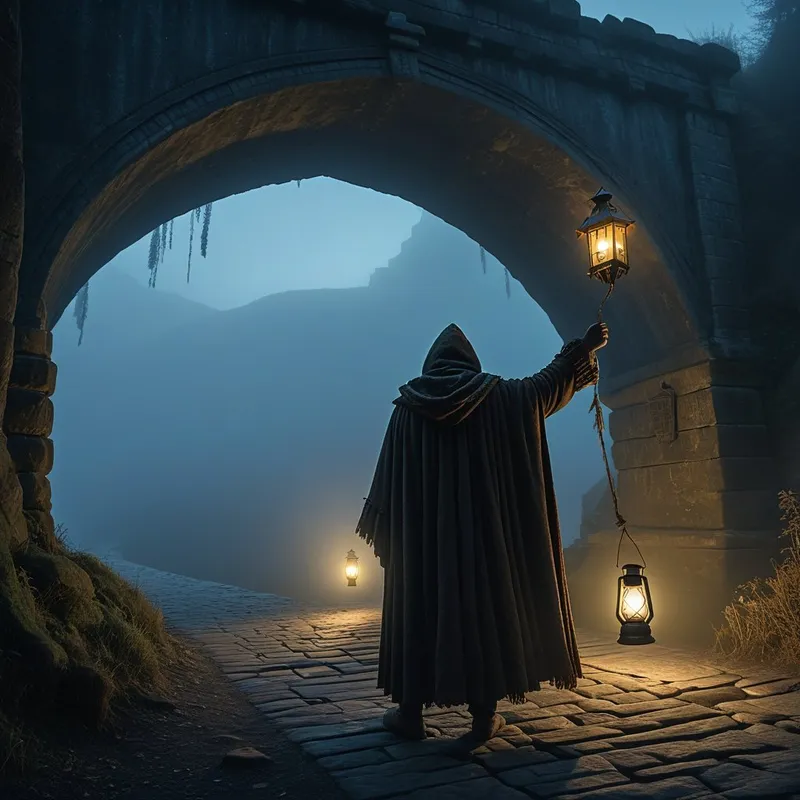
This myth did not spring from a single poet’s mind but seeped up from the very landscape of Scandinavia. In a world of dense, trackless forests, formidable mountains, and countless fast-flowing rivers, bridges were not mere conveniences; they were vital, vulnerable nodes of human connection and commerce. They were also liminal spaces, neither fully of the settled land nor the wild water, making them spiritually dangerous.
The stories of bridge trolls were oral folklore, told by the hearth in long winter nights and by travelers sharing tales on the road. They served a profound societal function beyond entertainment. First, they were cautionary tales, warning people—especially the young and reckless—against traveling alone at night, particularly to cross these uncanny places. Second, they personified very real dangers: outlaws who might lurk at such choke points to demand literal tolls or worse. The troll became the mythic mask for a human threat.
Finally, and perhaps most deeply, these stories reinforced a worldview where the natural world was animate and had to be negotiated with. The troll was the genius loci, the spirit of that specific place. The riddle contest formalized this negotiation. It established that while the wild (the troll) had power, human cunning (culture, intellect) could create a safe passage, but only through direct confrontation and respect for the rules of engagement. The myth taught that one does not simply take from or pass through the world; one must earn the right.
Symbolic Architecture
At its core, the bridge troll myth is a masterful depiction of the psyche’s encounter with the Shadow. The bridge is the classic symbol of transition, of moving from one state of being to another—from ignorance to knowledge, from dependency to independence, from one phase of life to the next.
The Shadow does not reside in the light of our conscious self, but in the archway we must pass under to become whole.
The troll is the guardian of this threshold. It is not evil, but oppositional. It embodies everything we fear we might meet in that new territory: failure, humiliation, the monstrous parts of ourselves we’ve denied. Its demand for a “toll” represents the inevitable cost of growth: you cannot cross into a new chapter of your life without sacrificing something of the old one—a comfort, a naive belief, a former identity.
The riddle is the exquisite key. It represents the necessity of consciousness. One cannot brute-force their way past the Shadow (the troll is always stronger). One cannot ignore it or pretend it isn’t there. The only way through is to understand it. The riddle, often about the nature of life and time, forces the traveler (the ego) to engage with fundamental truths. To answer correctly is to demonstrate sufficient self-awareness and insight to be worthy of passage. It is the moment the ego recognizes a part of the Shadow, names it, and in doing so, disarms its autonomous, terrifying power.
The Dreamer's Resonance
When this mythic pattern stirs in the modern dreamer, it signals a profound psychological process is underway. To dream of being stopped by a monstrous figure at a bridge, a doorway, or a gate is to feel one’s own psyche blocking further progress.
The somatic experience is often one of gripping dread, a cold paralysis in the chest. The dream bridge might be crumbling, or impossibly high, or lead into a fog. The troll-figure is rarely a literal troll; it may be a frightening stranger, a disapproving authority figure, a monstrous animal, or even a terrifying, distorted version of the dreamer themselves. This is the Shadow manifesting in a form the dreamer can perceive—all the repressed anger, shame, laziness, or ambition that has been deemed “unacceptable.”
The dream is staging the confrontation the waking self has been avoiding. The feeling of being “stuck” in life, in a career, or a relationship, finds its symbolic expression here. The dream asks the essential question posed by the troll: What are you willing to pay? What old self must you surrender? And what riddle of your own existence have you failed to solve? The anxiety in the dream is the toll being demanded. The resolution, if the dream allows it, comes not from fighting, but from a sudden insight—the answer to the unspoken riddle—that allows the figure to recede and the path to clear.
Alchemical Translation
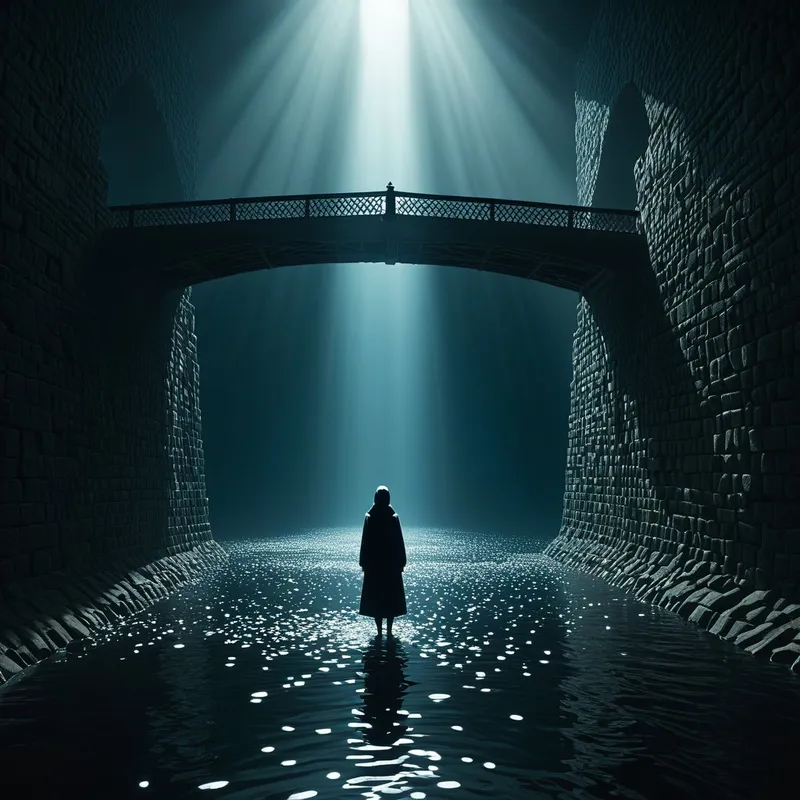
The journey of the myth models the individuation process with stark clarity. The traveler begins in a state of need or desire (the conscious goal, the “other side”). To achieve it, they must descend, psychologically, into the liminal space where the rules of ordinary life do not apply (the bridge/threshold).
Here, they meet the prima materia of their own transformation: the Shadow-troll. The alchemical operation is not destruction, but confrontation and integration. The riddle contest is the sacred vessel where this transmutation occurs.
The gold of the Self is not found by slaying the dragon of the Shadow, but by deciphering the language in which its scales are written.
The ego’s successful answer to the riddle represents a moment of psychic synthesis. A piece of the unconscious content is brought into the light of consciousness, understood, and its energy liberated. The troll’s “defeat” is its integration. It is no longer a terrifying, autonomous monster under the bridge (repressed in the unconscious), but its strength and ancient knowing become part of the foundation of the bridge itself. The structure that allows passage is now stronger for having incorporated that which once blocked it.
For the modern individual, this translates directly into life’s transitions. To change careers, one must answer the troll’s riddle of “What am I truly afraid of losing?” To enter a committed relationship, one must pay the toll of vulnerable self-disclosure. To achieve any meaningful goal, we must converse with the internal guardian that says “you can’t,” understand its origin, and in answering its challenge correctly—not with force, but with truth—we find we have not defeated a part of ourselves, but have finally invited it home. The bridge, once crossed, leads not away from who we were, but into a territory that includes all of who we are.
Associated Symbols
Explore related symbols from the CaleaDream lexicon: