Brass Serpent Myth Meaning & Symbolism
A people poisoned by serpents are saved by gazing upon a brass serpent lifted high, transforming the instrument of death into a symbol of salvation.
The Tale of the Brass Serpent
The sun was a hammer on an anvil of sand. The air, thick with the memory of miracles—parted sea, sweetened water, bread from heaven—now tasted only of ash and despair. The great host of Israel crawled through the Negev, a river of complaint flowing from their parched lips. They cursed the manna, they cursed the thirst, they cursed the God who had led them from the iron furnace of Egypt into this crucible of dust.
Their words were venom, and the wilderness heard. From fissures in the scorched earth, from beneath sun-bleached stones, they came. Serpents, fiery in color and in bite, a living tide of scaled judgment. Their fangs pierced leather and skin, and a burning poison spread, not just in the limb, but in the soul—a fever of certain death. The camp became a chorus of moans, the tents filled with the dying, their bodies wracked, their eyes wide with the terror of a punishment they now understood.
Moses, his face etched with the weight of a stubborn people, took their cries to the mountain. He stood before the presence that dwelt in cloud and fire, and he pleaded. The answer was not an antidote, not a revocation, but a mystery forged in metal.
"Make a seraph," the voice instructed, "and set it upon a standard."
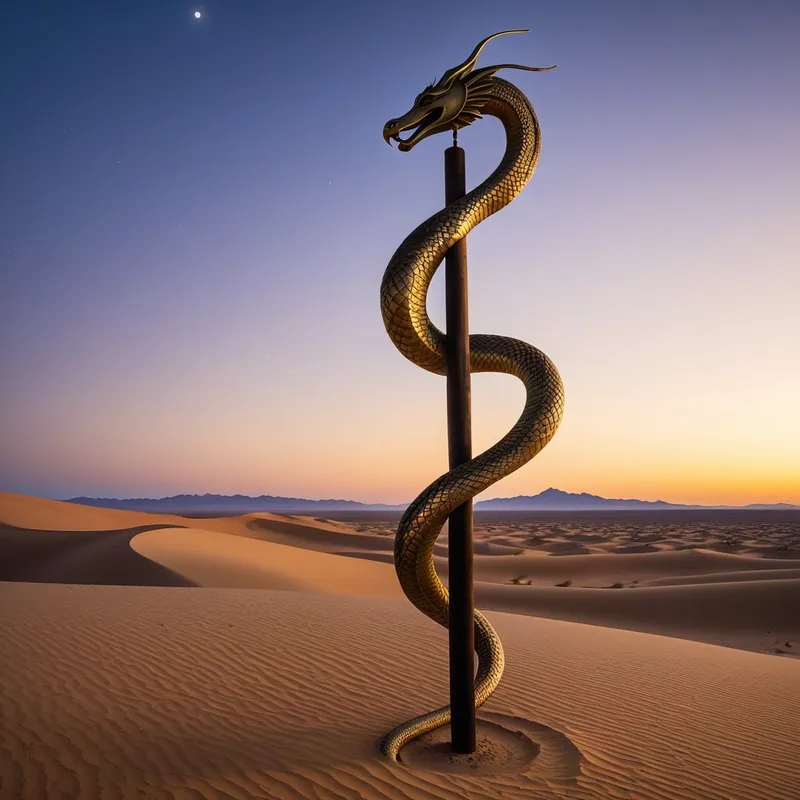
So Moses descended. The craftsmen brought brass, the metal of the desert sun, of mirrors and judgment. In the heart of the camp, with the dying all around, the furnace was lit. They did not fashion an angel or a shield, but the very image of their tormentor. From the molten metal rose a serpent, coiled and poised, a perfect, gleaming replica of the death that slithered at their feet. This effigy of the curse was lifted high upon a pole, raised for all to see from every corner of their suffering.
And a whisper went through the camp, a final, desperate commandment: Look. To the man clutching his swollen arm, to the mother weeping over her child, the word came. Turn your eyes from your wound, from the ground, from the dying. Look up. Gaze upon the thing that kills you.
Those who, in their agony, could muster the faith to behold the lifted serpent—not as an idol, but as a sign—felt the fire in their veins cool. The swelling receded like a tide. Breath returned, deep and clear. Where there was a corpse, a living man rose. They looked upon the form of their destruction, and in that act of witnessing, they were made whole. The symbol of death, lifted high, had become the conduit of life.
Cultural Origins & Context
This potent narrative is embedded in the Book of Numbers (Chapter 21), a text that chronicles the fraught journey from Sinai to the edge of the Promised Land. It functions as a pivotal etiology within the larger saga, explaining not just an event, but the origin of a sacred object. The story was preserved by priestly and prophetic storytellers, for whom it served a crucial dual purpose.
Firstly, it was a stark theological lesson on the gravity of rebellion ("speaking against God and against Moses") and the tangible consequences of ingratitude in the covenant relationship. The wilderness was a testing ground, and failure had immediate, physical repercussions. Secondly, and perhaps more enduringly, it established the legitimacy of the Nehushtan itself, which became a venerated relic in the Jerusalem Temple for centuries. It served as a tangible reminder of divine mercy—a mercy that was not the removal of consequence, but a paradoxical path through it. The story validated the object's power while carefully framing it not as a magical talisman, but as a God-appointed symbol requiring an act of faithful obedience to activate its grace.
Symbolic Architecture
At its heart, the myth presents a supreme paradox: healing comes from confronting the image of the poison.
The cure is not found in fleeing the wound, but in fully beholding the instrument that made it.
The seraph represents the biting, painful consequences of one's own actions—the "fiery serpents" of guilt, resentment, and self-destructive patterns we unleash through our complaints and rebellions against life's conditions. The poison is the psychic toxicity that follows, the inner conviction that we are doomed by our own nature.
The command to look upon the brass serpent is the divine prescription for shadow work. It is the instruction to cease running, to stop nursing the wound in self-pity, and to consciously, courageously observe the pattern of our own destruction. The brass serpent is that pattern made objective, lifted out of the murky soil of the unconscious and into the clear light of consciousness. It is no longer a hidden, slithering terror, but a defined, static symbol.
The pole is the axis of consciousness, the steadfastness required to hold the painful truth in view without turning away.
The healing occurs not because the brass has magic, but because the act of looking—this conscious, willing engagement with the symbol of one's affliction—transforms one's relationship to it. The poison loses its autonomous, fatal power the moment it is truly seen and acknowledged as part of the self's journey.
The Dreamer's Resonance
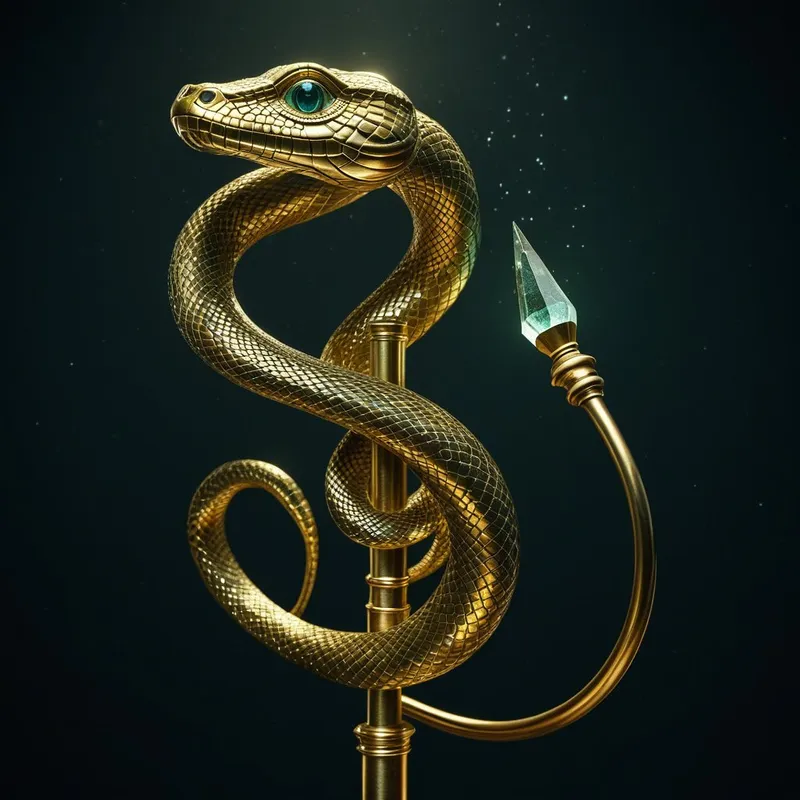
When this myth stirs in the modern psyche, it may manifest in dreams of being bitten or pursued by snakes, of suffering from a mysterious toxin, or of being lost in a vast, arid landscape. More subtly, it may appear as a dream of finding a strange, metallic artifact or being instructed to look at something terrifyingly familiar.
These dreams signal that the dreamer is in the grip of a psychic "venom." This could be the toxic after-effect of a betrayal (one's own or another's), a habit of corrosive complaint that is poisoning their outlook, or a deeply ingrained pattern of self-sabotage. The somatic feeling is often one of burning anxiety, swelling panic, or a feverish sense of being trapped with no cure.
The dream is presenting the Nehushtan—the symbolic solution. It calls for a radical shift from being a victim of the poison to becoming a witness to its form. The healing process begins when the dreamer, upon waking, can ask: "What is the 'fiery serpent' in my life right now? What painful pattern or consequence am I refusing to look at directly?" The dream urges a lifting up, a conscious examination, moving the problem from the realm of overwhelming sensation to the realm of observable symbol.
Alchemical Translation
The alchemy of the Brass Serpent is a masterclass in individuation. It models the transformation of nigredo—the blackening, the poisoning, the despair—into the albedo of clarity and healing, not by denial, but by a sacred inversion.
The first step is the acceptance of the bite. The wilderness journey is the ego's confrontation with reality, which shatters childish demands for constant comfort. The resulting "poison" is the dark night of the soul, the necessary despair that precedes transformation. The ego must surrender its narrative of unfair persecution and recognize its own role in generating the toxin.
Then comes the fashioning of the symbol. This is the work of consciousness, extracting the raw, chaotic experience of suffering and giving it a form. In therapy, art, or deep reflection, we "make a serpent of brass"—we name our pattern, define our wound, objectify our trauma. We lift it out of the swirling emotional body and place it before us as something to be studied.
The final, transcendent operation is the gaze that transmutes. This is the quintessential act of the Magician. By holding the symbol in steady, non-reactive awareness, we perform a psychological miracle. We see that the very thing we believed would destroy us contains, in its essence, the key to our salvation. The energy bound in the symptom is released. The serpent is no longer a predator in the grass, but a caduceus wrapped around the spine of our resolve—a symbol of healed duality.
Thus, the myth teaches that our deepest healing is always paradoxical. We are not saved from our demons, but by understanding them. We do not escape our shadows; we raise them into the light, and in that terrible, beautiful act of seeing, we are made whole.
Associated Symbols
Explore related symbols from the CaleaDream lexicon: