Bowls of the Eight Immortals Myth Meaning & Symbolism
A myth where celestial immortals, punished for their pride, must mend the cosmos by forging bowls from the very stars they shattered.
The Tale of Bowls of the Eight Immortals
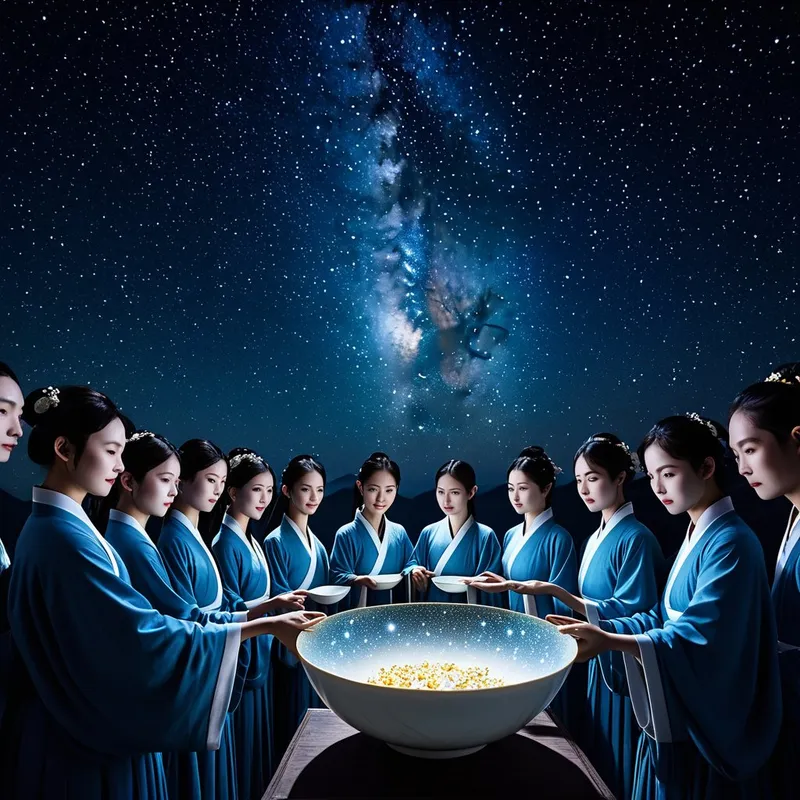
Listen, and hear a tale not of earth, but of the River of Stars. In the celestial courts, where jade pillars touch the void, there existed the Eight Immortals. Zhongli Quan, Lan Caihe, Lü Dongbin, He Xiangu, Cao Guojiu, Li Tieguai, Zhang Guolao, and Han Xiangzi. They were masters of the Dao, having transcended mortal dust to dance upon clouds and sip the wine of eternity.
One celestial evening, flushed with immortal wine and the pride of their station, they convened for a feast. But no earthly vessel would suffice for their divine nectar. Gazing up at the Silver River—the glittering band of the Milky Way—a boast was made. Why drink from clay or jade when they could drink from the stars themselves? With a collective will that bent the fabric of the heavens, they reached into the celestial current. They did not draw water, but light. They plucked eight of the brightest, most ancient stars from their celestial moorings, their cool, silvery radiance burning in immortal palms.
But a star is not a trinket. It is a knot in the cosmic weave. As the cold fire of the stolen stars touched their lips, a shudder ran through the universe. The Silver River, that timeless highway of light, tore. A wound opened in the night sky. The harmonious music of the spheres fractured into a discordant wail. The stars, orphaned and adrift, began to dim. The immortals’ feast turned to ashes in their mouths, the stolen light now a weight of terrible, silent accusation.
The Jade Emperor’s judgment was swift and absolute. Their transgression was not of theft, but of cosmic vandalism. They had broken the sacred pattern. Their punishment was not banishment, but a task: to mend what they had broken. They were cast not down to earth, but into the rupture, into the dark, silent rift between the stars. Their tools? Not magic, but the most humble of crafts: pottery. Their materials? The very shards of the stars they had shattered and the dust of the void. They must, with their own hands, fashion eight bowls. Not to drink from, but to contain. To gather the scattered light and, stitch by painful stitch, mend the Silver River.
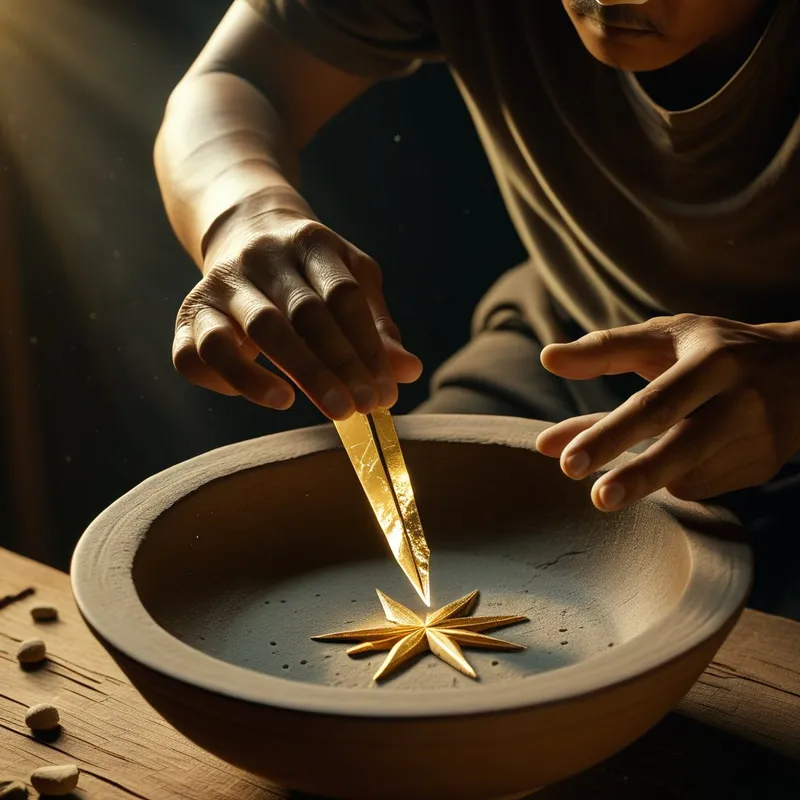
And so, they worked for what felt like eons. Li Tieguai’s crippled hands learned a new deftness. He Xiangu’s gentle touch coaxed light into clay. Lü Dongbin’s sharp mind turned from strategy to precision. They molded, they fired their bowls in the cold furnace of space, and they began the slow, meticulous work of gathering. Each captured photon, each glimmer of astral dust, was placed within a bowl. The bowls were never perfect; hairline fractures of their failure remained, glowing with the trapped light like golden scars. When at last the final mote of light was collected, they poured the contents of their bowls back into the rift. The Silver River flowed again, its music restored, its scar now a subtle, shimmering seam in the cosmos—a permanent reminder. The Eight Immortals were restored to their court, but they were changed. They now carried, as their primary emblem, not their powerful tools, but their humble, mended bowls.
Cultural Origins & Context
This myth, while not as universally prominent as the individual stories of the Eight Immortals, exists within the rich tapestry of Chinese myth and Daoist allegory. It is a story that likely evolved within temple traditions and oral storytelling, serving as a didactic narrative rather than a canonical scripture. The Eight Immortals themselves are folkloric composites, their cults popularized during the Tang and Song dynasties, representing a democratization of immortality—accessible to the old, the young, the lame, the noble, and the beggar alike.
The tale of the Bowls functions as a cosmic morality play. In a culture deeply invested in concepts of cosmic order (Dao), harmony (He), and celestial bureaucracy, the story underscores a profound truth: no being, however exalted, is above the natural law. It was told to temper spiritual ambition, to warn against the pride (Jiao) that can corrupt even the enlightened. The storyteller, perhaps a Daoshi or a village elder, used this celestial drama to mirror very human lessons about responsibility, consequence, and the dignity of reparative work.
Symbolic Architecture
The myth’s power lies in its stark, beautiful symbolism. The Silver River is the cosmic order, the interconnected web of existence. The stolen stars represent fragmented wholeness—the ego’s desire to possess and consume aspects of the Self (the luminous, the divine) for personal gratification, thereby rupturing internal and external harmony.
The bowl is the vessel of the soul, made not for taking, but for holding and restoring.
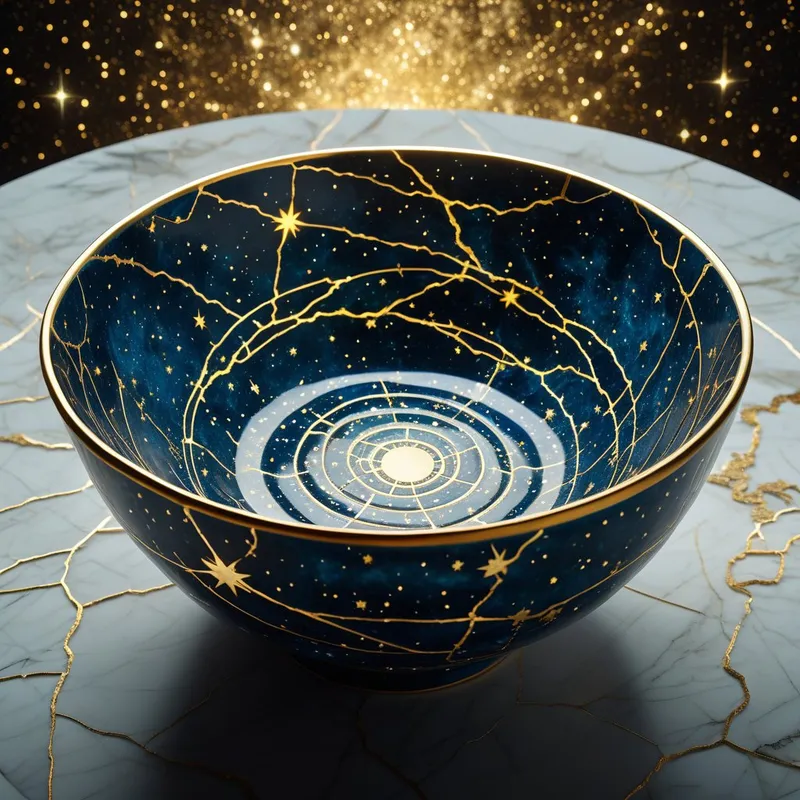
The Eight Immortals, in their fallen state, represent the fragmented psyche after a fall from grace—a state where one’s gifts (their immortality, their powers) are useless until applied to the task of mending. The act of crafting the bowls from the debris of their mistake is the ultimate alchemical process: the raw materials of failure (shame, guilt, brokenness) are consciously shaped into a container for consciousness itself. The glowing cracks—the kintsugi of the cosmos—symbolize that healing does not erase the wound; it transforms it into a source of strength and beauty, a testament to the journey. The bowl, now their primary symbol, marks a shift from active, often prideful, doing to receptive, humble holding.
The Dreamer’s Resonance
When this myth stirs in the modern unconscious, it often manifests in dreams of profound personal responsibility and fragmentation. One may dream of dropping and shattering a precious, luminous heirloom (a star). One may dream of trying, futilely, to gather spilt water or light with bare hands, feeling a desperate somatic urgency. The dreamer might find themselves in a vast, dark space, tasked with an impossible repair job, their usual skills rendered useless.
These are not dreams of fear, but of conscience and integration. The psyche is presenting a scenario where the dreamer’s actions (perhaps a betrayal of values, a moment of arrogant oversight, a neglected responsibility) have caused a rupture in their internal cosmos. The dream is the Jade Emperor’s judgment, issuing the sentence: you must mend this. The somatic feeling of futile gathering is the soul’s recognition that repair is a painstaking, piece-by-piece process. The dream calls the dreamer away from grandiosity and into the humble, meticulous craft of self-reconciliation.
Alchemical Translation
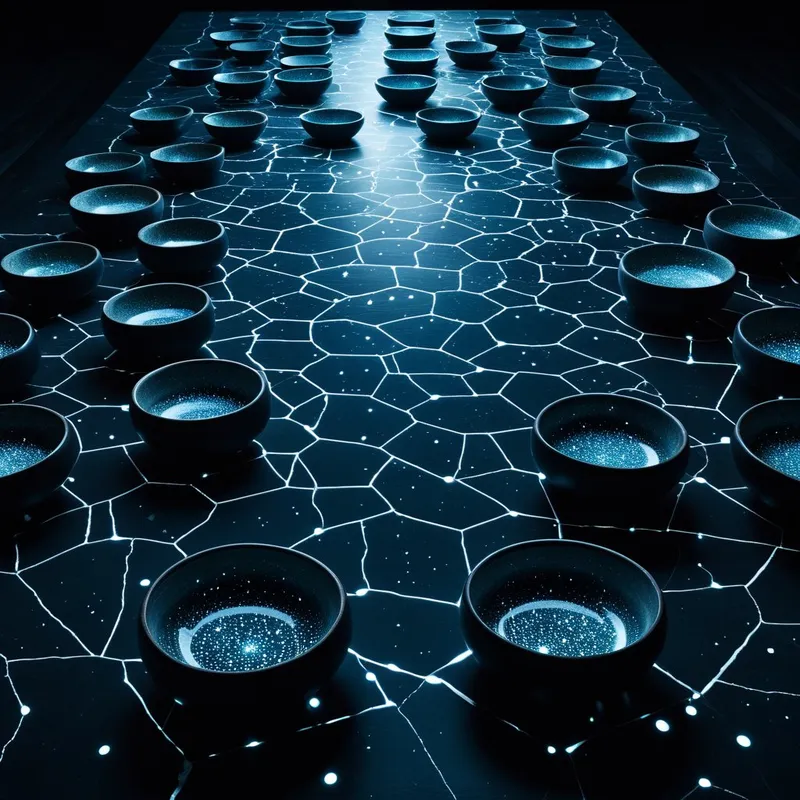
The myth models the complete arc of individuation, with a crucial emphasis on its often-skipped phase: reparation. The first alchemy is the attainment of power (immortality). The second, and more profound, is the transformation of that power through the crucible of failure.
Individuation is not crowned by the achievement of the goal, but by the willingness to kneel in the debris of one’s mistakes and begin, humbly, to rebuild.
The modern seeker often pursues the “immortal” state—perfect enlightenment, flawless success, unassailable wholeness. This myth says that state is an illusion that leads to cosmic vandalism. The true transformation begins with the fall: the recognition of one’s shadow, one’s capacity for harm, one’s pride. The task (making the bowls) is the conscious life thereafter—no longer spent in pursuit of new stars to steal, but in the daily, often tedious work of gathering the scattered pieces of one’s integrity, one’s relationships, one’s inner peace. The bowl one forges is the integrated Self: a container strong enough to hold one’s darkness and light, scarred yet radiant, whose purpose is no longer consumption, but compassionate holding. To carry your bowl is to carry the evidence of your fracture and your repair, which together constitute your true, humble authority.
Associated Symbols
Explore related symbols from the CaleaDream lexicon: