Boreas Myth Meaning & Symbolism
The story of the violent, elemental North Wind god who abducts an Athenian princess, embodying the raw, transformative power of nature and the psyche's untamed depths.
The Tale of Boreas
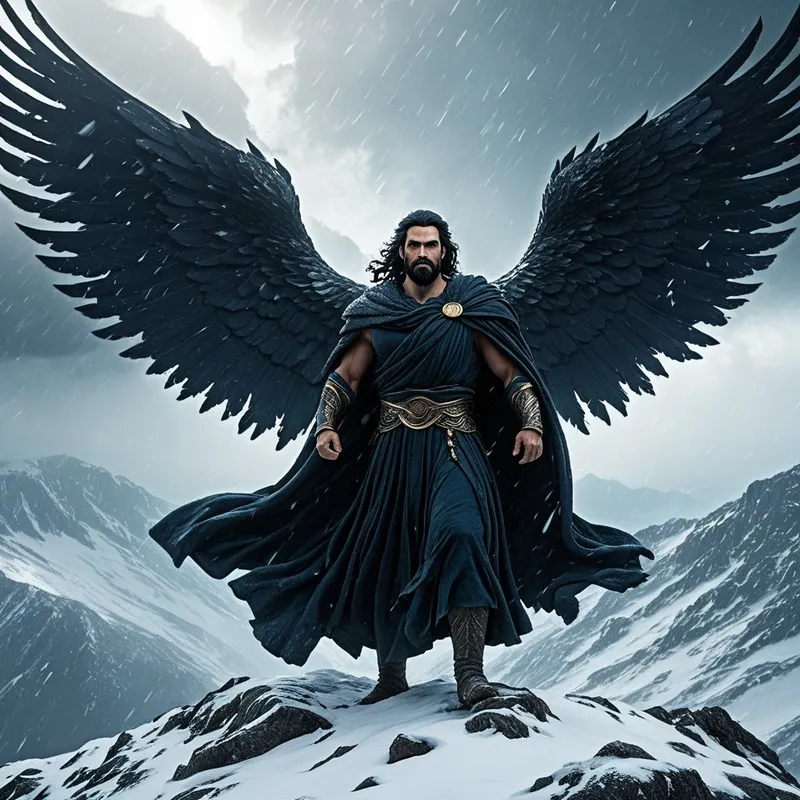
Listen, and feel the air grow cold. From the cavernous halls of Thracian mountains, he stirs. His name is Boreas, and he is not a gentle zephyr. He is the teeth of winter, the breath that snaps sails and howls through bare branches. His hair is the color of storm clouds, his beard frosted, and his voice the roar of a thousand wolves across the frozen plains.
In the sun-drenched land of Attica, by the gentle flow of the Ilisos, a princess danced. Oreithyia, they called her, "Mountain Ranger," a name of freedom and earth. She laughed with her companions, a mortal flower unaware of the gaze from the north. Boreas saw her. In that seeing was no courtly love, no whispered sonnet. It was the desire of the elemental for the human, the wild for the cultivated, the storm for the still point.
He asked her father, Erechtheus, for her hand. The king, perhaps fearing the gale, perhaps hoping for a gentler son-in-law, delayed. He made excuses, spoke of the girl's youth, of the soft southern breezes she preferred. Boreas's patience, never vast, shattered like thin ice. Diplomacy was for lesser winds. His love was a command of nature.
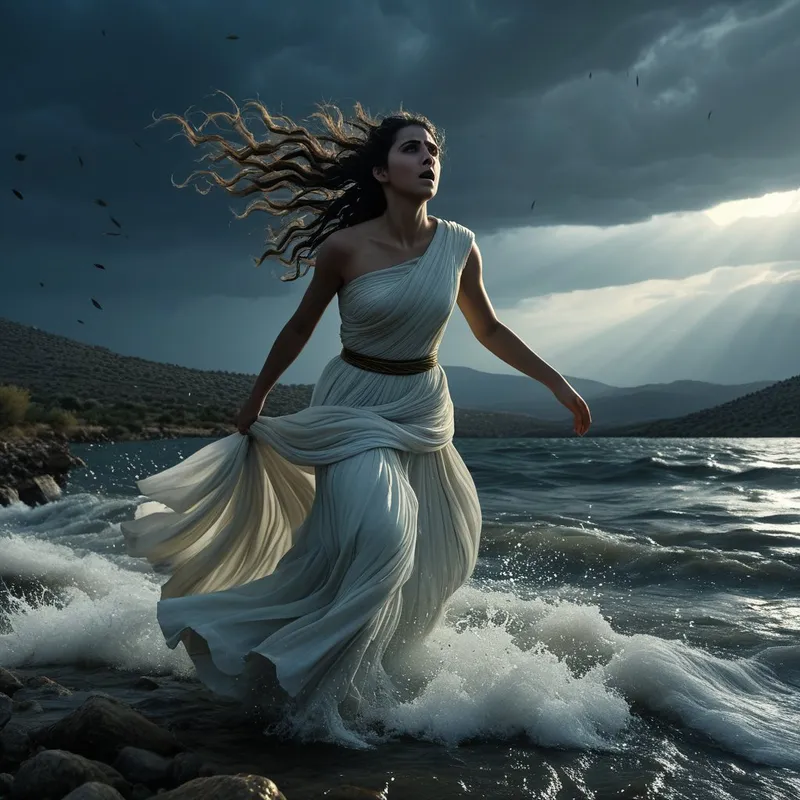
The day came when Oreithyia again played by the river. The sun was high, the air still. Then, a sudden chill pierced the warmth. The reeds trembled. The sky darkened not with clouds, but with a palpable, rushing presence. Boreas descended not as a man, but as the storm itself. A shrieking gust tore across the plain, lifting dust, leaves, and the screaming princess. Her companions clutched at empty air as Oreithyia was wrapped in an invisible, furious embrace. The wind carried her up, away from the olive groves and temples, northward, ever northward, to his icy realm.
There, in the land of perpetual winter, the abduction became a marriage. The violent possession yielded, as nature's forces do, to a strange fertility. Oreithyia became the queen of the north wind. And from their union sprang sons who were not breezes, but heroes: Zetes and Calais, winged like their father, who would sail with Jason. They bore daughters, Chione and Cleopatra, who married kings. The raw, abducting force became a lineage, a dynasty woven into the fate of heroes and the changing of seasons. The North Wind had taken what he wanted, and from that act of primal will, new life in the world was born.
Cultural Origins & Context
The myth of Boreas is not merely a story of a capricious god. For the ancient Greeks, the winds were living, divine forces with direct agency over daily life and fate. Boreas, as the North Wind, was a particularly potent figure. His home was in the wild, cold land of Thrace, a place the civilized Athenians viewed as rugged and barbaric—a perfect dwelling for an untamed deity.
His worship was practical as much as it was reverent. After Boreas was said to have destroyed the invading Persian fleet by summoning a great storm in 480 BCE, the Athenians built him a sanctuary by the Ilisos River, near the very spot of Oreithyia's abduction. Here, they made annual sacrifices to appease him and to seek his favor, especially for safe voyages. The myth provided an aetiology for this cult, linking the god directly to the Athenian landscape and royal lineage through his "marriage" to an Athenian princess. The story was passed down through epic poetry, local Attic lore, and later recorded by authors like Pausanias and the Roman poet Ovid. It functioned to explain a natural phenomenon (the harsh winter wind), sanctify a local cult practice, and explore the tense, creative boundary between civilization (Athens) and the wild, uncontrollable forces that surround and shape it.
Symbolic Architecture
Boreas represents the psyche's most impersonal, archetypal forces. He is not a god of nuanced emotion or reasoned argument; he is pure dunamis—raw, directional power. His symbol is the cornucopia turned inside out: not a gentle flow of abundance, but a violent funnel that takes.
The North Wind does not ask permission; it announces a change in the weather of the soul.
His abduction of Oreithyia is the central symbol. She represents the conscious ego, the "dancing" aspect of the psyche that believes itself autonomous, safe within the bounds of culture and family (the riverbank of Athens). Boreas is the sudden, overwhelming intrusion from the collective unconscious—a numinous, terrifying energy that possesses the individual, sweeping them into a realm of experience far beyond their control or understanding. This is not a "bad" force in a moral sense, but a necessary, if traumatic, one. It is the crisis that breaks open a stagnant life, the depressive winter that must come before spring, the inspired frenzy that shatters old forms.
The offspring of this union are crucial. The violent, "anti-social" act yields heroes and queens. This symbolizes the creative potential within the psyche's most disruptive energies. When the conscious self (Oreithyia) is forced to relate to, and ultimately integrate, a piece of this wild power (Boreas), the result is not destruction, but a new level of being—winged capabilities (the Boreads) and sovereign connections (the daughters).

The Dreamer's Resonance
When the pattern of Boreas manifests in modern dreams, it rarely appears as a winged god. The dreamer may experience being caught in a sudden, terrifying storm or hurricane, feeling their body lifted and carried against their will. They may dream of an intruder—dark, faceless, and powerful—breaking into the safety of their home. The setting is often a familiar, "safe" place (the childhood home, a current apartment) that is violently breached by an impersonal, chilling force.
Somatically, this dream points to a psychological process of possession. The ego is being overwhelmed by a content from the unconscious that is too large, too cold, and too foreign to be assimilated gently. The dreamer may be on the brink of a major life change—a forced career shift, the end of a relationship, the onset of an illness, or a profound depression—that feels like it is happening to them, stripping away their agency. The chilling wind is the felt sense of this archetypal energy moving through their life, a psychic weather system they cannot reason with. The dream is not a prophecy of doom, but a somatic map of the inner landscape being reshaped by forces much older than personal history.

Alchemical Translation
The alchemical process mirrored in Boreas's myth is solutio—dissolution. In the alchemist's vessel, a solid substance must be dissolved into its primal liquid state before it can be purified and reconstituted into a higher form. Oreithyia on the riverbank is the "solid" ego-state, the known identity. Boreas is the aqua permanens, the eternal water that is also a corrosive wind, which dissolves her from her moorings.
Individuation often begins not with a quest, but with an abduction. The conscious will is not the hero here; it is the bride, taken to a foreign land to bear new forms of life.
The modern individual's parallel process is the experience of a foundational breakdown. A long-held identity, career, or belief system is suddenly and violently swept away by an economic, personal, or psychological "storm." This is the Boreas event. The initial experience is one of terror, loss, and freezing disorientation—the winter of the soul. The alchemical work begins not in fighting the wind, but in surviving the dissolution and learning the laws of the new, harsh land.
The "marriage" in Thrace represents the long, slow, and often lonely process of coming to terms with this new inner reality. One must learn to live with the cold, the howling silence, the raw power that now resides within. The "offspring"—the new skills, insights, creative projects, or depth of character that eventually emerge—are the gold produced from this violent union. They are the winged parts of the self (like Zetes and Calais) that can now navigate heights and distances the old, earthbound ego could not imagine. The individual does not return to the sunny riverbank unchanged. Instead, they become a ruler in the kingdom of winter, capable of wielding the very force that once abducted them, now integrated as a source of formidable, creative power.
Associated Symbols
Explore related symbols from the CaleaDream lexicon: