
Book of Kells Myth Meaning & Symbolism
A sacred text of light, born from a perilous journey and divine fire, illuminating the world against encroaching shadows.
The Tale of Book of Kells
Listen, and let the breath of the Otherworld fill this space. This is not a story of a book, but of a living light, born in an age when the dark pressed close against the edge of the world.
In the time of mists, when the old gods still whispered in the oak groves and the new faith was a fragile flame, there came a calling. It was not a voice, but a pressure in the soul of certain men—monks of Iona. A divine unrest settled upon them, a knowing that the Word needed a vessel of unimaginable beauty, a fortress of ink and vellum against the coming night. They were to craft a Gospel that was not merely read, but beheld; a text where every curve of letter, every spiral of pigment, would be a prayer made visible, a trap for the divine.
And so they began. They gathered the skins of calves, treating them until they were as smooth as a still lake at dawn. They mined earth and crushed stone, brewing inks of deep black, vibrant red, and a blue snatched from the lapis lazuli sky. But the true material was time—years of it, lifetimes of it. In the cold scriptorium, by the light of tallow dips, their hands moved. They drew beasts that twisted upon themselves in eternal dance, birds whose beaks held their own tails, knots that had no beginning and no end. They wove the old symbols—the triskele, the serpent, the hound—into the new story of the Christ. The page itself became a cosmos, a temenos, where chaos was ordered into breathtaking harmony.
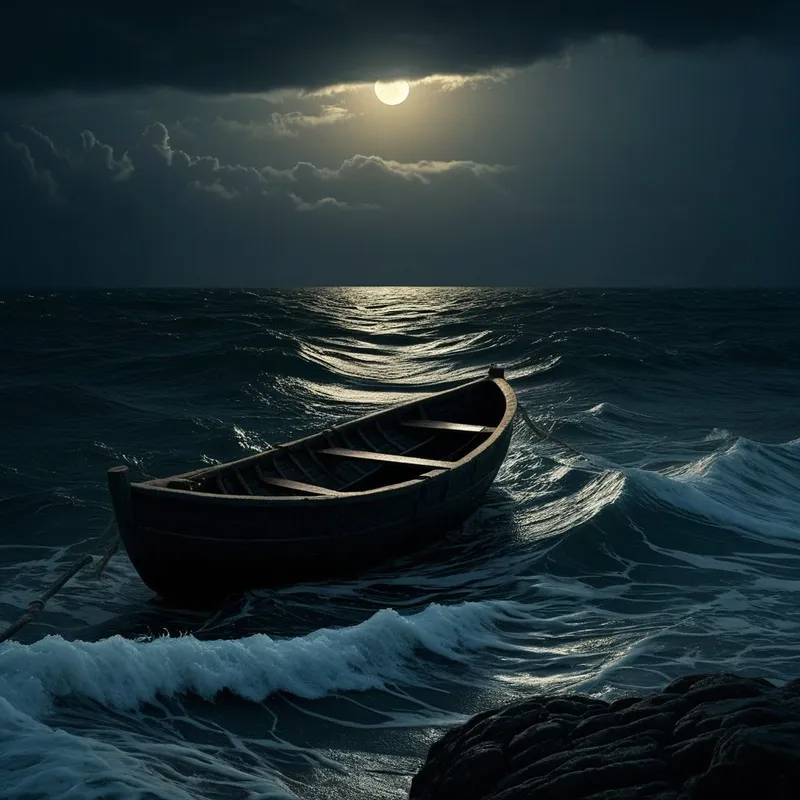
But darkness stirs at the birth of great light. Raiders from the sea, men with iron and fire, fell upon Iona. The sanctuary was violated. The monks, their hearts breaking like glass, gathered their most precious work—the unfinished Gospel—and fled across the treacherous sea in a frail coracle. They carried the light in a chest, sailing through storm and spray to the safer shores of Kells.
The work continued there, but it was different. The memory of the salt spray and the smoke of home seemed to have seeped into the vellum. The patterns grew even more complex, as if to build a higher, more impenetrable wall against the chaos outside. The Gospel was completed, not with a shout, but with the final, delicate stroke of a minium brush on the majestic Chi-Rho page. They placed it upon the altar. It did not just lie there; it resided. It was a captured sunrise, a silent hymn, a city of God built by human hands. And those who saw it knew they were not looking at a book, but at a door—and on the other side of that intricate, bewildering, beautiful door, blazed the unbearable and glorious light of the World Behind the World.
Cultural Origins & Context
The physical Book of Kells exists, housed in Trinity College Dublin. But the myth of its creation is woven from the historical threads of 8th and 9th century Insular Christianity. This was a culture of transition, where the vibrant, abstract, non-representational art of the pre-Christian Celts met the narrative and figurative demands of the Biblical text.
The myth was not recited by bards around a fire, but lived and breathed in the monastic scriptorium. It was passed down through the silent language of craft—from master illuminator to apprentice. The societal function was multifaceted: it was an act of supreme devotion, a theological argument in visual form (where complexity reflected the complexity of God’s creation), and a statement of cultural identity and resilience. In an era of Viking invasions and political fragmentation, creating something of such eternal, defiant beauty was an act of spiritual warfare. It proclaimed that the order of heaven could be manifested on earth, even as earthly order crumbled.
Symbolic Architecture
At its core, the myth is a profound map of the relationship between the human and the divine, the finite and the infinite.
The intricate knot with no end is not a puzzle to be solved, but a path to be walked—a labyrinth leading to the center of the self, where the divine spark resides.
The Manuscript itself symbolizes the human soul or psyche—a blank vellum (the tabula rasa of potential) awaiting inscription by experience and spirit. The Illumination represents the infusion of the transcendent into the mundane. The gold leaf and vibrant colors are not mere decoration; they are the Lumen Christi made material, the light of consciousness piercing the darkness of the unconscious and the historical world.
The Journey from Iona to Kells is the archetypal night sea journey, a descent into chaos and loss (the Viking raids) necessary for a higher re-integration. The work could not be finished in its original, pristine context; it had to be tempered by exile and danger. The Raiders symbolize the destructive, entropic forces of the unconscious and of history—everything that seeks to unravel the sacred pattern.
The Dreamer's Resonance
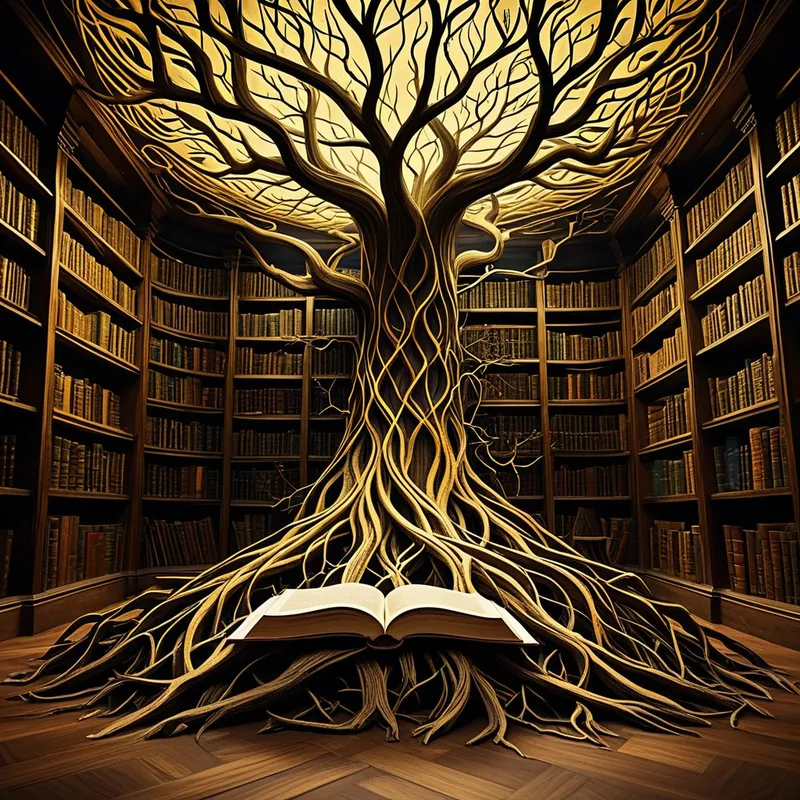
When this myth stirs in the modern psyche, it often manifests in dreams of intricate, overwhelming detail. One might dream of trying to read a book where the letters are alive and crawling, or of being in a library where every book contains a vast, miniature world. There is a somatic feeling of awe mixed with claustrophobia—the beauty is breathtaking, but the complexity feels inescapable.
This dream state indicates a psychological process of integration through complexity. The dreamer is likely facing a life situation or inner conflict that feels chaotic and overwhelming. The psyche is responding not by simplifying, but by diving deeper into the complexity, attempting to find or create a meaningful, beautiful pattern within it. It is the soul’s scriptorium at work, insisting that the answer is not in avoiding the mess, but in illuminating it—in finding the sacred order hidden within the apparent chaos.
Alchemical Translation
The alchemical process mirrored here is the opus contra naturam—the work against nature, or more accurately, the work of refining raw nature into spiritual gold. The base materials are the calfskin (the animal nature, the body), the mundane inks (earthly experience), and the limited, linear time of a human life.
The alchemist’s furnace is the focused attention of the scribe; the transmutation occurs not in a flash, but in the patient, devout application of hand and heart, stroke by stroke, over a lifetime.
The Nigredo, or blackening, is the flight from Iona—the destruction, the loss, the immersion in the chaotic sea of the unconscious. The Albedo, or whitening, is the preparation of the pure vellum page—the creation of a clean, receptive space within the self after the crisis. The Citrinitas, or yellowing, is the application of the gold leaf—the first flashes of true insight and spiritual awakening. The Rubedo, the final reddening, is the completion of the illuminated page, particularly the blood-red details: the integration of the spirit fully into the substance of the soul, resulting in the filius philosophorum, the philosophical child. This is the illuminated Self.
For the modern individual, the myth models the path of individuation as a sacred craft. It teaches that wholeness is not achieved by rejecting complexity or darkness, but by engaging with it so deeply and lovingly that you transform it into a masterpiece of meaning. Your life is the vellum. Your attention is the pen. Your struggles are the pigments. And the pattern you are weaving, though you may never see its entirety, is of divine and breathtaking intricacy.
Associated Symbols
Explore related symbols from the CaleaDream lexicon: