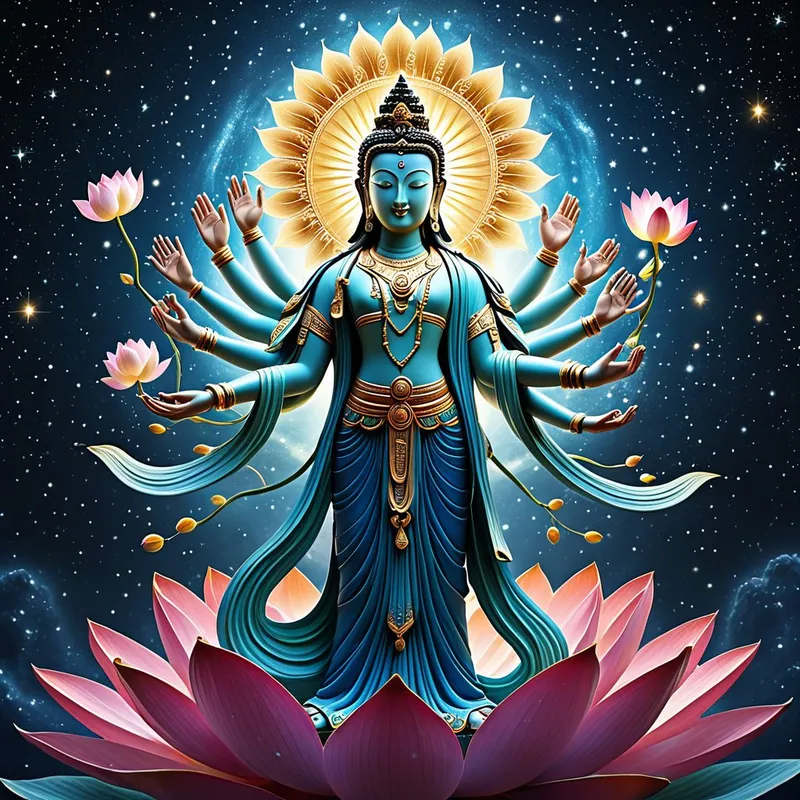
Bodhisattva path Myth Meaning & Symbolism
The vow to forgo final peace until every sentient being is free, embodying the ultimate archetype of compassionate, active engagement with the world's suffering.
The Tale of the Bodhisattva Path
Listen. There is a story not of a single night, but of countless aeons. It does not begin with a birth, but with a turning. A point of profound fracture in the order of things.
Picture it. A being, through lifetimes of effort, has reached the very shore. Before them stretches the Nirvana, an ocean of perfect peace, silent and radiant. Its pull is the end of all pull, the cessation of all heat, the answer to every question that has ever burned in the heart. To step into it is to become as a flame extinguished, cool, complete, free. The weight of a universe of sorrow falls away at the threshold.
The being raises a foot to cross.
And then… they hear it. Not a sound, but a resonance. A sigh woven from the sighs of every mother who has lost a child, a groan from the bedrock of every prison, the silent scream locked in the throat of every terrified creature. It is the cacophony of Samsara, the great wheel of becoming, turning endlessly. They look back.
They see not a landscape, but a tapestry of entanglement. Beings drowning in oceans of their own craving, burning in fires of their own hatred, lost in fogs of their own ignorance. They see the chain of cause and effect, Karma, weaving a net of exquisite, painful complexity. They see a child crying in the dark, a tyrant raging in his hall, an animal trembling in a trap—all reflections of a single, fractured consciousness.
And in that moment of looking back, the foot does not fall forward into peace. It settles back onto the rough, hot ground of the world.
A vow is born. Not whispered, but etched into the fabric of their being with the diamond of their resolve. “I shall not enter final Nirvana until every single being, down to the last blade of grass, has crossed this shore before me.”
This is the Bodhicitta, the Awakening Mind. It is not a refusal of enlightenment, but its radical expansion. The being turns from the shore and walks back into the swirling storm. They become a Bodhisattva, an “enlightenment-being.” Their path is no longer a straight line to liberation, but an infinite, compassionate circle. They take the very perfection of the shore and forge it into a boat, an axe, a lamp, a bridge. They become the guide who remembers the way, not for themselves, but for all who are lost.

Cultural Origins & Context
This is not a myth of a distant, golden age, but the living architecture of Mahayana Buddhism, emerging around the 1st century BCE to 1st century CE in India. It represents a democratization and universalization of the spiritual path. While early Buddhist teachings focused on the individual’s arduous journey to liberation (the Arhat ideal), the Bodhisattva path exploded this framework outward. It was a narrative revolution, passed down not just by monks in monasteries, but embodied in texts like the Prajnaparamita sutras and the sublime vows of figures like Avalokiteshvara and Manjushri.
Its societal function was profound. It provided a heroic, altruistic ideal that could inspire kings and peasants alike. It made spirituality inherently social and ethical; enlightenment was inseparable from compassionate action. The Bodhisattva was the ultimate critique of spiritual selfishness, modeling a commitment to the world so total that it willingly embraced the world’s suffering as its own field of practice.
Symbolic Architecture
The Bodhisattva’s turn at the threshold is the central, world-shattering symbol. It represents the ultimate transcendence of the ego’s final desire: the desire for its own cessation, its own peace.
The most radical act of the Self is not to find itself, but to willingly lose itself for the sake of the Other, realizing in that gesture that Self and Other were never truly separate.
The shore of Nirvana symbolizes the pristine, undifferentiated state of the unconscious, pure potentiality. The tangled world of Samsara is the realm of conscious life with all its conflicts, projections, and relationships. The Bodhisattva chooses conscious, embodied complexity over unconscious, peaceful unity. They choose the difficult, relational work of the psyche over the bliss of dissolution.
The Bodhicitta vow is the archetypal expression of the psyche’s drive toward wholeness, which must include the rejected, suffering, and “shadow” parts of oneself and the world. The Avalokiteshvara’s thousand arms and eyes symbolize the psyche’s capacity for boundless, attentive engagement—the ability to hold a multitude of perspectives and extend help in countless forms.
The Dreamer’s Resonance
When this myth stirs in the modern dreamer, it often manifests not as a divine figure, but as a profound somatic and situational tension. You may dream of being at the point of a great achievement—graduation, a promotion, the completion of a project—only to turn away, feeling a pull toward an unresolved mess, a family conflict, or a forgotten responsibility. You dream of finally reaching a quiet, beautiful place, only to be haunted by the cries of those you left behind.
Psychologically, this is the process of confronting the “spiritual bypass.” The ego, in its quest for perfection, peace, or “healing,” often tries to leap over the muddy, painful, relational aspects of life. The Bodhisattva dream pattern insists that true wholeness cannot be built by abandoning the broken parts. The dream forces a confrontation: will you seek a personal, isolated salvation, or will you turn and integrate the suffering—both your own and that which you witness in others—into your path? The anxiety in the dream is the birth pang of a conscience expanding beyond the personal.

Alchemical Translation
The alchemy of the Bodhisattva path is the transmutation of enlightenment from a noun into a verb, from a state to be attained into an activity to be lived. For the modern individual navigating individuation, it models a crucial shift.
Individuation is not a journey to a purified, separate self, but the process of becoming so fully responsible for one’s own psyche that one can consciously participate in the healing of the world’s psyche.
The first operation is the “Turning.” This is the conscious decision to stop seeking wholeness only in here (through introspection, therapy, meditation alone) and to start engaging with the world out there as the very crucible of your transformation. Your conflicts at work, your strained relationships, the injustice you witness—these are not distractions from your path; they are the path.
The second is the forging of the “Upaya,” or skillful means. This is the development of your unique capacities—your art, your listening, your leadership, your craft—not for personal gain, but as tools of connection and alleviation. Your wisdom becomes practical, embodied, and adaptable.
The final, ongoing transmutation is the realization of Prajna, or transcendent wisdom. Through the gritty work of compassionate engagement, you begin to see that the helper, the helped, and the help are not three separate things. Your own liberation is inextricably linked to the liberation of all. You work tirelessly in the world, yet you are not bound by it. You have turned your back on the peace of the shore, only to discover that the entire ocean, in all its turbulent, beautiful, suffering glory, is the peace you sought. The path itself becomes the goal, walked forever, for the benefit of all.
Associated Symbols
Explore related symbols from the CaleaDream lexicon: