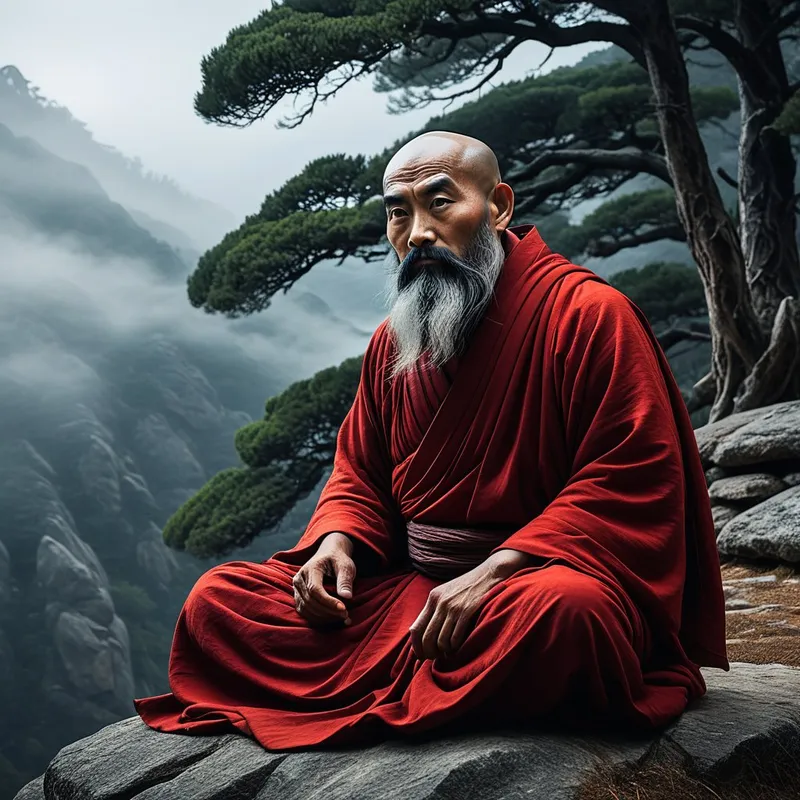
Bodhidharma Myth Meaning & Symbolism
The legendary monk who brought Zen from India to China, faced an emperor, and meditated for nine years before a cave wall to awaken the mind.
The Tale of Bodhidharma
The wind that howls down from the western peaks carries more than ice. It carries a rumor. It whispers of a prince who cast aside his throne, a master who walked away from the known world, a man whose gaze could cut through stone and soul alike. His name was Bodhidharma.
He came from the land of the Buddha’s birth, crossing mountains that scraped the sky and rivers wide as sorrow. His purpose was a single, burning ember carried in the cup of his heart: to bring the true Dharma to the East, to a land where the teachings had grown ornate, tangled in scripture and merit. He arrived in the kingdom of Liang, where Emperor Wu, a devout patron of Buddhism, awaited him. The court was splendor; gold-leafed statues and the murmur of sutras copied on silk.
“I have built temples, funded monasteries, ordained countless monks,” declared the Emperor. “What merit have I earned?”
The monk from the west stood like a weathered cypress. His eyes, dark pools of stillness, held no reflection of the imperial glory. “No merit,” he said, his voice the sound of dry earth. “All these are just petty deeds, leading to rebirth in the heavens, but still within the cycle of suffering. They have the appearance of wisdom but are in essence empty.”
The air in the hall grew cold. “Then what is the sacred truth?” the Emperor demanded, his piety turning to confusion.
“Vast emptiness,” Bodhidharma replied. “Nothing sacred.”
“Who stands before me?” the Emperor finally asked, affronted.
“I do not know.”
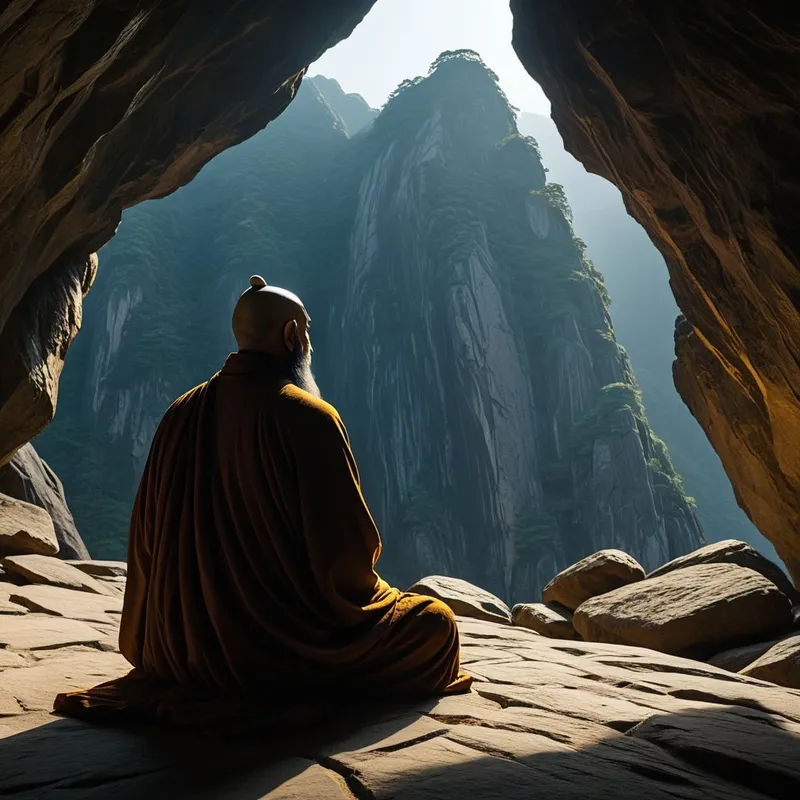
With that, the interview was over. The truth, it seemed, could not be traded for patronage. Turned away, Bodhidharma walked north. He came to the Song Mountains. There, he found a cave facing a wall of sheer rock. And there, he sat down. He turned his gaze upon the wall, and he did not turn it away. Not for a day, not for a season, but for nine years.
Seasons wheeled. Snow buried the entrance, then melted to reveal wildflowers at his unmoving knees. His shadow, cast by the sun and moon in their endless chase, etched itself into the stone until the rock remembered his form. It is said that in his fierce concentration, he once cut off his own eyelids to punish a moment of drowsiness; where they fell, the first tea plants grew, their leaves offering wakefulness to future generations. Once, a seeker named Huike came, begging for instruction. Bodhidharma, lost in the wall’s vast nothingness, did not acknowledge him. Huike stood in the snow outside the cave all night. By dawn, the snow reached his waist. Desperate to prove his resolve, Huike took a blade and severed his own left arm, offering it to the master.
Only then did Bodhidharma turn. “What do you seek?”
“My mind is not at peace,” Huike cried. “Please, master, pacify it for me.”
“Bring me your mind, and I will pacify it.”
After a long search within, Huike confessed, “I cannot find it.”
“There,” said Bodhidharma. “I have pacified it for you.”
In that impossible moment, facing the wall that was not a wall, hearing the instruction that was not an instruction, something was transmitted. Not a scripture, not a ritual, but the very marrow of awakening. The work was done. When Bodhidharma finally arose, legend says he left only a single sandal behind in his grave, while his body was seen walking west, back toward India, one foot bare.
Cultural Origins & Context
The figure of Bodhidharma straddles the nebulous border between history and myth. He is traditionally dated to the 5th or 6th century CE, credited with bringing the Chan school from India to China. The earliest accounts are sparse, found in Chinese Buddhist biographies like the Continued Biographies of Eminent Monks. Over centuries, particularly within the Chan/Zen traditions that claimed him as their First Patriarch, the stories crystallized into a potent mythological corpus.
These tales were not told as dry history but as “koans” and teaching stories, passed from master to disciple in meditation halls. Their function was not to record facts but to shatter conventional thinking. Bodhidharma became the archetypal iconoclast, the personification of the Zen spirit itself—direct, uncompromising, and pointing relentlessly beyond forms and words to the mind’s inherent nature. He was the antidote to a Buddhism grown scholastic and ritualistic, a human lightning bolt aimed at the heart of conceptual complacency.
Symbolic Architecture
Bodhidharma is the embodiment of the Dharmakaya—truth itself—meeting the world of form. His myth is a masterclass in symbolic paradox.
The wall is not an obstacle, but the very gateway. To face it is to turn one’s back on the world of discrimination, and in that utter turning, to see through the world itself.
His rejection of Emperor Wu’s merit symbolizes the futility of seeking spiritual attainment through external accumulation. True awakening cannot be bought, built, or earned; it is the recognition of what one has always been. The legendary nine-year meditation is not about duration but about the absolute totality of effort—a perseverance that exhausts perseverance itself. The wall-gazing (biguan) represents the single-pointed introspection that eventually dissolves the boundary between seer and seen, between the seeking mind and the sought-after truth.
The severing of Huike’s arm is a brutal, perfect symbol of the sacrifice required: the abandonment of the grasping, calculating “self” that seeks peace. One must offer up the very instrument of one’s suffering. Bodhidharma’s response, “Bring me your mind,” is the core of the myth’s psychological surgery. It forces a confrontation with the insubstantiality of the ego-construct. The mind that can be found and pacified is an object; the true mind is the boundless subject, the awareness in which all objects arise and fall.

The Dreamer's Resonance
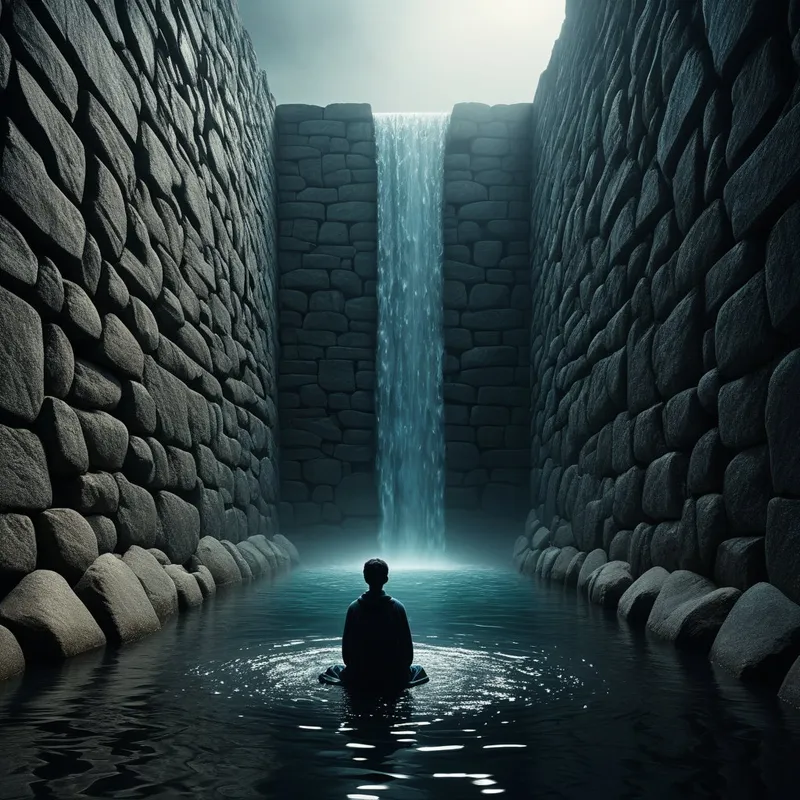
When the pattern of Bodhidharma surfaces in modern dreams, it signals a profound encounter with the psyche’s own “wall.” The dreamer may find themselves sitting before an immense, impassable barrier—a wall of fog, of dark water, of featureless stone. This is the somatic experience of a core psychological impasse: the felt sense of a problem with no solution, a seeking with no apparent object, a profound frustration with the offerings of the conventional world (the Emperor’s court).
The figure in the dream—whether a silent monk, a shadow, or simply an implacable presence—represents the uncompromising Self, the inner patriarch who demands absolute honesty. This dream is not about finding an answer, but about exhausting the questions. It is a call to “sit with” an unbearable tension, a depression, or a void, without turning away toward easy comforts or intellectual explanations. The psychological process is one of containment: holding the conflict until the opposites—seeker and sought, problem and solution—reveal their fundamental unity. The dream may feel stark, arduous, even cruel, mirroring Huike’s ordeal in the snow. It is the psyche’s way of initiating a confrontation with the illusory nature of the egoic mind that feels so solid and troubled.
Alchemical Translation
The alchemical journey modeled by Bodhidharma is the opus contra naturam—the work against nature—which in depth psychology is the work against the ego’s habitual identifications. It is the distillation of consciousness from the lead of personal narrative into the gold of impersonal awareness.
The transmutation occurs not when something new is gained, but when everything assumed is utterly lost. The philosopher’s stone is the rubble of the wall you spent a lifetime facing.
The first stage is the Nigredo, the blackening: Bodhidharma’s “no merit” and his turning toward the cave. This is the necessary disillusionment, the dark night where all previous spiritual or psychological achievements are revealed as inadequate. The ego’s projects are dissolved in the acid of truth.
The nine-year gaze is the Albedo, the whitening, the relentless purification. It is the sustained focus of meditation or deep introspection that burns away attachments, fantasies, and distractions. It is a fierce, moonlit clarity that endures.
The transmission to Huike is the Rubedo, the reddening, the culmination. It is not an intellectual understanding but a somatic, whole-being realization—the “red” blood of direct experience. The severed arm is the sacrifice of the old identity; the peace that comes from not finding the mind is the birth of the integrated Self, no longer identified with any passing content of consciousness.
For the modern individual, this myth instructs us that our deepest transformation awaits not in adding more tools to the ego’s kit, but in the courageous, patient facing of our own inner wall—the core wound, the fundamental anxiety, the sense of lack. The triumph is not in scaling it, but in seeing through it, discovering that what we are is the vast space in which both wall and watcher appear and are, ultimately, set free.
Associated Symbols
Explore related symbols from the CaleaDream lexicon: