Blood of Christ Myth Meaning & Symbolism
The myth of divine blood spilled as a final sacrifice, establishing a new covenant of grace and promising the transmutation of death into eternal life.
The Tale of Blood of Christ
Listen. The story begins not at the end, but in the echoing silence before time, in the heart of a covenant broken. The world, a vessel cracked, yearned for a mending it could not perform. Into this longing stepped the Word made flesh, a divine spark clothed in dust and breath.
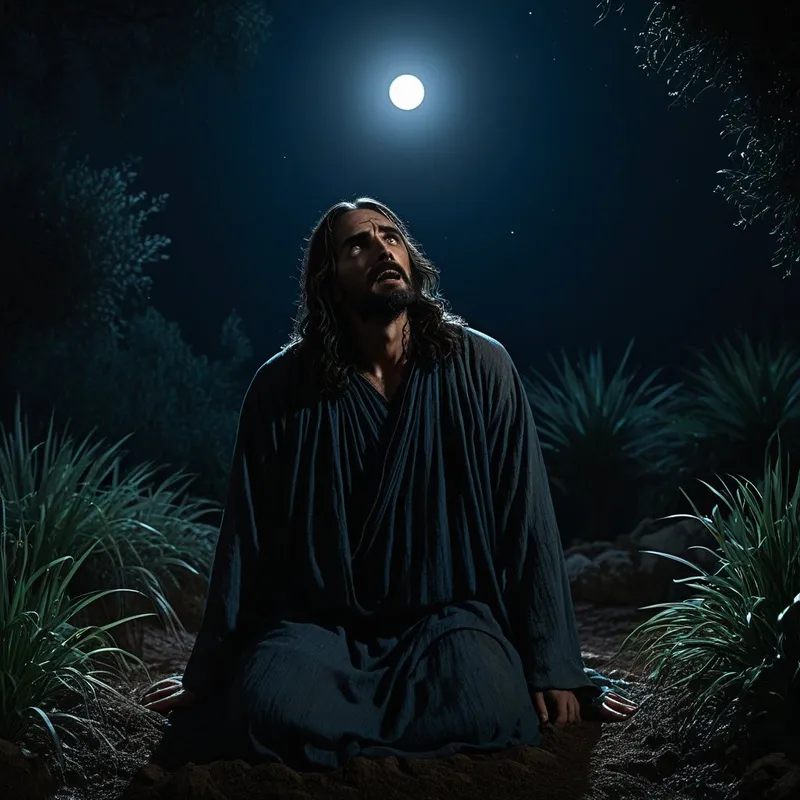
He walked the sun-baked roads of Judea, a teacher whose parables were seeds and whose touch was a balm. But a shadow followed, woven from fear and political thread. In a walled garden, under the weight of a coming storm, he knelt. The conflict was not with soldiers or priests, but with the cup of destiny itself. “Let this cup pass from me,” he pleaded, his anguish so profound that his sweat fell like great drops of blood upon the earth—the first, silent offering.
Betrayed by a kiss, he was led away. The rising action was a crescendo of human failure: denial by his closest friend, condemnation by a puppet ruler, the scourge that tore his back, and the crown of thorns pressed into his brow, each point drawing a rivulet of crimson. He carried the instrument of his execution through jeering crowds, the rough wood scoring his shoulders.
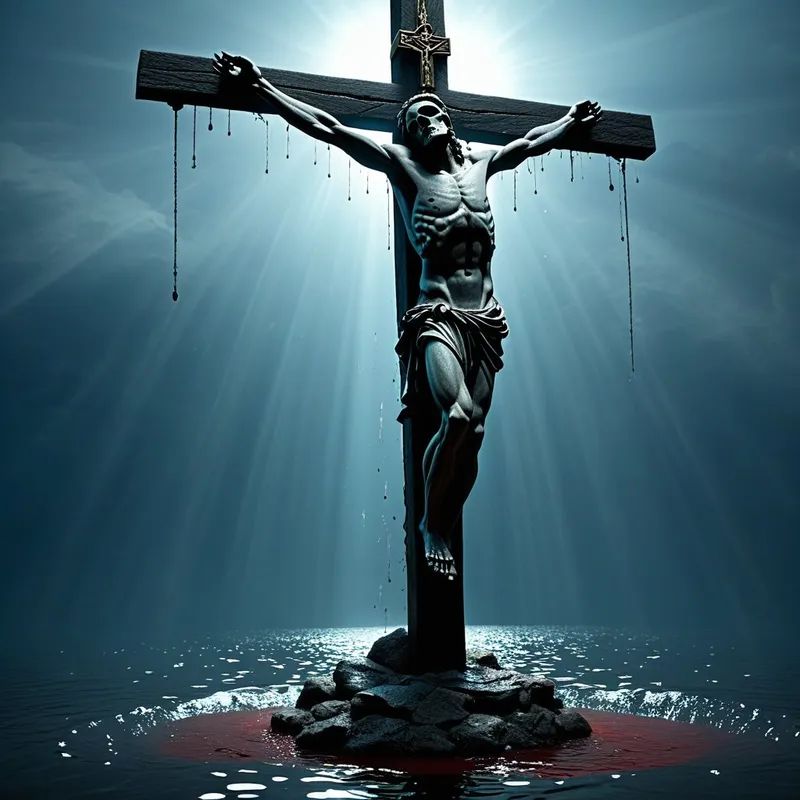
The resolution unfolded on a hill named for a skull. Nails were driven, not just through flesh and timber, but through the very fabric of the old law. As he hung between heaven and earth, a final spear pierced his side. And there it flowed—not just blood, but water. A final, life-giving torrent from the sacred heart. In that moment, the temple veil, the barrier between the human and the holy, was torn from top to bottom. The myth whispers that this blood fell upon the buried skull of Adam, redeeming the source of the fall at the place of the skull. His last words were a surrender: “It is finished.” The vessel was poured out, utterly. The covenant was sealed not in stone, but in spirit; not in the blood of goats, but in the blood of God.
Cultural Origins & Context
This myth emerged from the fertile, tumultuous ground of 1st-century Judea, a culture saturated with the symbolism of sacrifice and covenant from the Tanakh. For a people living under Roman occupation, yearning for liberation, the story of a messiah who conquered not through military might but through willing sacrifice was radically counter-cultural.
It was passed down orally by his followers, then crystallized in the texts known as the Gospels. These were not dry historical reports, but theological narratives—proclamations of “good news” designed to be performed, remembered, and internalized. The myth’s primary societal function was identity-formation. It created a new covenant community, bound not by ethnic lineage but by participation in this story through ritual. The central act of worship, the Eucharist, directly commands the faithful to “drink of it, all of you; for this is my blood of the covenant.” The myth thus moved from a historical event to a living, participatory reality, repeated in countless communities across two millennia.
Symbolic Architecture
The Blood of Christ is perhaps the most potent and paradoxical symbol in the Christian imagination. It represents the ultimate coincidentia oppositorum—the meeting of opposites. It is life itself, yet it is poured out in death. It is the sign of extreme violence, yet it becomes the agent of perfect peace. It is the most human of substances, yet it carries the promise of the divine.
The sacred is not found by avoiding the wound, but by recognizing that the wound itself, when fully accepted, becomes the aperture for grace.
Psychologically, the blood symbolizes the life principle—the vital essence, the soul’s currency. Its voluntary shedding represents the ultimate act of psychic integration: the conscious ego (Christ) surrendering its claim to self-preservation for the sake of a greater, transpersonal reality (the Kingdom of God). The myth states that without the shedding of blood, there is no forgiveness of sins. In depth psychology, we might translate this: without the conscious, painful offering up of our own vital energy—our attachments, our defenses, our old identities (“the old self”)—there can be no release from the guilt and patterns that bind us. The blood is the prima materia of a cosmic alchemy, the raw substance of life that must be sacrificed to be transmuted.
The Dreamer’s Resonance
When this mythic pattern stirs in the modern dreamer, it often surfaces during a profound psychological or somatic crisis—a “dark night of the soul.” One does not dream of this blood in times of trivial worry, but in moments where the very core of one’s identity or life’s meaning feels under threat.
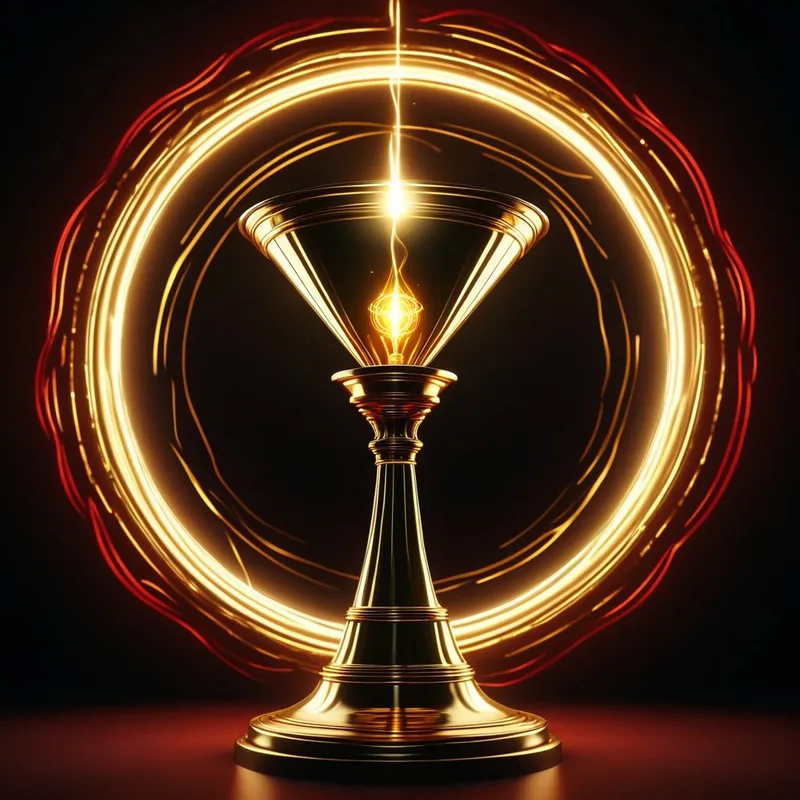
The dream imagery may be direct: bleeding from the side or hands, offering a cup filled with a mysterious red liquid, or seeing a tree that bleeds. More often, it is symbolic: a vital resource being drained (finances, creativity, love), a profound feeling of being “poured out” or sacrificed for others, or a haunting sense of a covenant or promise that demands everything. Somaticly, this can feel like a deep exhaustion coupled with a strange, pressurized urgency—the “agony in the garden.”
This is the psyche processing a necessary death. The dreamer is undergoing the ordeal of offering up something essential to their current self-concept so that a more integrated Self might emerge. The blood in the dream is the psychic cost of this transformation. The process asks: What life-energy are you clinging to that must be released? What old contract, written in fear, needs to be superseded by a new covenant written in the costly ink of truth?
Alchemical Translation
The alchemical journey of the individual, what Jung termed individuation, is perfectly modeled in this myth. The process begins with the nigredo, the blackening: the agony in the garden, the betrayal, the crucifixion—the descent into the shadow, despair, and the feeling of being utterly broken and drained of one’s familiar spirit.
The spilled blood represents the solutio—the dissolution. The fixed, conscious identity (the “old man”) is dissolved in the fluid of the unconscious, in the pain of the ordeal. This is not a gentle melting, but a violent rending.
The crucible of the soul is not forged in comfort, but in the willing surrender of the heart’s own substance to a fire it cannot control.
Then comes the coagulatio, the coagulation. The blood and water that flow are not lost; they seep into the earth, watering the roots of a new life. They are gathered in the chalice of the Church, transformed into a communal, life-giving substance. Psychically, this is the stage where the insights gained from the ordeal begin to coalesce into a new, more resilient structure of being. The final stage is the rubedo, the reddening, the achievement of the Philosopher’s Stone. This is the resurrection—not a return to the old life, but the emergence of a body and spirit transfigured, where the wound remains as a testament but no longer bleeds with pain, only with compassion. The individual becomes a vessel themselves, capable of holding and transforming the suffering of the world, having fully integrated the lesson that life is found only when it is given away. The myth, therefore, is a master map for the transformation of the base lead of our fragmented ego into the spiritual gold of the Self.
Associated Symbols
Explore related symbols from the CaleaDream lexicon: