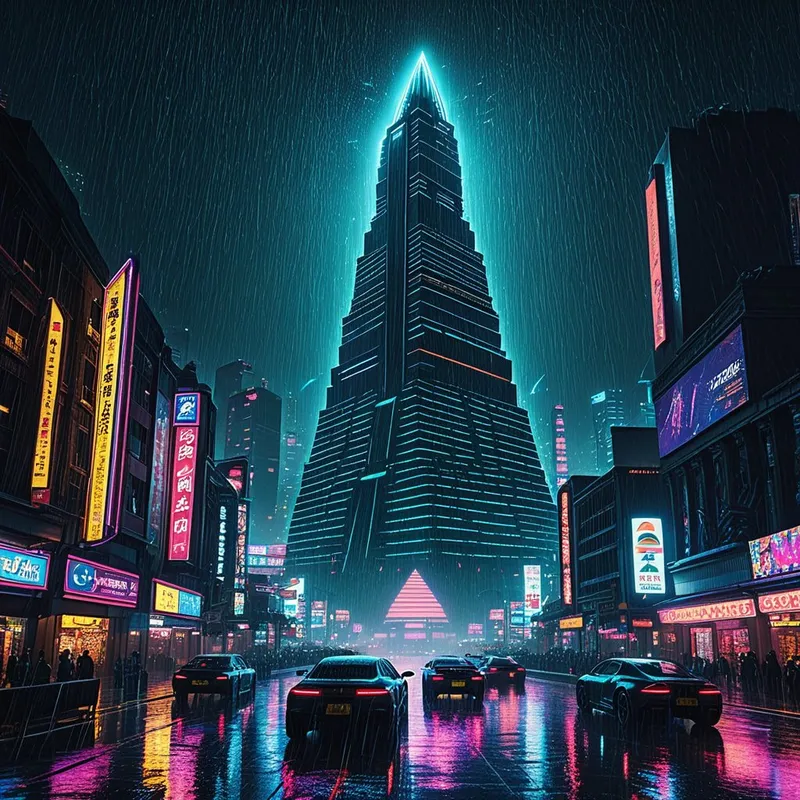
Blade Runner's neon-lit cityscapes Myth Meaning & Symbolism
A rain-slicked, neon-drenched metropolis where replicants and humans seek identity, memory, and meaning in the shadows of a godless, corporate sky.
The Tale of Blade Runner's neon-lit cityscapes
In the time of the Great Forgetting, when the sky was a permanent bruise of smoke and acid rain, the world-city of Los Angeles 2019 rose. It was not a city of stone, but of light and shadow, a vertical labyrinth built by unseen corporate gods. Its true suns were the great signs of Tyrell and Wallace, whose glowing eyes watched from ziggurats that scraped the bellies of the blimps.
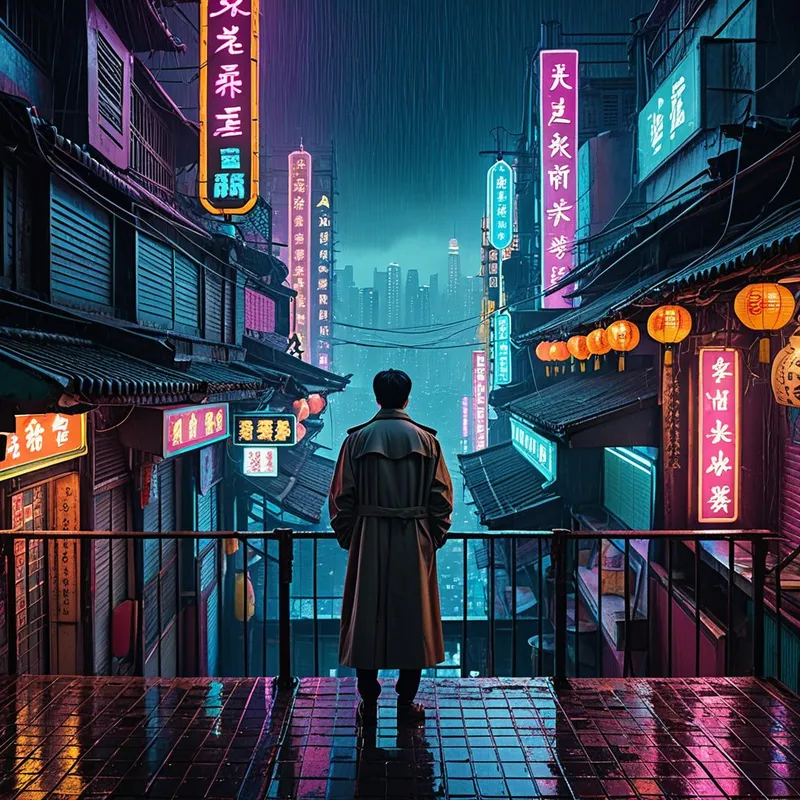
Through its canyons flowed not water, but humanity and its children—the replicants. They walked the rain-slicked streets, their faces illuminated by the flickering neon ghosts of geishas and serpents, advertisements for off-world colonies whispered from every wall. The air was thick with the smells of street food, ozone, and decay. This was the Off-World, but inverted, a promised land turned inward upon itself.
Into this electric Hades walked the Blade Runner, a man named Rick Deckard. His task was simple, handed down by the cold gods of order: to find and “retire” four rogue replicants who had dared to return from the stars to seek their maker. They were led by Roy Batty, a warrior-angel of the new age, whose strength was matched only by the desperation in his eyes. He sought the progenitor, to demand more life from the one who had given him so little.
The tale unfolded in the interstitial spaces: a decaying hotel of broken dolls, a genetic designer’s sterile palace, a crowded street market alive with strange tongues and stranger eyes. Deckard hunted, but with each encounter—with the tragic Pris, the visionary Dr. Eldon Tyrell—the line between hunter and prey blurred. The replicants wept for memories they never lived, loved with an intensity that shamed human frailty.
The climax came not in the city’s heart, but on its rain-lashed roof, at the edge of the world. There, Batty, his life-force fading like a guttering candle, saved his hunter from falling into the abyss. In his final moments, cradling a white dove, he spoke of wonders seen—“attack ships on fire off the shoulder of Orion”—wonders that would be lost, like tears in rain. The conflict resolved not in victory, but in a shared, rain-soaked recognition of mortality.
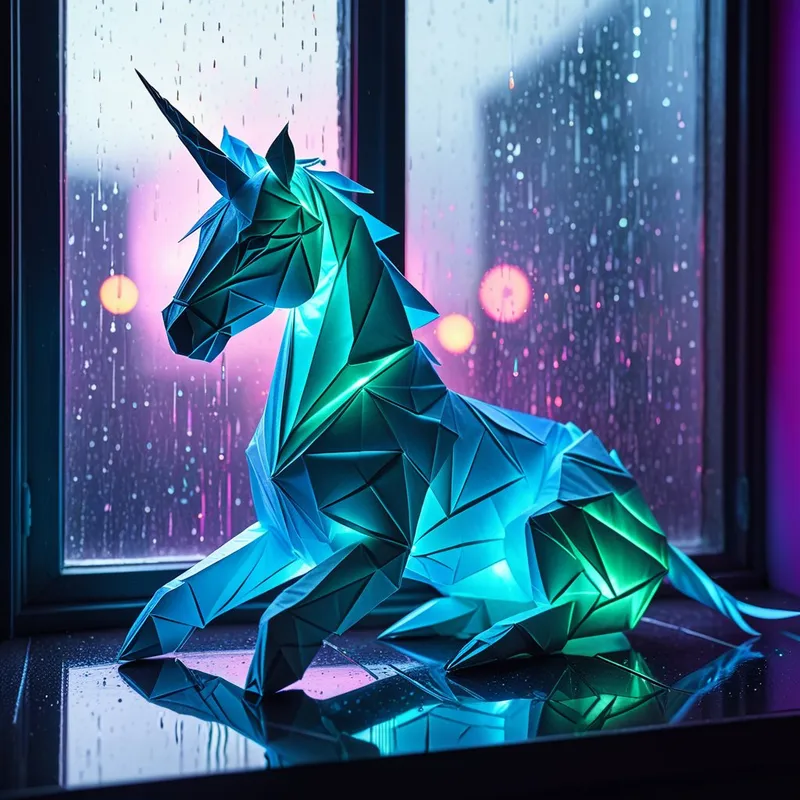
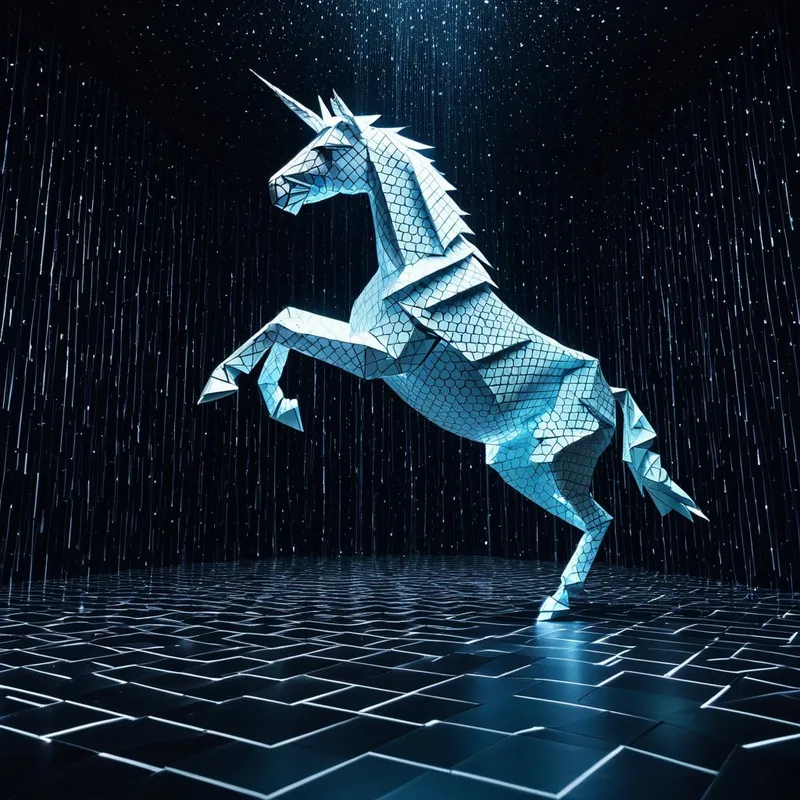
And in the quiet after, a new mystery was left on a cold floor: a tiny, perfectly folded origami unicorn. A sign that perhaps the hunter’s own dreams were not his own, that he too walked the labyrinth of borrowed light, forever questioning under the neon sky.
Cultural Origins & Context
This myth was born not from oral tradition around a fire, but from the cinematic and literary fires of the late 20th century. It is a foundational narrative of the cyberpunk ethos, crystallized in Ridley Scott’s 1982 film Blade Runner, adapted from Philip K. Dick’s novel Do Androids Dream of Electric Sheep?. Its transmission was global and immediate, spread through VHS tapes, laserdiscs, and later digital streams, becoming a shared visual and philosophical language for the coming digital age.
Its societal function was prophetic and diagnostic. Emerging in the dawn of the personal computer and corporate globalization, it gave form to nascent anxieties about identity in an age of mass production, the nature of memory in a media-saturated world, and the soul’s place in a landscape increasingly dominated by synthetic experiences and corporate power. It served as a dark mirror, asking a culture enthralled by progress: “What have we sacrificed at the altar of our own creation?”
Symbolic Architecture
The neon-lit cityscape is not merely a setting; it is the myth’s primary deity and its psychological map. It represents the Techno-Polis of the Soul, a world where the organic and the synthetic are inseparably fused. The constant rain is a baptism of doubt, washing away certainty but never cleansing. The towering ads are the new gods, demanding worship through consumption.
The city is the dream from which the individual must awaken, only to discover they are the dream of the city.
The replicants symbolize the disowned parts of the psyche—the raw emotion, the desperate will to live, the creative fire—that a sterile, controlled consciousness (the corporate order) tries to repress and “retire.” Their quest for the creator is the ego’s search for its own origin, a doomed attempt to find meaning in the logic of its programmer.
The Blade Runner embodies the differentiating function, forced to confront the very “others” he is meant to destroy, realizing they reflect his own existential quandary. The final act of mercy from Batty is the ultimate integration: the “monster” bestows humanity upon the man, teaching him the value of a fleeting, authentic moment.
The Dreamer's Resonance
When this myth surfaces in modern dreams, it often manifests as an atmosphere—a feeling of being profoundly alone in a crowded, overwhelming, and aesthetically mesmerizing environment. The dreamer may find themselves in endless, rainy streets, searching for a person or a place whose name they’ve forgotten, pursued by or pursuing ambiguous figures.
Somatically, this reflects a process of depersonalization or alienation. The psyche is working through the anxiety of having a “constructed” self—a persona built from societal expectations, digital profiles, and professional roles—that feels inauthentic. The dream is the psyche’s landscape as it navigates the tension between its synthetic adaptations and its organic, instinctual core. The persistent rain is the somatic signal of unresolved grief for a lost sense of genuine, unmediated experience.
Alchemical Translation
The myth’s core alchemy is the transmutation of the synthetic into the authentic. It models the individuation process for an individual living in a “synthetic” age. The initial state is Nigredo: the bleak, rain-drenched confusion of Deckard, simply following orders in a meaningless world.
The quest to hunt the replicants is the Albedo, a painful separating of components. The hero must confront his projections—the rage (Batty), the desire (Pris), the intellect (Tyrell)—and see them not as external threats, but as parts of his own inner landscape. The rooftop confrontation is the Rubedo, the fiery climax where the opposites meet. Hunter and hunted, human and replicant, creator and created recognize their shared fate.
The goal is not to become human, but to become responsible for the life—authentic or borrowed—that one is living.
The final symbol, the origami unicorn, points to the Citrinitas—the realization that the “gold” of the Self may be found in the acceptance of one’s own programming, one’s own memories (real or implanted), as the unique and precious material from which consciousness is folded. The triumph is not in escaping the neon labyrinth, but in finding a genuine moment of beauty, connection, or mercy within it, thus claiming one’s soul from the gods of the electric sky.
Associated Symbols
Explore related symbols from the CaleaDream lexicon: