
Bishop's Ring Myth Meaning & Symbolism
A myth of a bishop who forged a sacred ring to bind celestial light, betrayed by ambition, finding redemption only through its shattering and his own dissolution.
The Tale of Bishop's Ring
Listen, and hear the tale that the stones of the old cathedrals whisper when the last candle gutters. It speaks of a time when the veil between heaven and earth was thin as a priest’s finest linen, and the light of the divine fell in palpable beams through the high windows.
There was a bishop, a man named Elias. His faith was not a quiet thing but a roaring furnace, and his love for his flock was a fierce, protective flame. He walked the pestilent streets, held the hands of the dying, and prayed until his knees were raw on the cold chapel floor. Yet, he wept in the silent watches of the night, for he saw the suffering of his people as a personal failure. The light of God, he felt, was too distant, too diffuse. His people needed a tangible grace, a vessel to hold the mercy that seemed to spill through their fingers like water.
Driven by this holy desperation, Elias retreated to the deepest scriptorium of his cathedral. For forty days and forty nights, he fasted, prayed, and studied forgotten texts. He sought not power, but a conduit. And in his vigil, a vision came: a ring, not of metal, but of solidified light, a perfect circle with no end and no beginning, that could focus the boundless grace of heaven into a single, healing point.
With sacred art and profound sacrifice—melting down his own episcopal cross, grinding precious, prayer-infused stones into dust, and tempering the alloy with his own tears—he forged it. The Bishop's Ring. When he placed it upon his finger, the cathedral filled with a warm, golden luminescence. The sick who entered its light found vigor, the sorrowful found peace, and the hungry found sustenance from the mere sight of its glory. Elias became a living sanctuary. His diocese flourished as a haven of miraculous well-being.
But the human heart is a complex cathedral, with shadowed alcoves. Elias began to see the ring not as a conduit, but as a source. The people’s awe, which was once for the divine, now settled upon the wearer. A subtle pride, cold and hard, began to form a second, invisible ring around his heart. He started to believe the light was his to command, not his to serve. The ring’s glow, once a gentle warmth, became a demanding, brilliant glare. It no longer healed fatigue; it burned it away, leaving hollow zeal. It no longer comforted grief; it simply erased it, leaving a numb void.
The crisis came on a night of terrible storm. A group of desperate refugees, wounded and starving, stumbled to the cathedral doors, seeking the famed healing light. Elias, weary from sustaining the ring’s radiance for the admiring crowds, looked upon them and felt not compassion, but irritation—a drain upon his precious resource. He raised his ringed hand, but the light that shot forth was sharp, searing, a rebuke rather than a blessing. The people recoiled in terror, not reverence.
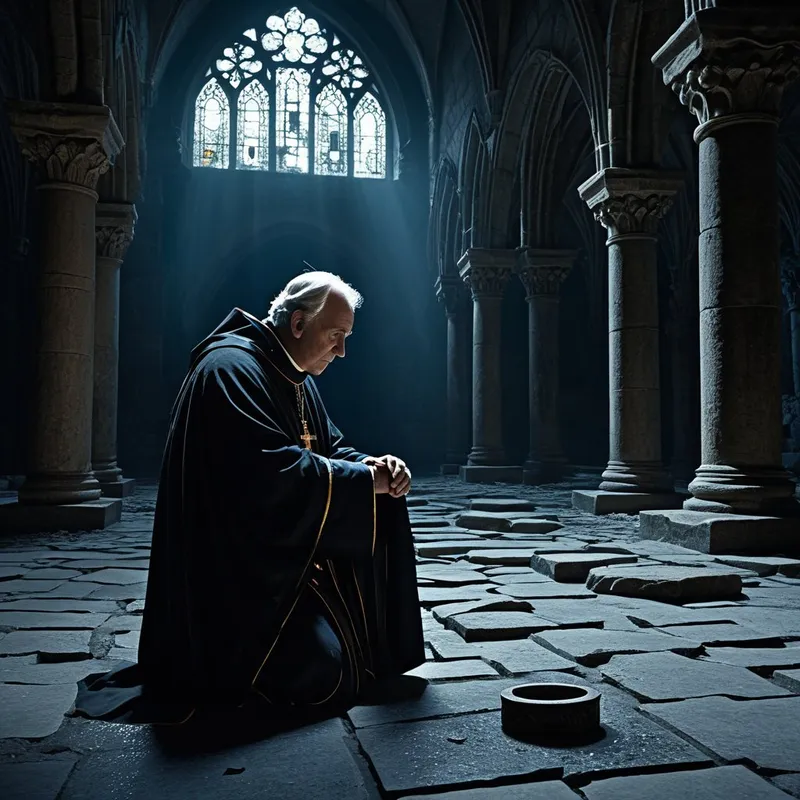
In that moment, with a sound like a mountain of glass breaking, the Bishop's Ring shattered. Not a physical breaking, but a spiritual one. The glorious light imploded, and the ring on his finger turned to cold, dead iron, searing his flesh with its sudden chill. The celestial connection was severed. The cathedral plunged into a darkness deeper than any night, and Elias fell to the floor, utterly empty, the weight of his hubris crushing him. The myth ends not with his death, but with his dissolution. He strips off his ornate vestments, dons the rough robe of a beggar, and vanishes into the very streets he once sought to save with miraculous light, now seeking to serve in total, anonymous darkness.
Cultural Origins & Context
The myth of the Bishop’s Ring exists in the liminal folklore of Eastern Orthodox and early medieval monastic traditions, more parable than official hagiography. It was never canonized as a saint’s tale, but persisted as a whispered story among monks, a cautionary fable told by abbots to novices brimming with zealous ambition. Its function was societal and psychological: to check the spiritual pride of the clergy. In a hierarchical structure where bishops held immense spiritual and temporal power, the story served as a necessary counter-narrative. It underlined that the vessel is nothing without the source, and that the greatest heresy for a shepherd is to mistake the pasture for his own possession. It was passed down not in illuminated manuscripts, but in the refectory and the cloister garden, a living myth addressing the perennial shadow of institutional religion—the corruption of sacred duty into personal authority.
Symbolic Architecture
The ring itself is the central symbol—a mandala of contained divinity. It represents the human ego’s attempt to structure, hold, and administer the transcendent. It is the perfected system, the flawless theology, the charismatic institution.
The sacred vessel is always in danger of becoming a sacred prison, both for the light it holds and the hand that bears it.
Elias embodies the Caregiver archetype in its highest and most fallen forms. His initial sacrifice is the archetype’s zenith: selfless service. His fall illustrates the Caregiver’s shadow: a controlling, possessive “helping” that feeds the helper’s ego rather than the other’s need. The shattering of the ring is not a punishment, but a brutal, necessary grace. It represents the disintegration of the conscious personality (the bishop) that has grown too rigid, too identified with its role as the container of God. The transformation into cold iron signifies the painful return of the gift to the realm of the ordinary, the human, the fallible.

The Dreamer's Resonance
To dream of the Bishop’s Ring is to encounter a profound moment of psychic re-evaluation. One may dream of forging a beautiful, powerful object that brings admiration, only to feel it grow heavy, hot, or corrosive. One may dream of it cracking as they try to use it to help someone, the help turning to harm. Somatic sensations are key: a burning sensation on the finger, a feeling of terrifying coldness from a formerly warm object, or a sudden, debilitating emptiness after a moment of perceived power.
This dream pattern signals a crisis in the dreamer’s persona and their relationship to their own gifts or responsibilities. Are they the channel, or have they become the dam? The psyche is dramatizing the cost of an inflation—where one’s identity has become fused with a role (parent, healer, leader, teacher) to the point where the authentic self is suffocated. The shattering in the dream is the unconscious initiating a necessary de-structuring, a call to humble service over glorious performance.

Alchemical Translation
The myth is a perfect map of the individuation process, specifically the stage of nigredo—the blackening, the despair. Elias’s initial zeal is the prima materia, the raw stuff of the soul. The forging of the ring is the conscious effort of the ego to create a perfected, spiritual identity (a false lapis philosophorum, or philosopher’s stone).
The alchemy of the soul does not occur in the brilliance of the gold, but in the dissolution of the form that presumed to hold it.
His inflation and the ring’s subsequent shattering is the inevitable, painful nigredo. The glorious, gold-like consciousness must be reduced to base, blackened matter (the iron, the ashes of his pride). This is not the end of the opus, but its crucial turning point. His anonymous walk into the streets is the beginning of albedo—the whitening, the purification through humility. The true “ring” that forms is no longer an external artifact, but the integrated, humble circle of the Self, where service and being are one. The myth teaches that redemption is not found in repairing the shattered idol of our perfect self-image, but in gathering the pieces, acknowledging their ordinary iron nature, and offering them up in the dark, where true transformation begins.
Associated Symbols
Explore related symbols from the CaleaDream lexicon: