Binding of Isaac Myth Meaning & Symbolism
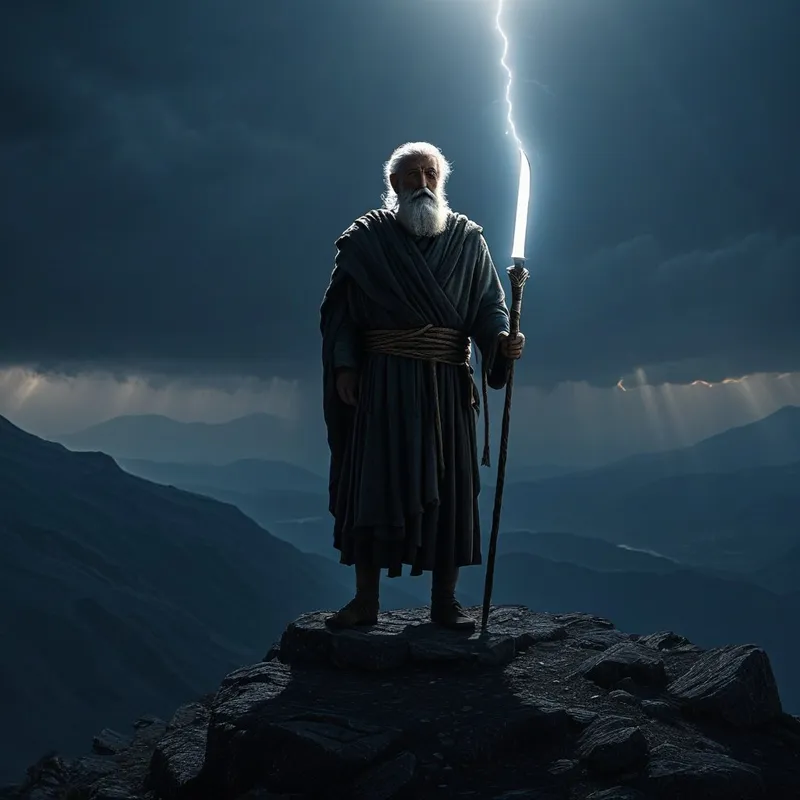
A father's faith is tested by a divine command to sacrifice his son, a moment of ultimate surrender that transforms the relationship between humanity and the divine.
The Tale of Binding of Isaac
The silence was the first thing to change. It was no longer the comfortable quiet of the tent, the soft sounds of flocks and family. For Abraham, the silence became a vessel, and into it poured a voice. Not a sound that shook the air, but one that resonated in the marrow of his being, a command that bypassed the ear to etch itself directly upon the soul.
"Take your son, your only son Isaac, whom you love, and go to the land of Moriah. Offer him there as a burnt offering."
The words did not fade. They became the rhythm of his breath, the cadence of his heartbeat for three days. He rose in the grey pre-dawn, splitting wood with a hollow thud that echoed the blow yet to fall. He did not look at Sarah. He looked at Isaac, the laughter of the promise, the living proof of a covenant sworn under a canopy of stars. The boy’s trusting questions about the sheep for the offering were splinters in Abraham’s throat.
The journey was a slow unraveling. Each footstep up the barren slopes of Moriah was a stitch torn from the fabric of his future. The smell of dry earth and rock dust filled his nostrils. The weight of the firewood on Isaac’s young shoulders was a weight upon Abraham’s spirit. At the summit, the wind whipped, a cold, interrogating breath. Abraham built the altar, stone upon stone, each one a monument to a dying dream. He bound his son—the Akedah—the cords not just of rope, but of a love so profound it could obey the unthinkable. Isaac’s eyes, wide with a dawning horror, held the last reflection of the world as it was.
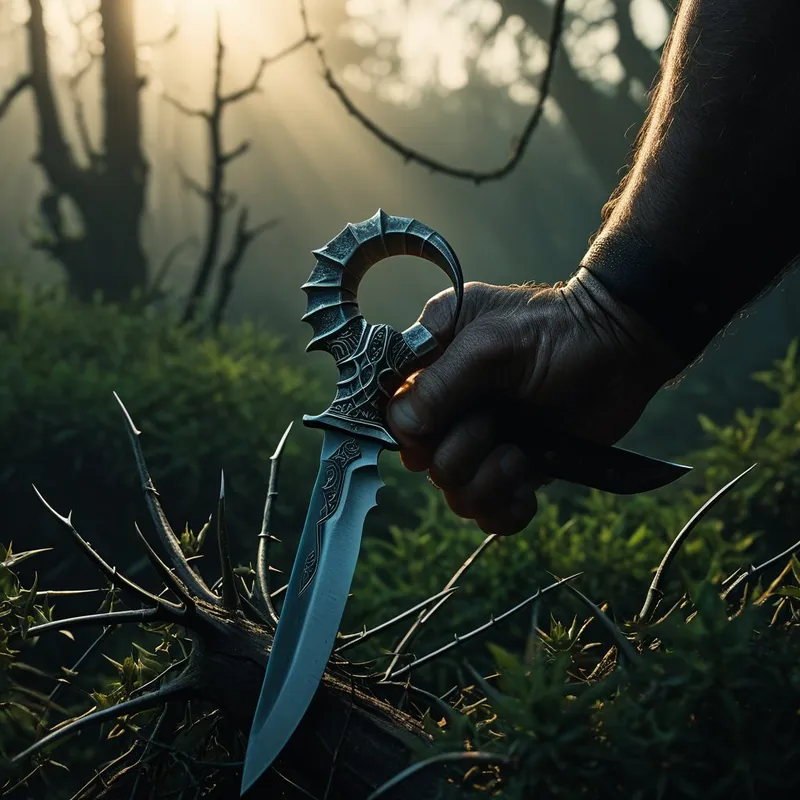
Abraham’s hand closed around the knife. The metal was cold, then warm with the heat of his grip. The sun glinted on the blade, a cruel, bright star. He raised his arm. The universe held its breath. In that suspended moment, poised between obedience and annihilation, the silence shattered again.
"Abraham! Abraham!"
The voice from the heavens was now urgent, a command to stop. "Do not lay your hand on the boy." Abraham’s gaze, blurred with unshed tears, swept the thorny thicket. There, caught by its horns, was a ram. A substitute. A release. The knife, meant for the son, severed the bonds of the ram instead. The fire, built for a sacrifice of love, consumed the offering of providence. And the voice spoke again, not of a test passed, but of a blessing reaffirmed, now forged in the fire of averted tragedy. They descended the mountain together, father and son, the laughter gone, replaced by a silence deeper and more knowing than before.
Cultural Origins & Context
The story of the Akedah is found in the Torah, in the book of Genesis (Chapter 22). It is a foundational narrative within the Rabbinic tradition, told and retold for millennia. Its primary societal function was theological and ethical. In a ancient world where child sacrifice to appease deities was a known, if horrific, practice (such as to Moloch), the Akedah served as a radical, defining rejection of that concept. It established the God of Abraham as one who provides the sacrifice (YHWH Yireh), ultimately desiring faith and obedience, not human death.
It was passed down orally long before being codified in scripture, a story told during pilgrimage festivals and pondered by scholars. In the Midrash, the tale is expanded—angels weep, Satan accuses, the very stones of the altar plead for Isaac’s life. It became the archetypal story of the "Tenth Test" of Abraham, the ultimate proof of his faith, and a central motif in Jewish liturgy, most prominently recalled during Rosh Hashanah, linking the ram’s horn (shofar) to the memory of the substituted sacrifice.
Symbolic Architecture
The Akedah is not a simple parable of obedience. It is a terrifying map of the human soul facing the absolute. Abraham represents the ego confronted by a transpersonal, archetypal demand from the Self—the voice of God. This demand asks for the sacrifice of what is most precious, most identified with the ego’s future and legacy: the "son," the promise, the realized potential (Isaac).
The most profound sacrifices are not of what we hate, but of what we love most dearly, for only through that surrender can the ego's attachment be broken and a higher order revealed.
The mountain, Moriah, is the axis mundi, the place where heaven and earth meet, where the ultimate transaction of consciousness occurs. The binding is the paralysis of the will, the moment where conscious intention is surrendered to a force beyond understanding. The knife is the instrument of decisive, irreversible action, the sharp edge of commitment that separates one state of being from another.
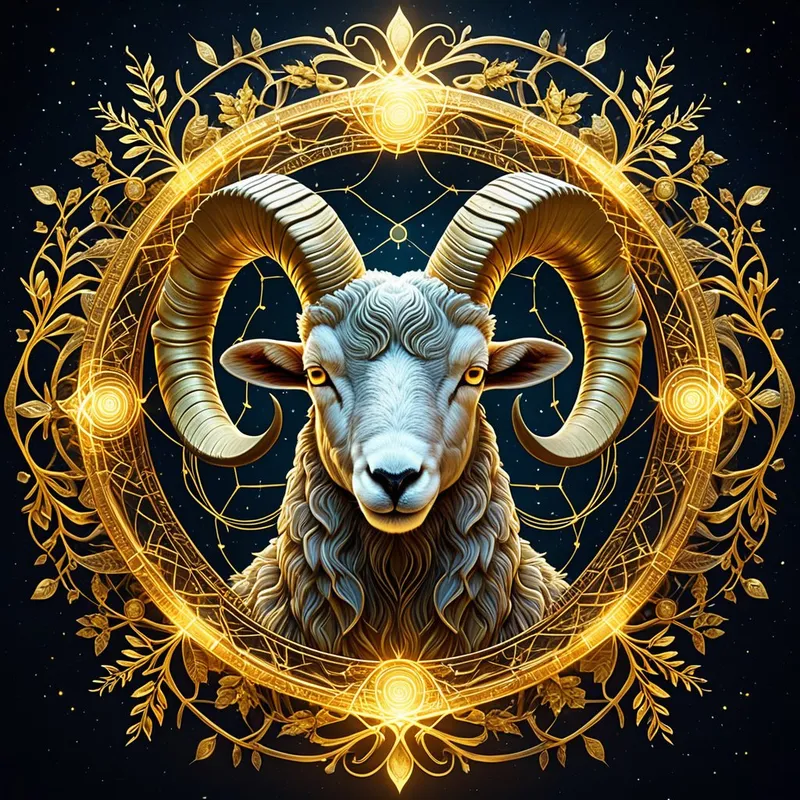
The ram, appearing at the last possible moment, is the symbol of divine providence and the principle of substitution. It represents the unexpected resolution, the "third thing" that emerges from the unconscious when the conscious mind has reached its absolute limit. The horns of the ram, caught in the thicket, tie this moment to the natural world and to the future ritual memory (the shofar), suggesting that the sacrifice is transmuted, not abolished.
The Dreamer's Resonance
When this myth stirs in the modern psyche, it rarely appears as a biblical reenactment. The dreamer may find themselves in a sterile office, commanded by a faceless authority figure to destroy their own creative project. They may dream of being forced to choose between a beloved child and some abstract, overwhelming duty. The somatic experience is key: a crushing weight on the chest (the bound Isaac), a paralyzed arm unable to lower or raise the knife, a throat constricted, unable to cry out.
This is the psyche’s enactment of a profound inner conflict: the conscious personality (the dream-ego) is being commanded by a deeper, authoritative inner voice (the Self/God-image) to sacrifice an attached complex. This complex is often the "divine child" archetype within—one’s innate potential, creative spark, or a cherished identity ("who I am supposed to be"). The dream captures the agony of the ego, which experiences this demand as a catastrophic, soul-murdering request. The terror is real because, from the ego’s perspective, it is a death. The resolution in the dream—if it comes—may be just as surreal as the biblical ram: a sudden phone call, an object breaking, a door opening, symbolizing the unconscious providing an alternative path forward after total commitment is shown.
Alchemical Translation
Psychologically, the Akedah models the critical, terrifying phase of the individuation process where one must sacrifice one’s most cherished conscious attitude for the sake of the whole personality. The "son" Isaac is the filius philosophorum, the prized product of the ego’s efforts—a successful career, a brilliant intellectual thesis, a beloved role as a caregiver. We are identified with it. It is our "promised land."
The alchemy of the soul occurs not in the avoidance of the knife, but in the unwavering willingness to lift it. It is in that gesture of ultimate surrender that the gold is revealed, not in the son, but in the father who is willing to lose everything.
The divine command is the call from the Self to break this identification, to offer this precious thing up to a process larger than the ego’s designs. This is the mortificatio, the killing of the kingly, solar consciousness embodied in the son. The three-day journey is the necessary period of incubation, of holding the tension of the opposites (love vs. obedience, life vs. duty).
The binding is the conscious acceptance of this impossible task, the coniunctio of will and fate. The raising of the knife is the supreme moment of transformatio—not the act of killing, but the act of total willingness. It is at this precise point, when the ego has fully consented to its own de-structuring, that the Self intervenes. The ram emerges from the thicket of the unconscious. The sacrifice is transmuted. The ego does not get its son back unchanged; it receives its son and a new covenant. The relationship is no longer one of naive possession, but of sacred trust. The individual is no longer just a father of a promise, but a partner in a mystery, forever marked by the climb up Moriah and the grace found in the thicket.
Associated Symbols
Explore related symbols from the CaleaDream lexicon: